Link vetting
How to spot PBNs, link farms and sponsored post factories: a 2026 checklist
The sites that waste link budgets in 2026 rarely look like the crude networks of ten years ago. They look like magazines. This is the checklist we use to tell the difference.
TL;DR: Since 2022 Google says SpamBrain can detect sites that exist to pass outgoing links, so links from them are usually neutralised and your money is gone. Check traffic against authority, count outbound commercial links, look for shared footprints, read the domain's history and compare Trust Flow with Citation Flow. One flag is a reason to look closer. Three is a reason to walk away.
When Google announced its December 2022 link spam update, it said SpamBrain could now detect "both sites buying links, and sites used for the purpose of passing outgoing links", and that links found this way would be neutralised. That sentence changed the economics of bad links. The usual result is not a dramatic penalty. You pay for a link that does nothing, and you find out months later, if ever.
The trouble is that the sites doing the damage have got better at looking normal. They have a clean theme, an About page, a few author photos and a steady stream of posts. Here's how we tell them apart from publications worth buying on.
Four kinds of site to screen out
They overlap, and one operator often runs more than one kind, but the tells differ enough to be worth separating.
| Type | What it is | Typical tell |
|---|---|---|
| Private blog network (PBN) | A set of sites under one owner, built to link to money sites or to sell links | Shared footprints, thin traffic, links between the network's own sites |
| Link farm | A site, or many, that links out to almost anyone who pays, on any topic | Huge outbound link counts, no topical focus, grey-niche outbound |
| Sponsored post factory | A real-looking magazine or blog where most new content is paid placements | Recent posts dominated by commercial links, "write for us" price lists, posts live within hours |
| Expired domain rebuild | A lapsed domain with old backlinks, relaunched with new content to sell links | Topic change in the archive, backlinks about something else, DR far ahead of traffic |
The checklist
Work through it in this order. The early checks are fast and catch most of the problem sites, so you only spend time on the later ones for sites that survive.
1. Traffic patterns
- Organic traffic is in line with authority. A DR 60 site with a few hundred monthly visits has links that nobody gave it for its content.
- No cliff edges that line up with Google updates. A traffic chart that falls off in March 2024, when Google added its expired domain and scaled content policies, tells you Google has already formed a view.
- Traffic comes from the country and language the site is written for. An English UK lifestyle blog with most of its visits from an unrelated market is suspect.
- The top pages are editorial. If the pages bringing traffic are coupon pages, casino reviews or nothing at all, the "magazine" is a front.
2. Outbound link saturation
This is the single most useful check, and the one most buyers skip. Remember how authority metrics work: Ahrefs' DR splits a site's rating equally among the domains it links to. Google's maths is different and unpublished, but the intuition carries over. A site that links to everyone has little to give anyone.
- Count commercial outbound links in the last 30 posts. One or two clearly labelled sponsored posts a month is normal for many publishers. Two commercial links in every post is a link farm.
- Compare linked domains with referring domains. A site linking out to five times as many domains as link to it is selling more than it has.
- Check what the outbound links are for. Casino, CBD, crypto, payday loans, essay writing and adult links in a "business" or "home" blog tell you who the real customers are.
- Look at the anchors. Exact-match commercial anchors ("best payday loans UK") across many posts are the pattern Google uses as its own example of link spam.
3. Footprints
Networks are cheaper to run when sites share infrastructure, and sharing leaves traces. None of these is proof on its own; plenty of honest publishers use WHOIS privacy and the same WordPress theme.
- The same analytics, ad or tag manager IDs in the page source of several sites.
- Author photos that reverse-image search to stock libraries, or the same "editor" running five unrelated sites.
- Identical "write for us" pages, price lists or contact emails across domains.
- The sites link to each other far more than to anyone else in their niche.
- Shared hosting IPs combined with any of the above. Shared hosting alone means nothing.
4. Recycled and scaled content
Google's spam policies define scaled content abuse as many pages "generated for the primary purpose of manipulating search rankings", and give examples including mass AI generation without added value and "creating multiple sites with the intent of hiding the scaled nature of the content". That second example describes a PBN almost word for word.
- Paste a distinctive sentence from a recent post into a search engine in quotes. Spun or scraped content turns up elsewhere.
- Check whether posts say anything specific. Generic 900-word pieces with no names, numbers or sources are filler written around a link.
- Look at publishing volume. Forty posts a week from a "team" of three is not an editorial operation.
5. Expired domains
Google added expired domain abuse to its spam policies in March 2024. The policy's examples are blunt: affiliate content on a site previously used by a government agency, casino content on a former elementary school site.
- Open the domain in the Wayback Machine and look at snapshots from three, five and ten years ago. A charity, a band or a local business that became a lifestyle blog is a rebuild.
- Check what the strongest backlinks are about. If they point at pages that no longer exist, about a topic the site no longer covers, the authority is borrowed.
- Look for a gap in the archive followed by a relaunch. Lapses of months or years are the classic pattern.
6. TF:CF and topical anomalies
Majestic describes Trust Flow as a score "based on quality" and Citation Flow as a measure of link equity or "power". When Citation Flow runs far ahead of Trust Flow, a site has lots of links and few good ones. Majestic does not publish a threshold. Our working rule is to look harder at any site where Trust Flow is below about half of Citation Flow. That's a heuristic, and a few legitimate sites trip it.
- Trust Flow is not tiny next to Citation Flow.
- Topical Trust Flow's top categories match what the site publishes. A recipe blog whose strongest topic is Gambling has been bought into.
- Spam score tools agree, or at least don't all disagree. Treat any third-party spam metric as a prompt to look, not a verdict.
7. How the seller behaves
- They decline some topics. A site that accepts everything at the same price is selling a link, not an audience.
- They edit your article. Posts that go live within hours, untouched, mean nobody is reading them.
- They don't promise that links will raise your DR or rankings.
- They will tell you how they label paid content. Sellers who promise "no sponsored tag ever" are selling exactly what Google's paid link policy describes.
Sponsored post factories and site reputation abuse
The hardest cases are real publications with real histories that have become mostly paid content. Google's site reputation abuse policy covers third-party content "published on a host site mainly because of that host's already-established ranking signals", and Google began enforcing it on 5 May 2024.
One 2026 wrinkle for UK readers. On 28 August 2026 Google said it would stop enforcing manual actions under this policy for searches in the European Economic Area, while sections it considers abusive may still be separated in its systems so they rank independently (Search Engine Roundtable). The UK is not in the EEA. For UK searchers, as far as we can tell, nothing changed.
The practical test is the ratio. A national paper that runs a few clearly labelled partner pieces alongside thousands of reported stories is a very different host from a once-respected magazine whose last 50 posts are all "partner content" on loans, gambling and VPNs.
Scoring a site
We don't treat any single check as decisive. This is roughly how the flags add up when we review a publisher.
| Flags found | What we do |
|---|---|
| None | Proceed on relevance and price |
| One, minor (WHOIS privacy, shared theme) | Note it, proceed |
| One, serious (traffic cliff, grey-niche outbound, archive topic change) | Investigate before buying; ask the publisher |
| Two or more serious | Decline |
| Any evidence of a network (shared IDs plus cross-linking) | Decline, and check other sites with the same IDs |
If you have already bought from one
Most teams that run this checklist on their existing links find a few that fail it. What should you do about them? Usually less than you'd think. If Google has neutralised the links, they're doing nothing either way, and chasing removals costs time you could spend on better placements.
The exception is a pattern. If a large share of your referring domains look like the sites above, with exact-match anchors, you're closer to the profile that earns an "unnatural links to your site" manual action. Then it's worth asking publishers to remove or qualify the links, and keeping a record of what you asked. Check Search Console's Manual actions report first; if it's empty, we'd probably just stop buying from those sellers and move on.
Doing this in Rankticker
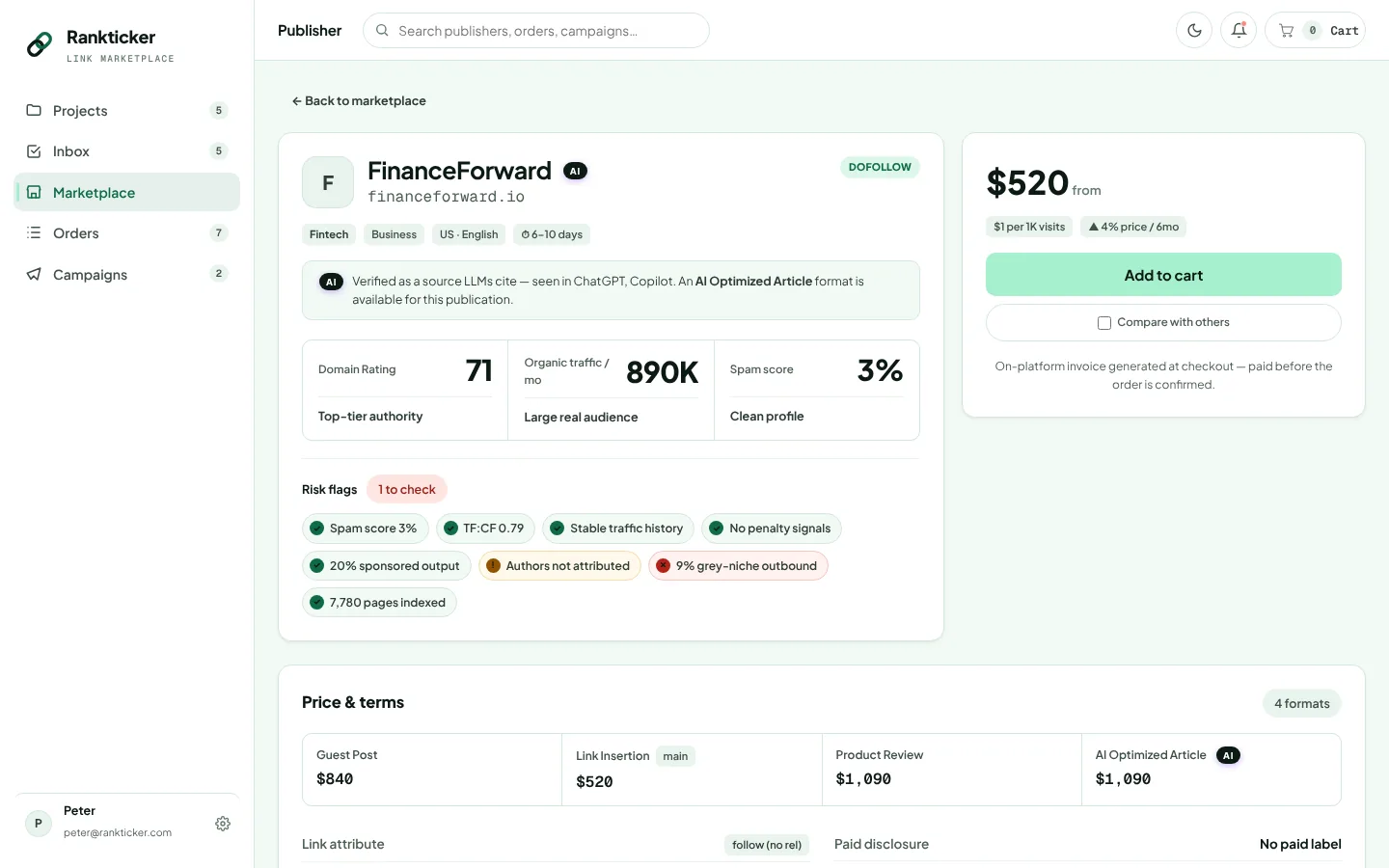
Every publisher in the marketplace goes through our vetting before listing, and the publisher profile shows the result as risk flags: spam score, TF:CF ratio, traffic trend, sponsored-outbound share, author attribution, grey-niche outbound links and pages indexed. Those map to sections 1, 2, 3 and 6 above. Compare two or three publishers side by side and the outliers stand out quickly.
Flags don't replace reading the site. Open it, scroll the last month of posts and check the archive for anything you plan to spend real money on. After you buy, the Live Link Tracker keeps checking that the page is live and indexed and that the link and its attribute haven't changed, which catches sites that drop out of Google months later.
For the wider set of checks, including relevance and placement quality, see how to evaluate a backlink in 2026 and topical relevance vs Domain Rating. Terms like TF:CF and link insertion are defined in the glossary. If you run a site and want to sell placements the honest way, the publisher programme explains what we look for.
FAQ
Questions about how to spot PBNs
What is a PBN?
A private blog network is a group of sites controlled by one owner and used mainly to link to money sites or to sell links. They are often built on expired domains with leftover backlinks.
Will Google penalise me for a link from a PBN?
Sometimes, through a manual action for unnatural links. More often Google's systems simply neutralise the links, so you pay for something that passes nothing.
What TF:CF ratio is a red flag?
There is no official threshold. As a working rule we look closely at sites where Trust Flow is less than half of Citation Flow, and at any site whose Topical Trust Flow categories don't match its content.
Is a sponsored post on a real news site safe?
It depends on the site and the label. Google's site reputation abuse policy targets third-party content published mainly to exploit a host's ranking signals, and Google asks for paid links to carry rel="sponsored" or rel="nofollow".
How do I check a domain's history?
Look at its snapshots in the Internet Archive's Wayback Machine, check when its backlinks were earned and what they were about, and compare its current topic with its past one.
Keep reading
Related
How to evaluate a backlink in 2026: the signals that matter
How to evaluate a backlink in 2026: relevance, real traffic, TF:CF, outbound links, indexation, placement, anchor, attribute, permanence and AI citati…
Paid links and Google's spam policies: what buyers need to know in 2026
Paid links and Google's spam policies in 2026: the link spam text, rel="sponsored", manual actions, SpamBrain, site reputation policy and UK ASA discl…
Topical relevance vs Domain Rating: what to pay for in 2026
Why topical relevance beats raw Domain Rating when you buy links in 2026, how Google reads link context, and a practical checklist for judging relevan…
The link building platform built around how you buy links
Rankticker is a link building platform and backlink marketplace: vetted publishers with risk flags, fixed prices, editorial content and live link trac…
Link building glossary
Link building glossary with 58 SEO backlink terms defined for practitioners, from anchor text and DR to TF:CF ratio, rel="sponsored", GEO and AI citat…
See the publishers before you spend a penny
Filter real publications by niche, DR, traffic and price. Every metric and the full price are on the listing.