Use cases
Fintech backlinks
Finance is where Google asks for the most trust and the FCA watches the copy. Links still matter here, but the publication, the page and the words around the link all get read more closely.
Find publishers in this nicheSee how it works
The problem
Why finance links get more scrutiny
Google gives extra weight to trust on topics that affect people's money, health or safety. Its own guidance calls these "Your Money or Your Life" topics and says that "of these aspects, trust is most important" (Google Search Central). A link from a site with no named authors and a sidebar of casino ads is a poor trust signal for a savings app, whatever its DR says.
Supply is tighter too. Plenty of good publishers won't take finance content at all, and many treat crypto, short-term lending, CFDs and trading as grey niches with a surcharge or a flat no. Some news sites have also rented out their "money" sections to third parties. Google's site reputation policy targets content published mainly to borrow the host's ranking signals, and those sections can lose visibility overnight.
The bigger difference is legal. Who signs off a guest post? In the UK, copy that invites someone to take up a regulated financial product can be a financial promotion.
Compliance note: section 21 of the Financial Services and Markets Act 2000 restricts communicating financial promotions unless an authorised person makes or approves them, and the FCA says all financial promotions must be clear, fair and not misleading regardless of the media type. Its FG24/1 guidance says unauthorised people, including affiliate marketers, who promote regulated products without approval may be committing a criminal offence. Cryptoasset promotions have their own guidance (FG23/3). Treat any article that names your rates, returns or product features as something your compliance team signs off. This is general information, not legal advice.
Placements
Publications and formats that work in finance
Personal finance and consumer money press
For B2C apps, savings, credit and investing. Look for named authors and visible editorial policies on the publisher profile, since that is what both readers and quality raters check.
Payments, banking and fintech trade press
For B2B infrastructure, APIs, payments and regtech. Smaller traffic, better readers, and the coverage gets quoted in procurement decks.
Data-led and reactive commentary
Anonymised spending or transaction data, or comment after a Bank of England rate decision or a Budget. Editors need a quote within hours on those days.
Explainers and AI Optimized Articles
Neutral, factual pieces ("how the ISA allowance works") that AI answers can cite. They rarely count as promotions when they stay generic, but check with compliance.
Comparison and review sites also matter a great deal in finance, but many run on affiliate deals rather than sponsored posts. Treat a paid placement there as you would any other ad: disclosed, and checked by compliance.
Targets and anchors
Point links at pages that earn trust
Product pages in finance carry risk warnings and rates that need compliance review every time they move. They are awkward link targets. Guides, calculators, research reports and glossary pages take links more naturally and pass relevance through internal links to the product.
For B2B fintech, add API documentation landing pages and use-case pages ("payouts for marketplaces"). Procurement teams read the security page closely, so it can justify a link or two as well.
Keep anchors mostly branded and descriptive. "Best savings account" or "cheap loans" as exact-match anchors on paid placements is probably the fastest way to make a link profile look bought, and the anchor itself can read as promotional copy. Product names and plain descriptions ("our mortgage overpayment calculator") are safer on both counts.
In Rankticker
How the filters help a fintech campaign
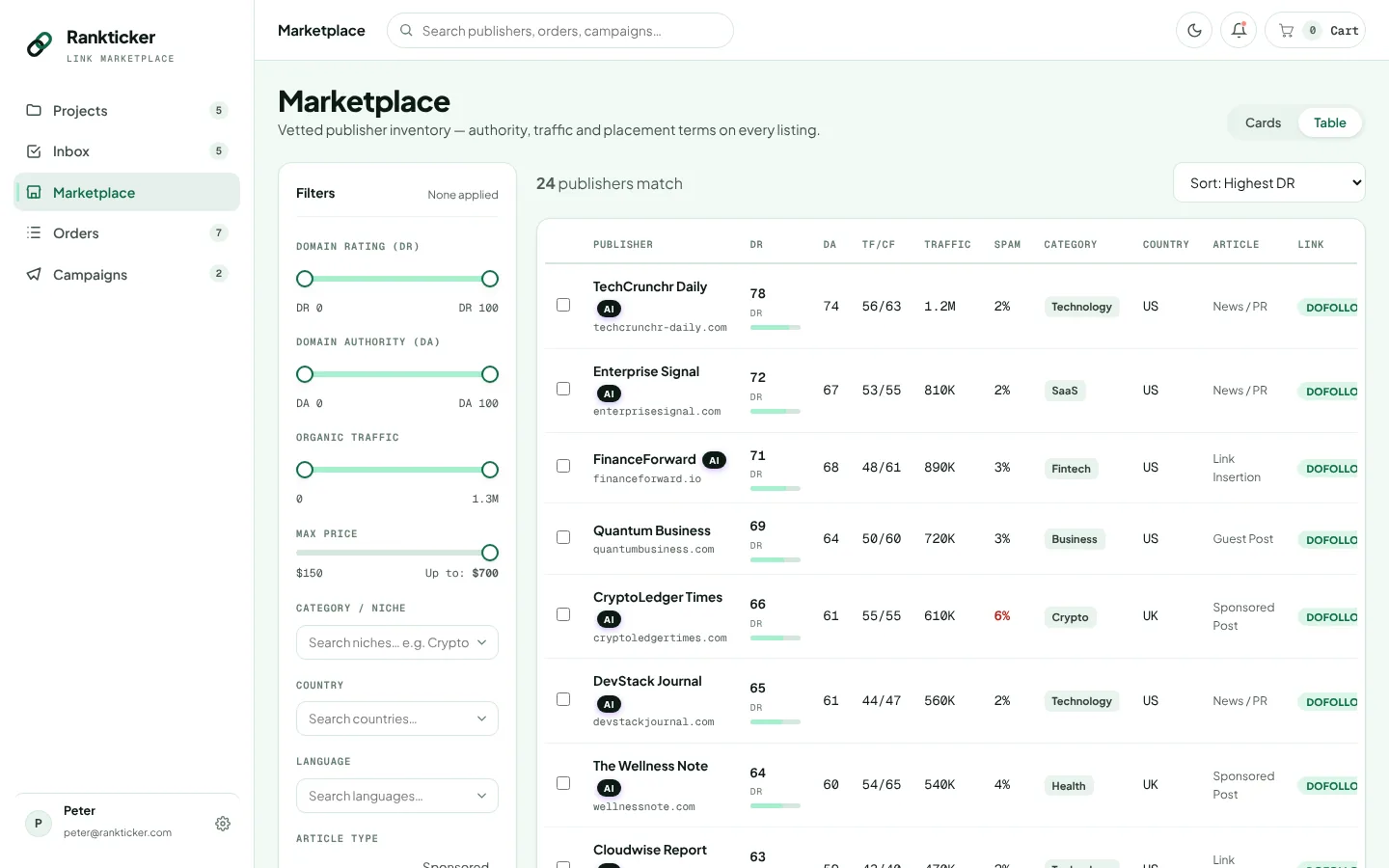
Set the niche filter to finance and the country filter to the market where you hold permissions. A UK e-money institution gets little from US personal finance blogs, and a promotion aimed at a market where you aren't authorised is its own problem.
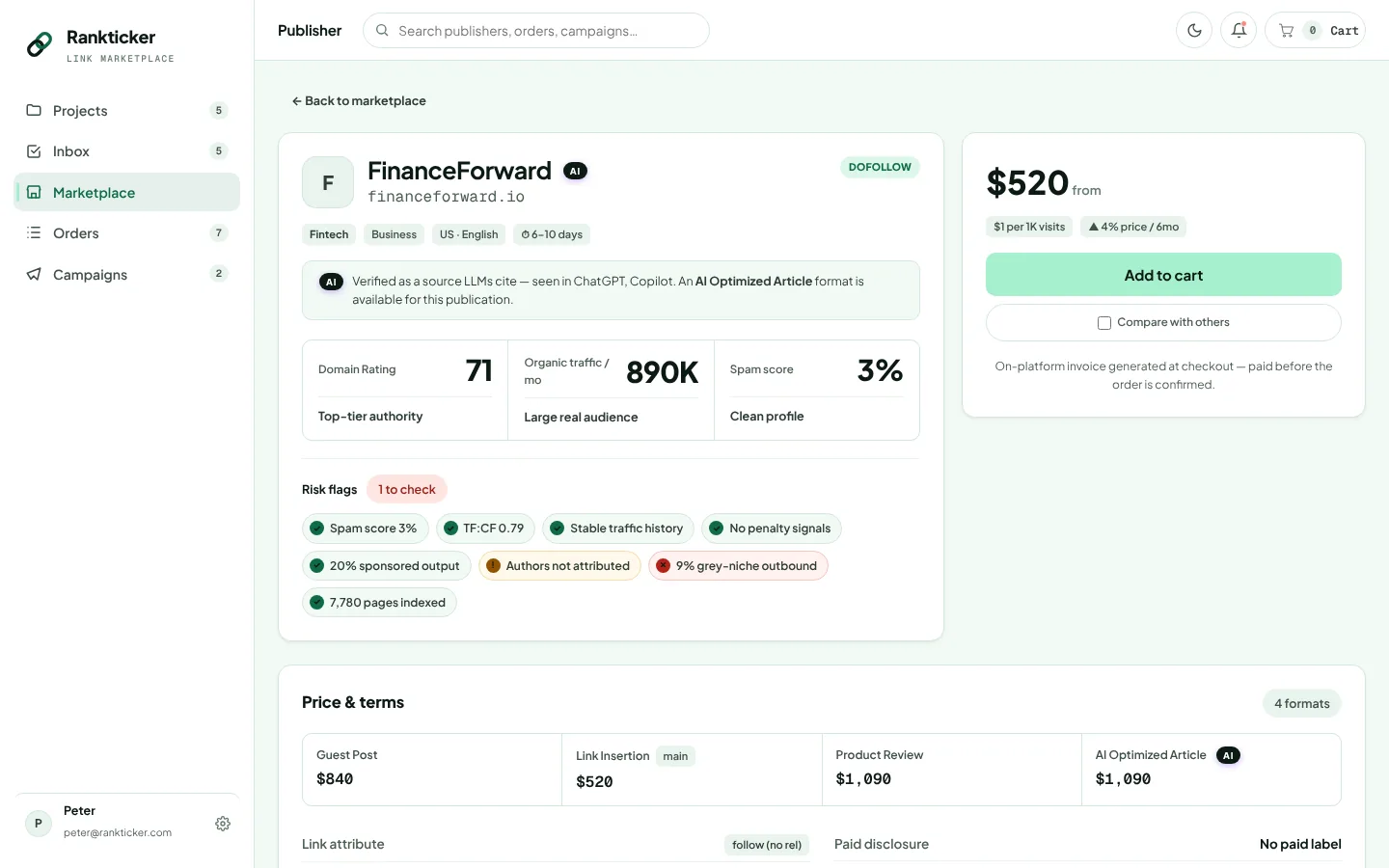
On each publisher profile, check author attribution and the grey-niche outbound flag. A finance blog that links out to offshore brokers and payday lenders is a neighbourhood you don't want. If you sell crypto or lending products, check the "grey niches accepted" field before ordering, not after.
Use the "supply own content" toggle in the cart when compliance has approved the copy. Every order then passes Chief Editor review and publisher review, and the Live Link Tracker flags it if the publisher later edits the anchor or the link attribute.
Example only: a UK business payments platform. Objective: improve AI visibility. Monthly budget £4,000 to £7,000. Geo: United Kingdom. Targets: two research reports, a fees calculator, the "payouts for marketplaces" use-case page. Anchors: branded and descriptive only, no exact-match commercial terms. Max cost per link £600. Filters: finance niche, English, DR 40+, organic traffic 10,000+, AI badge required, no publishers with grey-niche outbound. Mode: semi-auto, with compliance approving each placement. Illustrative figures, not a quote.
AI visibility
What people ask AI about money
The prompts are part research, part reassurance: "best business current account for a sole trader", "is [app] FCA regulated", "cheapest way to send money to Poland", "[provider] vs [provider] for a limited company". The trust questions are where a wrong or outdated answer costs you most.
Answers draw on comparison sites, personal finance journalism, forum threads and the provider's own help pages. You can't place a link on a regulator's register, but you can make sure the publications AI engines cite describe your permissions and fees correctly. The AI visibility tools track citation share and answer sentiment by engine, and our piece on brand mentions in AI answers explains why unlinked mentions count too.
Fintech link building checklist
- Get compliance sign-off on any copy naming rates or returns
- Filter by the country where you hold permissions
- Check author attribution and grey-niche outbound on every profile
- Link to guides, calculators and research before product pages
- Avoid exact-match commercial anchors on paid placements
- Use rel="sponsored" on paid links, as Google recommends, and a clear ad label on the article
- Have a commentary rota ready for rate decisions and Budget day
FAQ
Questions about fintech backlinks
Is a sponsored article about my fintech product a financial promotion?
It can be. If the content invites or induces someone to take up a regulated financial product, it may be a financial promotion under section 21 of FSMA and needs to be communicated or approved by an authorised person. Ask your compliance team before it goes live.
Do finance publishers accept crypto or lending content?
Some do, many don't, and some charge more. Each Rankticker publisher profile shows which grey niches the site accepts, so you can filter before you order.
Can I supply my own compliance-approved copy?
Yes. Turn on 'supply own content' when you configure the placement in the cart. The order still goes through Chief Editor and publisher review, and you see any requested edits before it goes live.
Which pages should fintech brands build links to?
Guides, calculators, research and glossary pages usually take links more naturally than product pages, and they pass relevance to the product pages through internal links. B2B fintechs should also consider API and use-case pages.
How do AI assistants pick fintech brands to recommend?
They summarise what comparison sites, personal finance press and forums say. Getting accurate coverage on those sources is the main lever. The AIO Performance tab shows which ones are cited in your niche.
Keep reading
Related
Link building for law firms
Link building for law firms: local and legal placements, practice and office page targets, SRA publicity rules, anchors and AI visibility for legal qu…
Link building for SaaS
Link building for SaaS: which publications move comparison and feature pages, how to set anchors, and how to get cited when buyers ask AI for software…
Paid links and Google's spam policies: what buyers need to know in 2026
Paid links and Google's spam policies in 2026: the link spam text, rel="sponsored", manual actions, SpamBrain, site reputation policy and UK ASA discl…
Topical relevance vs Domain Rating: what to pay for in 2026
Why topical relevance beats raw Domain Rating when you buy links in 2026, how Google reads link context, and a practical checklist for judging relevan…
Publisher vetting
Rankticker product tour
See the publishers before you spend a penny
Filter real publications by niche, DR, traffic and price. Every metric and the full price are on the listing.