Use cases
Link building by industry
The same DR 50 placement can be a good buy for one business and a waste for another. These guides cover what changes by sector: which publications count, which pages to build to, and which rules apply.
Open the marketplaceSee the product
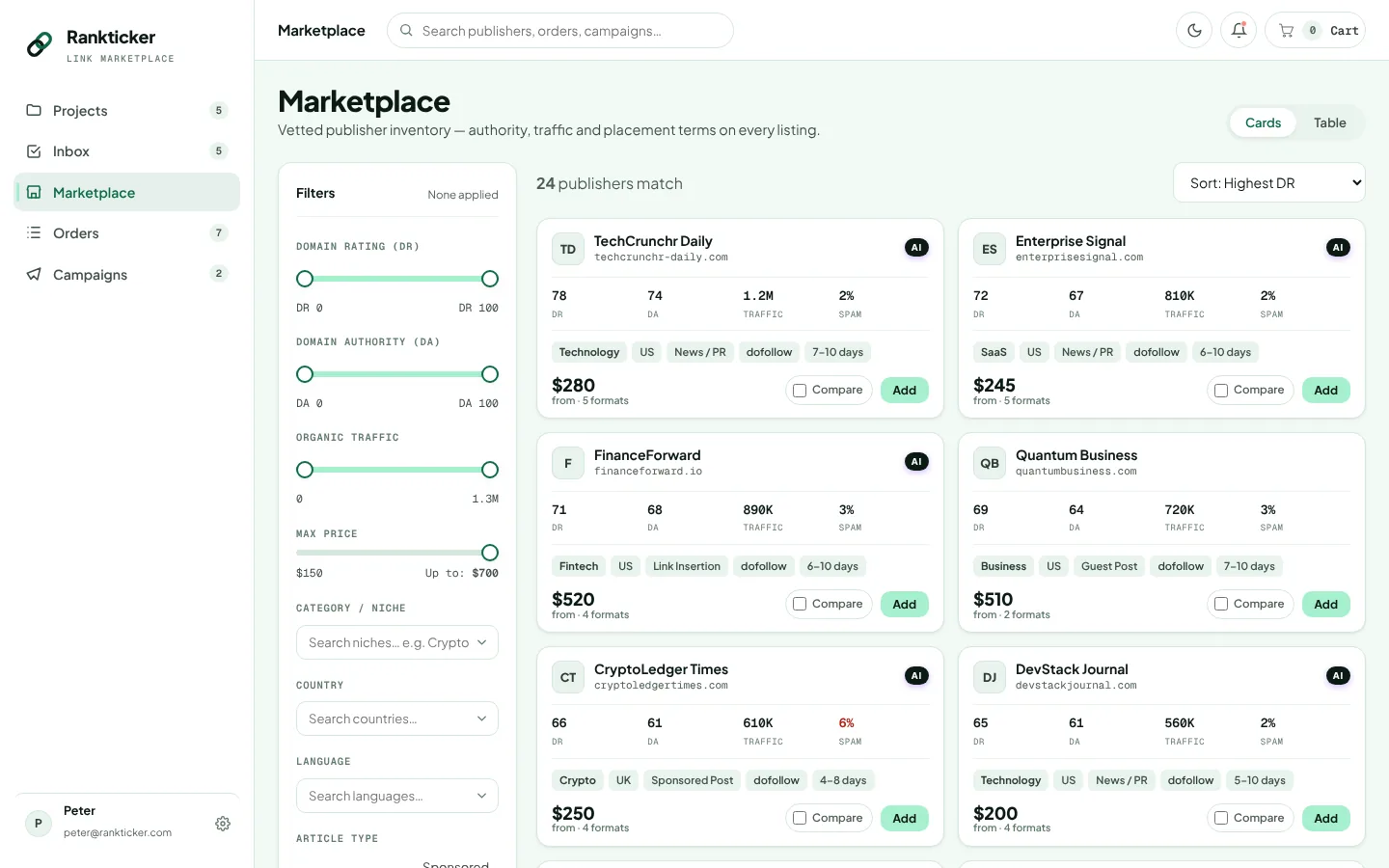
What actually changes from one industry to the next
Link metrics travel well between industries. Almost nothing else does.
A fintech app and a fashion label might buy from publishers with the same DR, but the fintech placement has to pass a compliance review, sit on a site Google would trust with money advice, and avoid anchors that read like an advert for a loan. The fashion placement needs to be live before the gift guides are finalised. A solicitor in Leeds wants the local paper more than a national magazine. A security vendor's buyers will ignore anything that sounds like marketing.
Each guide below works through the same questions for one sector. What makes links hard there. Which publication types and formats editors in that sector accept. Which pages to point links at, and what anchor mix fits. How the marketplace filters help, with an example campaign setup. What buyers in that sector ask AI assistants, and which sources the answers cite. And where relevant, which UK rules apply: the FCA for financial promotions, the ASA and CAP Code for health and pricing claims, the SRA for law firm publicity.
Software and B2B
Technical buyers and long sales cycles
SaaS
Links to comparison, feature and integration pages, where shortlists get made.
Cybersecurity
Threat research and fast expert commentary for a sceptical, technical audience.
Edtech
Reaching school leaders, universities and parents, who each read different things.
HR and recruitment
Two audiences at once: employers hiring and candidates looking for work.
Money, health and law
YMYL sectors with regulated copy
Google gives extra weight to trust on topics that affect health and money, and UK regulators read sponsored content the same way they read ads.
Fintech
Finance publications that pass YMYL scrutiny, with FCA promotion rules in mind.
Insurance
Getting past the aggregators with credible consumer and finance coverage.
Health and wellness
Clinician-led placements and ASA-safe claims for clinics and wellness brands.
Legal
Practice area and office pages, local press, and SRA publicity rules.
Consumer brands
Retail, lifestyle and seasonal demand
Consumer sectors live on reviews, gift guides and booking windows. Timing matters as much as the publisher.
Ecommerce
Authority for category pages, planned around peak trading.
Fashion and beauty
Editorial round-ups, reviews and gift guides booked months ahead.
Food and drink
Food writers and reviews, with the stricter rules on what can be promoted.
Travel
Destination-relevant placements live before the January booking rush.
Automotive
Different plans for dealers, leasing brokers and parts retailers.
Agencies
Running all of the above for clients
Agencies tend to have clients in four or five of these sectors at once, each with its own anchor plan, compliance reviewer and monthly report. Rankticker gives every client website its own project, with campaigns, budgets and cost caps per client, semi-auto approvals and link monitoring after go-live.
Whatever the sector, a few things don't change. We vet publishers for real readership and topical fit, you choose the link attribute on every order, and nobody can promise rankings. Google's spam policies ask for paid links to carry rel="sponsored" or rel="nofollow", and our post on paid links and Google's policies explains what that means in practice.
FAQ
Questions about link building by industry
Does Rankticker work for regulated industries?
Yes, with care on your side. You can supply your own compliance-approved copy, review every draft before it reaches the publisher, and choose rel="sponsored" on each order. You remain responsible for what your marketing claims.
My industry isn't listed. Can I still use Rankticker?
Yes. The marketplace filters by niche, country and language for any sector. The guides here cover the industries where link building has the most specific quirks.
Do the example budgets on these pages reflect Rankticker prices?
No. They are illustrative campaign setups to show how the settings fit together. Real costs depend on the publishers you choose; see the pricing page and the prices on each listing.
Can one account cover several industries?
Yes. Each website gets its own project, with its own campaigns, filters and tracking, so an agency or group can run very different sectors side by side.
Keep reading
Related
Topical relevance vs Domain Rating: what to pay for in 2026
Why topical relevance beats raw Domain Rating when you buy links in 2026, how Google reads link context, and a practical checklist for judging relevan…
How to evaluate a backlink in 2026: the signals that matter
How to evaluate a backlink in 2026: relevance, real traffic, TF:CF, outbound links, indexation, placement, anchor, attribute, permanence and AI citati…
Paid links and Google's spam policies: what buyers need to know in 2026
Paid links and Google's spam policies in 2026: the link spam text, rel="sponsored", manual actions, SpamBrain, site reputation policy and UK ASA discl…
Marketplace
Rankticker product tour
See the publishers before you spend a penny
Filter real publications by niche, DR, traffic and price. Every metric and the full price are on the listing.