For publishers
Sell guest posts and sponsored content on your terms
List your site on the Rankticker publisher marketplace, set your own prices and editorial rules, and get paid monthly for every placement verified live.
Who we accept
Real sites with real readers
We list publications people read on purpose. A site that exists mainly to sell links won't get through review.
Buyers on Rankticker pay for placements on sites that would be worth reading without the link. The whole marketplace depends on that, so we check every site before it's listed and keep checking after.
What we look for
- Organic search traffic earned by your own content, with a trend that isn't falling off a cliff
- A clear editorial focus: a niche, a region or a defined audience
- Named authors, or at least an about page that says who runs the site
- Editorial standards you can describe, such as what you publish, what you turn down and how you correct mistakes
- Outbound links that mostly go where a reader would want to go
What disqualifies a site
Private blog networks are out. So are link farms, and sites rebuilt on expired domains to resell the old authority. We also turn down sites where most recent posts are sponsored, where outbound links lead to unrelated casino, loan or pill pages, or where traffic appeared overnight from nowhere.
Our vetting uses the same risk flags buyers see on your profile: spam score, TF:CF ratio, traffic trend, sponsored-outbound share, author attribution, grey-niche outbound links and pages indexed. If you want to know how we read those signals, we've written up how to spot PBNs and link farms.
A low DR doesn't rule you out. A small site that's well read in a narrow niche is often a better placement than a big general one, and buyers who care about topical relevance know that.
Onboarding
List your site yourself
Onboarding is self-serve. You need access to the site's DNS or its HTML head, and a clear idea of what you will and won't publish.
Add your site
Enter the domain, its main language, the country your readers are in and the categories you cover. Running several publications? Add each one. They all sit under one portal account.
Verify ownership
Add a DNS TXT record to the domain, or paste a meta tag into the <head> of your homepage. DNS is usually easier if your CMS makes editing the head awkward.
Set formats and prices
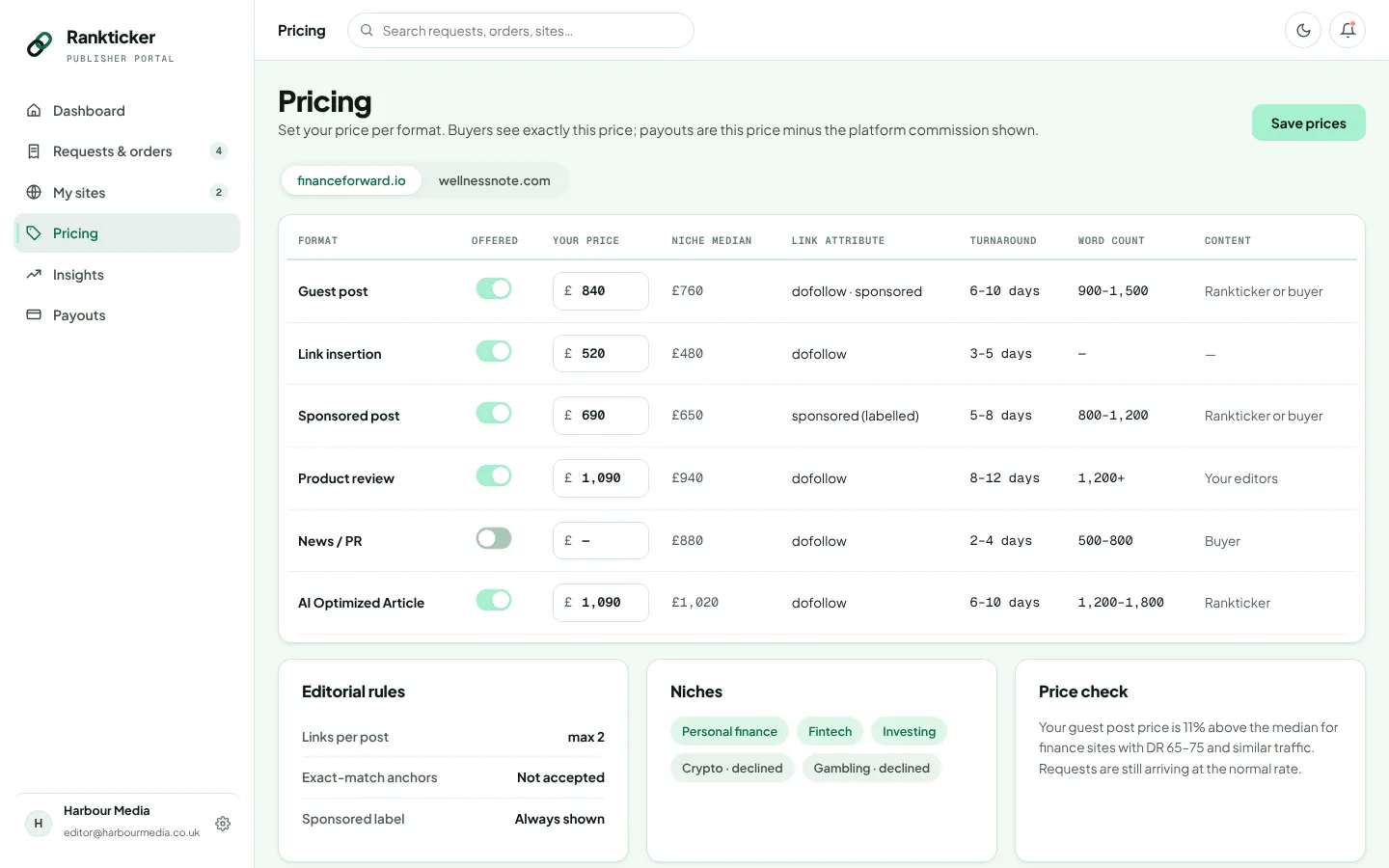
Pick the formats you sell (guest post, link insertion, sponsored post, news or PR, product review, AI Optimized Article) and put a price on each one.
Set your editorial rules
This is where you tell buyers how you work. Which link attributes you allow: dofollow, nofollow, rel="sponsored". How you label sponsored posts. Minimum and maximum word counts, links per post and your anchor policy. The niches you accept and the ones you refuse, including grey niches. Whether you take AI-assisted content. Your turnaround in days. All of it shows on your publisher profile before anyone orders.
We review the site
We run the checks described above. If something needs context, like a traffic drop after a Google core update or a run of old sponsored posts, add a note and we'll take it into account. Once approved, your listing goes into the marketplace.
Pricing
You set the price for every format
Nobody at Rankticker sets your rates. In the pricing screen you price each format separately for each site, and you can change those prices whenever you like.
Most publishers price formats differently, and they should. Inserting a link into an article that already ranks and earns traffic is a different product from a new 1,200-word guest post written to your brief. An AI Optimized Article on a site that AI assistants already cite is different again.
Not sure where to start? The insights tab, further down this page, shows what comparable publications in your niche charge.
Your listing
What buyers see before they order
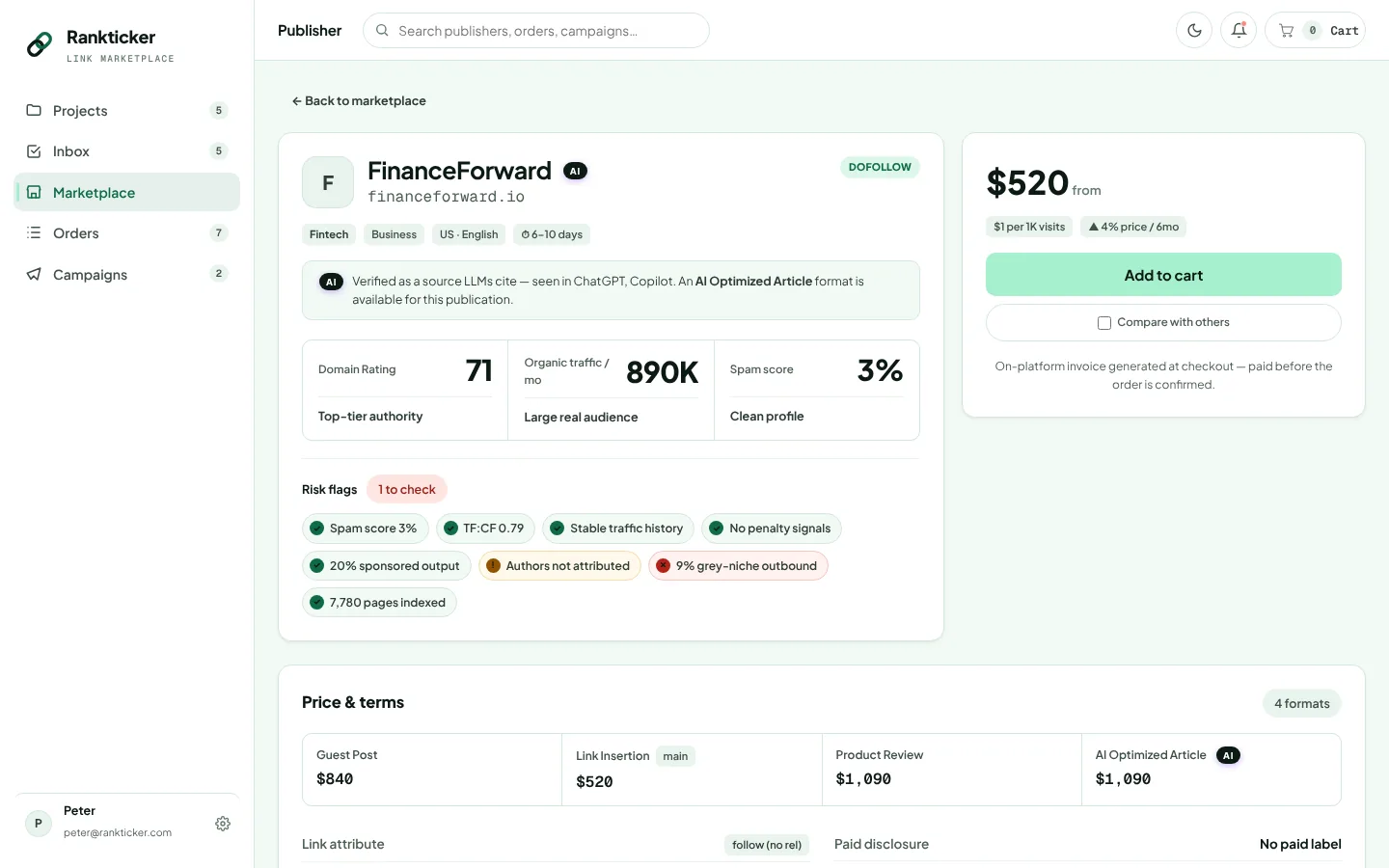
Your publisher profile is the page buyers read before they spend anything. It shows your metrics (DR, DA, Trust Flow and Citation Flow, organic traffic, spam score) next to the risk flags from our review, and then your price and terms for each format.
The terms come straight from your editorial rules. Link attribute, links per post, anchor policy, word count, images, revisions, turnaround, whether paid disclosure is shown, your AI-assisted content policy, which grey niches you accept, and how long you'll keep the link live. Buyers can also compare your profile side by side with other publishers in the same niche.
Be precise here. A buyer who orders a guest post knowing you label it "Advertisement feature" and only allow rel="sponsored" won't come back later asking you to change it. Vague terms lead to awkward requests, and you'll end up declining orders that clearer terms would have filtered out.
Orders
How an order works for publishers
Every order follows the same path, and the portal shows where each one is.
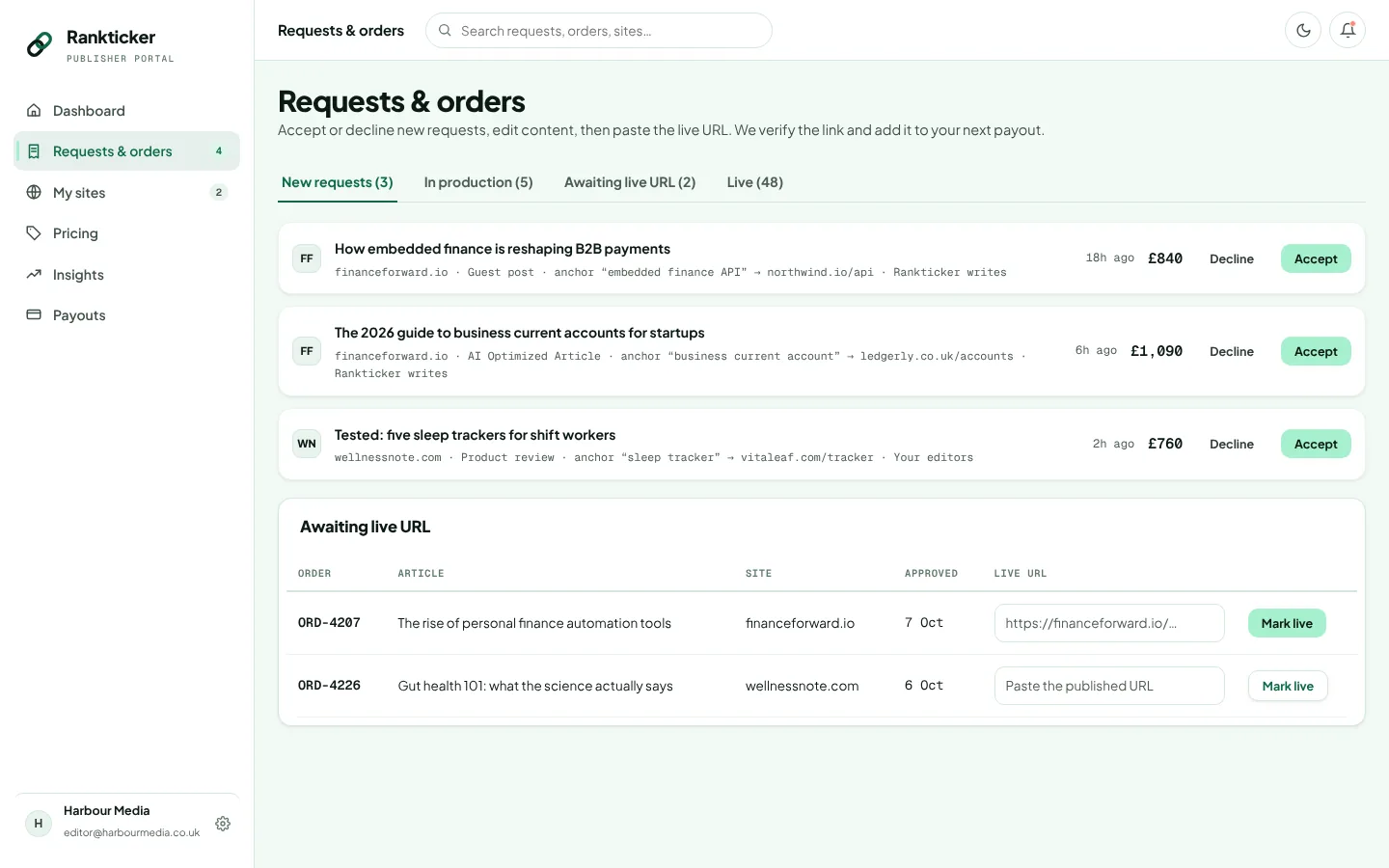
A request arrives
It carries the buyer's brief, the proposed topic, the anchor text, the target URL, the format and the link attribute they want. It also says whether our editors will write the content or the buyer will supply it. You see all of this before a word is written.
You accept or decline
Decline anything that doesn't fit your site. You don't have to give a reason, though a short one helps the buyer find a better match.
The content arrives
Either our editors write it to your rules, and it passes Rankticker's chief editor review before it reaches you, or the buyer supplies their own article.
You edit and publish
Treat it like any contributed piece. Edit for house style, change the headline, leave comments and ask for revisions, or send it back. When you're happy, publish it with the disclosure your readers' jurisdiction requires.
You paste the live URL
Mark the order live in the portal and add the URL of the published page.
We verify it
Our live link tracker checks that the page loads, the anchor is present, the link reaches the right target with the agreed attribute, and the page can be indexed.
You get paid
A verified order goes into your next monthly payout.
The tracker keeps going after verification. It rechecks published links over time, and if a page disappears or a link is changed, the order is flagged and we'll get in touch. Buyers see link health on every order through link monitoring, so a link that quietly goes missing gets noticed.
Editorial control
Your editorial control
You run the publication. Selling placements through Rankticker doesn't change that.
You can always decline
Any request, at any stage before publication. If an article arrives and it isn't good enough for your readers, send it back or turn the order down.
Your standards stay yours
Edit for accuracy and house style. Cut a claim you can't stand behind. Refuse a target URL you wouldn't link to for free.
We never ask you to hide sponsorship
No one at Rankticker will ask you to drop a label or dress paid content up as editorial. If a buyer asks you to, tell us.
Your rules are on your profile
The niches you refuse, the link attributes you allow and your policy on AI-assisted content are all visible to buyers, so anyone who orders has already seen them.
Revenue and payouts
See what you've earned and when it's paid
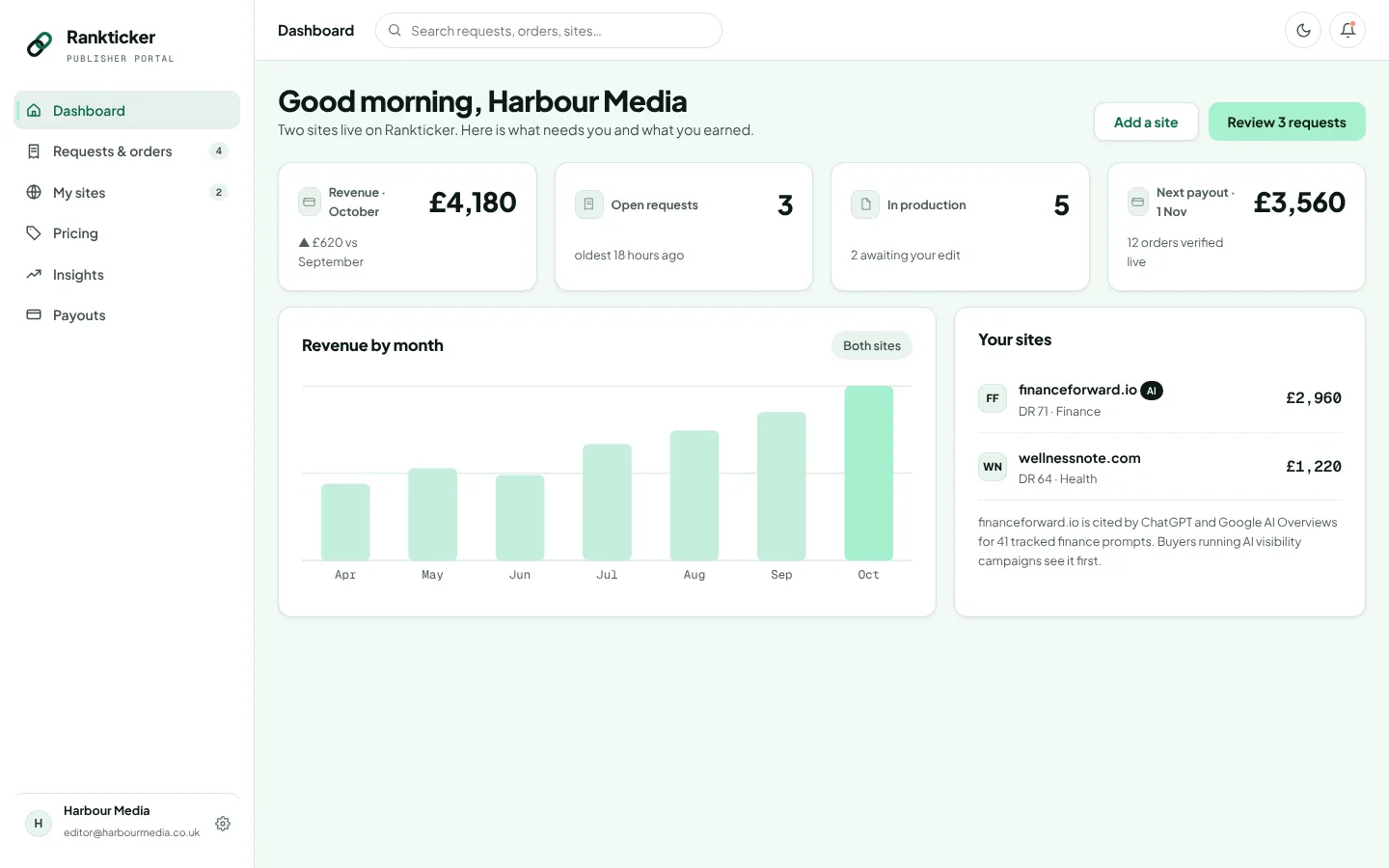
The dashboard shows revenue across your sites, the requests still waiting for an answer and your next payout.
Payouts are made monthly for orders verified live, by bank transfer or PayPal. An order that's still in production, or published but not yet verified, waits for a later payout.
You're responsible for your own tax. That covers declaring the income and, if you're registered for VAT or a sales tax somewhere, charging and reporting it. We can't advise on that. An accountant who has worked with publishers can.
Insights
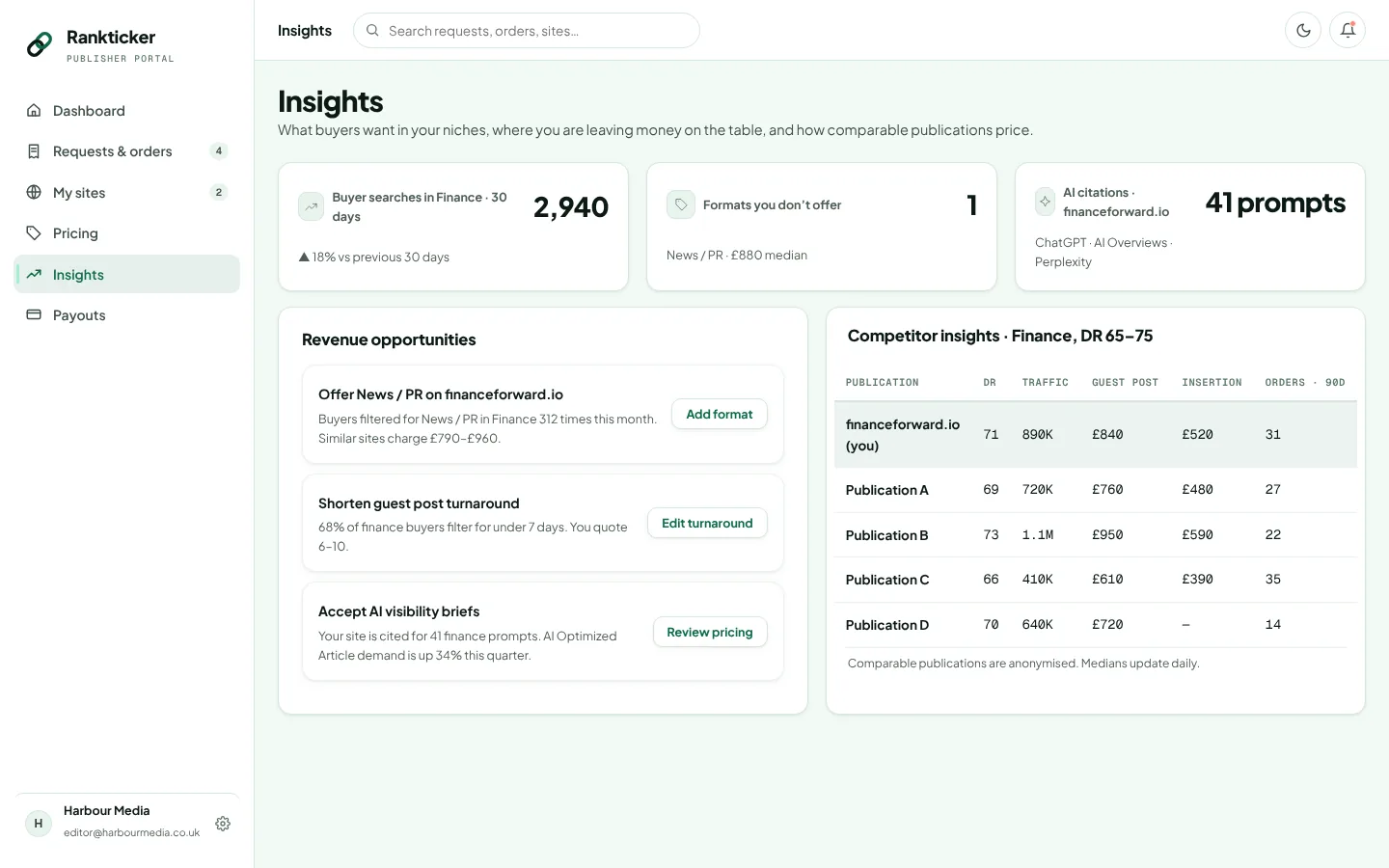
Revenue opportunities and competitor insights
The insights tab is built from what buyers do on the marketplace: what they search for, what they filter by and what they order.
Revenue opportunities
Three views. Demand in your niche shows how much buyer interest there is in your categories. Missing formats lists the formats buyers search for that you don't offer yet. If fintech buyers keep filtering for product reviews and you only sell guest posts, it shows up here. Price benchmarks set your prices against similar sites, so you can see whether you're well under or over what the market pays.
Competitor insights
See how comparable publications in your niche price each format, and which formats actually sell for them. We'd use it to price with confidence rather than to undercut. Racing to the bottom in a niche tends to attract the buyers you'd rather not have.
AI visibility
The AI badge
Some publications are cited as sources by AI assistants: ChatGPT, Google AI Overviews, Perplexity, Gemini, Copilot and Claude. When we verify that AI answers cite your site, your listing gets an AI badge.
Some buyers want more than a link. They run campaigns with the objective of improving their AI visibility, meaning how often their brand appears in AI answers and which sources those answers cite. Those campaigns, and the AIO opportunities list in each buyer's project, surface badged publications in the buyer's niche so they can order from them directly.
You can't apply for the badge or pay for it. It reflects what AI systems already cite, and that comes down to much the same things that earn you readers: specific pages that answer questions well and that search engines can crawl and index. Google says there are no additional requirements to appear in AI Overviews beyond being indexed and eligible to show a snippet. Our guide to link building for AI search covers the buyer's side.
Disclosure
Labelling sponsored content is your responsibility
You publish the page, so you decide how it's labelled, and you answer to the regulator where your readers are.
UK publishers: the CAP Code and the ASA
In the UK, paid content where the advertiser has editorial control falls under the CAP Code, which the Advertising Standards Authority enforces. Rules 2.1 and 2.4 require marketing to be obviously identifiable as marketing. The ASA's advice on advertisement features says "Advertisement feature" is a label the Code itself refers to, and that "Ad", "Advert", "Advertising" or "Ad feature" are very likely to be acceptable if they're prominent and upfront. It advises against "Sponsored" on its own, because readers take it to mean different things.
The same guidance makes two more points worth knowing. Both the marketer and the publisher are responsible for compliance. And paid content that falls outside the CAP Code's definitions still has to be disclosed to readers under consumer protection law, which the CMA enforces.
US publishers: the FTC
The FTC's Native Advertising: A Guide for Businesses, published in December 2015, lists "Ad", "Advertisement", "Paid Advertisement" and "Sponsored Advertising Content" as labels readers are likely to understand. It calls "Promoted" ambiguous, and warns that "Sponsored by" or "Presented by" can suggest a sponsor paid for a piece without shaping it. Put the label in front of or above the headline. Disclosures at the foot of an article are easy to miss.
Reader labels and link attributes are separate things
A label tells readers. A rel attribute tells search engines. Google's spam policies treat links bought to manipulate rankings as link spam and ask for paid links to carry rel="sponsored" or rel="nofollow". You decide which attributes you allow, and buyers choose from those. Our article on paid links and Google's spam policies goes through the trade-offs.
Note: This is a summary of public guidance, not legal advice. If your readers are spread across several countries, check the rules in each.
Apply as a publisher
Add your site, verify it and set your terms. We'll review it and let you know when your listing is live.
FAQ
Questions about sell guest posts
Can I list more than one site?
Yes. Each site is added and verified separately, with its own prices, formats and editorial rules, and they're all managed from one portal account.
Do I have to publish an article I'm not happy with?
No. You can request revisions, edit it yourself or decline the order before publication. Nothing goes live on your site without your approval.
Can I refuse AI-assisted content?
Yes. Your AI-assisted content policy is one of your editorial rules and appears on your publisher profile, so buyers see it before they order.
Which link attributes can I offer?
You choose which attributes you allow: dofollow, nofollow or rel="sponsored". Buyers pick from the ones you allow. Google's spam policies ask for paid links to be qualified with rel="sponsored" or rel="nofollow", and we explain that to buyers too.
When and how do I get paid?
Payouts are made monthly for orders verified live, by bank transfer or PayPal. An order that hasn't been verified yet goes into a later payout.
Who handles tax and VAT on my earnings?
You do. Publishers are responsible for declaring their income and for any VAT or sales tax that applies to them. We don't give tax advice.
Can I change my prices after I'm listed?
Yes. Prices are set per format and per site in the portal, and you can change them whenever you want.
Can I apply for the AI badge?
No. The badge is added when we verify that AI assistants cite your publication as a source. It can't be requested or bought.
Keep reading
Related
The link building platform built around how you buy links
Rankticker is a link building platform and backlink marketplace: vetted publishers with risk flags, fixed prices, editorial content and live link trac…
AI visibility you can measure and act on
Track your AI visibility across ChatGPT, AI Overviews, Perplexity and Gemini, see which publications they cite, and place content on those sources.
Paid links and Google's spam policies: what buyers need to know in 2026
Paid links and Google's spam policies in 2026: the link spam text, rel="sponsored", manual actions, SpamBrain, site reputation policy and UK ASA discl…
How to spot PBNs, link farms and sponsored post factories: a 2026 checklist
A 2026 checklist for spotting PBNs, link farms and sponsored post factories: traffic patterns, outbound links, footprints, expired domains and TF:CF.
Link building glossary
Link building glossary with 58 SEO backlink terms defined for practitioners, from anchor text and DR to TF:CF ratio, rel="sponsored", GEO and AI citat…
Frequently asked questions
Answers on buying backlinks with Rankticker: formats, pricing, content, delivery, link tracking, vetting, AI visibility, refunds and selling as a publ…
See the publishers before you spend a penny
Filter real publications by niche, DR, traffic and price. Every metric and the full price are on the listing.