AI visibility
AI visibility you can measure and act on
Rankticker tracks the prompts that matter in your niche, shows how often AI answers mention and cite you, and lists the publications those answers rely on so you can place content there.
Open the marketplaceSee the product
How AI search picks sources
AI answers are built from search results
Every major AI search product runs a web search behind the scenes, reads some of what comes back, and cites a handful of pages. Whether you appear depends on whether you are in those pages.
The engines publish less about this than SEOs would like. What they do say lines up.
Google AI Overviews and AI Mode
Google's documentation on AI features says both may use "query fan-out", issuing multiple related searches across subtopics and data sources to build a response. To show up as a supporting link, a page "must be indexed and eligible to be shown in Google Search with a snippet". Google also says there are "no additional requirements" and no special optimizations needed. In other words, the same index and the same quality systems decide which pages are available to cite.
ChatGPT search
OpenAI's help page for ChatGPT search says it typically rewrites your question into one or more targeted queries, sends them to search providers it partners with, and ranks what it gets back using "multiple factors intended to help users find relevant, reliable information". To be eligible at all, a site has to let OAI-SearchBot crawl it.
Perplexity
Perplexity says in its own FAQ that it searches the web for each question and attaches numbered footnotes linking to the sources it used. Its answers are citation-heavy by design, which makes it the easiest engine to audit.
Gemini
Google's Gemini API documentation describes "grounding with Google Search", which connects the model to real-time web content and returns inline annotations that tie parts of the answer to source URLs. That's the developer API, but it's a fair picture of how Gemini handles questions about current information.
Microsoft Copilot
Copilot's web answers come from Bing. In February 2026 Microsoft added an AI Performance report to Bing Webmaster Tools that shows how often a site's pages are cited across Copilot and Bing's AI summaries, plus the "grounding queries" the AI used to retrieve them. It's a sample, but it's the first time one of the engines has shown publishers their citation data directly.
Put those together and the mechanism is plain enough. The model searches, picks a few pages, and summarises them. If a trade publication ranks for the searches the model runs, and it has written about your competitor but not you, the answer will mention your competitor.
What the research says
Mentions on other sites carry a lot of the weight
There's more marketing than research in this area. These are the studies we think are worth reading, with what they found and what they didn't.
| Study | Data | Finding |
|---|---|---|
| Ahrefs, May 2025 | 75,000 brands, Google AI Overviews | Branded web mentions had the strongest correlation with AI Overview brand visibility (0.664). Number of backlinks was 0.218 and Domain Rating 0.326. |
| Profound, June 2025 | 680 million citations, Aug 2024 to Jun 2025 | Wikipedia was the most-cited domain on ChatGPT. Reddit was the most-cited on Google AI Overviews and on Perplexity. Publishers such as Forbes, NerdWallet and Business Insider appear in the top ten on more than one engine. |
| Semrush, November 2025 | 230,000+ prompts, ChatGPT search, AI Mode, Perplexity, July to October 2025 | On ChatGPT, Reddit's citation rate fell from close to 60% of responses to about 10% within six weeks. PR Newswire, Forbes and Medium were the biggest gainers. Semrush says the data doesn't show why. |
| Seer Interactive, November 2025 | 3,119 informational queries, 42 client organisations | Brands cited in an AI Overview got 35% more organic clicks and 91% more paid clicks than brands that weren't. Seer notes stronger brands may simply be cited more often. |
| Aggarwal et al., KDD 2024 | Controlled tests on generative engine responses | Adding quotations, statistics and source citations raised a page's visibility in generated answers, by up to about 40% for the best methods. Keyword stuffing did worse than the unedited baseline. |
Three things stand out to us. First, a brand's presence on other people's websites seems to matter more for AI answers than its own link profile, though everything above is correlation. Second, the set of sources differs by engine: ChatGPT leaned on Wikipedia while Perplexity leaned on Reddit, in the same period. Third, the sources move. A domain that was in most ChatGPT answers in August was in a tenth of them by mid-September.
That last point is why we track before recommending anything. A list of "sites AI loves" from last year is out of date by now, and it was never specific to your niche anyway. There's more on this in how brand mentions end up in AI answers.
Measurement
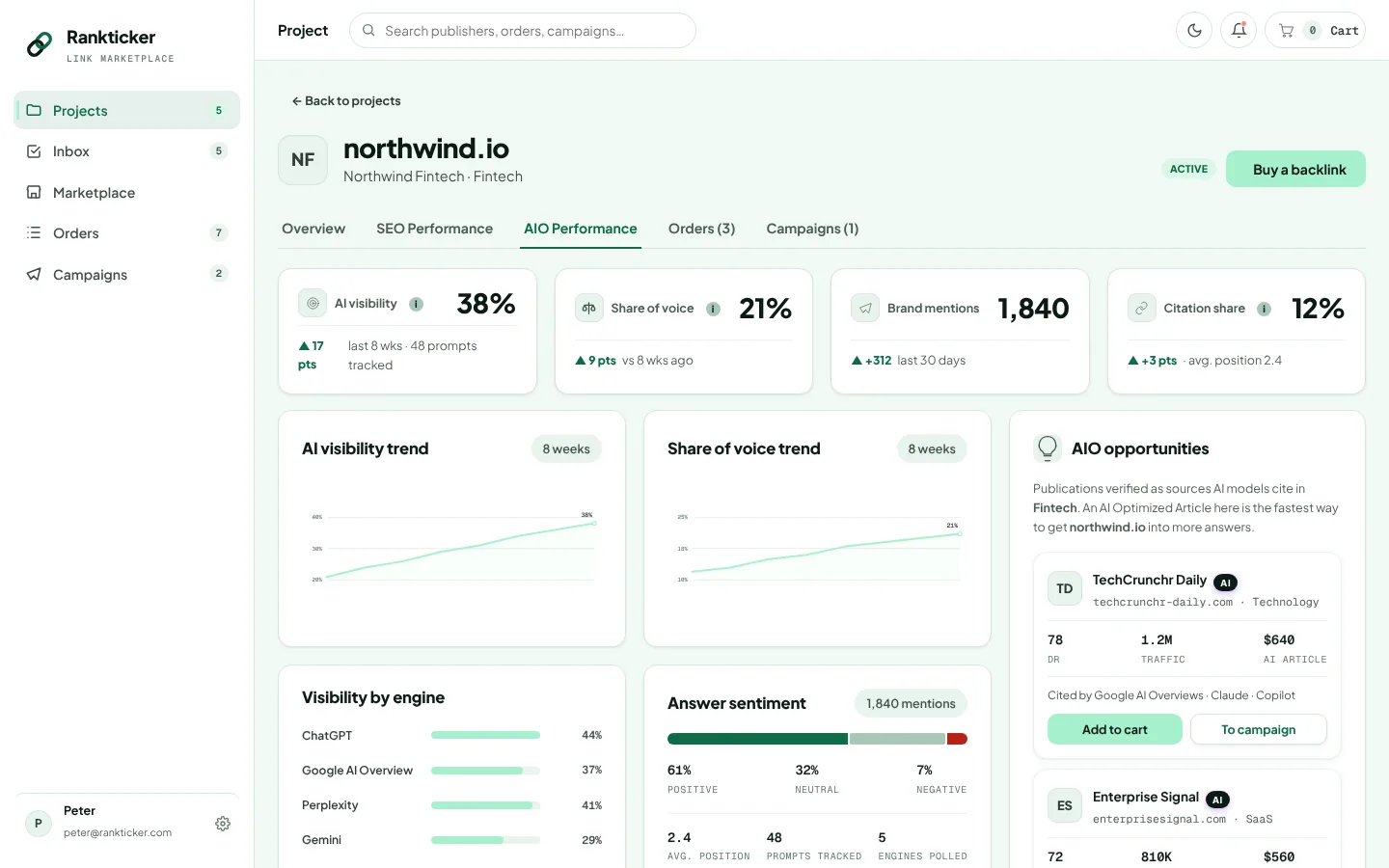
What Rankticker tracks for each project
You add the prompts a buyer in your market would type, such as "best accounting software for UK sole traders" or "is it safe to buy a used EV battery". We run them across ChatGPT, Google AI Overviews, Perplexity and Gemini on a schedule and record the answers, the brands named and the sources cited.
The AIO performance tab in each project turns that into a handful of numbers you can track month to month, next to the SEO performance data for the same site.
| Metric | What it tells you |
|---|---|
| AI visibility | The share of tracked prompts where your brand is mentioned or cited, overall and as a trend. |
| Share of voice | Your mentions as a share of all mentions of you and the competitors you track, for the same prompts. |
| Brand mentions | How many answers name your brand, cited or not. |
| Citation share | How often your own pages are among the cited sources, compared with competitors. |
| Visibility by engine | The same figures split by ChatGPT, Google AI Overview, Perplexity and Gemini. They often disagree. |
| Answer sentiment | Whether the answers that mention you describe you positively, neutrally or negatively. |
| Prompts tracked | The prompts behind every number above, so you can see exactly what was asked. |
AI answers vary between runs and between users, so treat any single answer as an anecdote. The trend across many prompts and many runs is the useful part.
Choosing prompts worth tracking
Start from the questions that come before a purchase. "What's the best CRM for a ten-person agency" is worth tracking. "What is a CRM" mostly isn't, because the answer rarely names vendors. We'd mix three kinds: category questions where buyers want a shortlist, comparison questions that name you or a competitor, and problem questions where your product is one possible answer.
Write them the way people type into ChatGPT, which is longer and chattier than a Google query. Include the place if it matters ("in the UK", "near Manchester"), since answers change with it. Keep the set stable for a few months so the trend means something, and add new prompts alongside rather than swapping old ones out.
AIO opportunities
Buy from the publications that shape the answers
Each time we record an answer, we also record the URLs it cites. We do this for your prompts and for prompts about the competitors you name. Over a few weeks a pattern shows up: the same trade titles, review sites and news outlets keep appearing as sources for your topics.
Where those publications sell placements through Rankticker, two things happen. The listing gets an AI flag in the marketplace, so you can filter for it. And the publication appears as an AIO opportunity on your project's AIO performance tab, with the engines it was cited in and the prompts it was cited for.
An AIO opportunity is still a normal listing. You see the same metrics, risk flags, prices and terms as for any other publisher, and you order it the same way. The difference is that you know it is already being read by the systems you're trying to reach.
Note: the AI flag says a publication has been cited for real prompts. It does not mean an article you place there will be cited too. Citations depend on the page, the prompt and the engine on the day.
Formats
What you can place on AI-cited publications
Pick the format that fits the publication and what you want said about you. Formats and prices vary by publisher and are shown on each listing.
Editorials
A full article on the publication, on a topic where your brand is a natural reference. Good for category questions such as "best X for Y".
PR features
Coverage of something real, such as a launch, a piece of research or a funding round. News coverage suits prompts about recent events.
Press releases
Distribution on news and wire-style sites. Semrush saw PR Newswire among ChatGPT's biggest gainers in late 2025. Results vary a lot by topic.
Product reviews
An independent review of your product on a site people check before buying. Review content turns up often in comparison prompts.
Expert commentary
Quotes from someone at your company inside a wider article. Short, attributable claims are easy for a model to repeat with a name attached.
AI Optimized Articles
An article written for quotability and clear structure, described below. Available where the publisher offers it.
For the trade-offs between these and older link formats, see press releases for SEO and AI visibility and digital PR vs guest posts vs link insertions.
The format
What goes into an AI Optimized Article
An AI Optimized Article is a normal article on a real publication, written for that publication's readers. We just write it so that the parts worth quoting are easy to find and hard to misread. Some of the choices come from the GEO paper by Aggarwal and colleagues, which found that quotations, statistics and cited sources helped. Most of it is just careful editing.
- Entities named in full and consistently: your brand, your product, the category and the place, written the same way every time.
- Specific facts with a source next to them, such as a price, a date, a test result or a regulation by name.
- Short claims that stand on their own, so a sentence still makes sense when it's lifted out of the paragraph.
- Headings that match how people ask, with the answer in the first sentence or two below each one.
- Tables for comparisons and specs, where a model or a reader can pull one row without reading the rest.
- A named author and a visible date, because both readers and retrieval systems look for them.
- Outbound links to the original sources, including ones that aren't you.
What it doesn't contain: keyword stuffing, invented statistics, or a list of your product's features dressed up as an article. Publishers reject those, readers skip them, and the GEO research found keyword stuffing made things worse.
Will it be cited? Sometimes. It is more quotable than an average guest post, and it sits on a site that engines already use. That is as far as we will go.
Campaigns
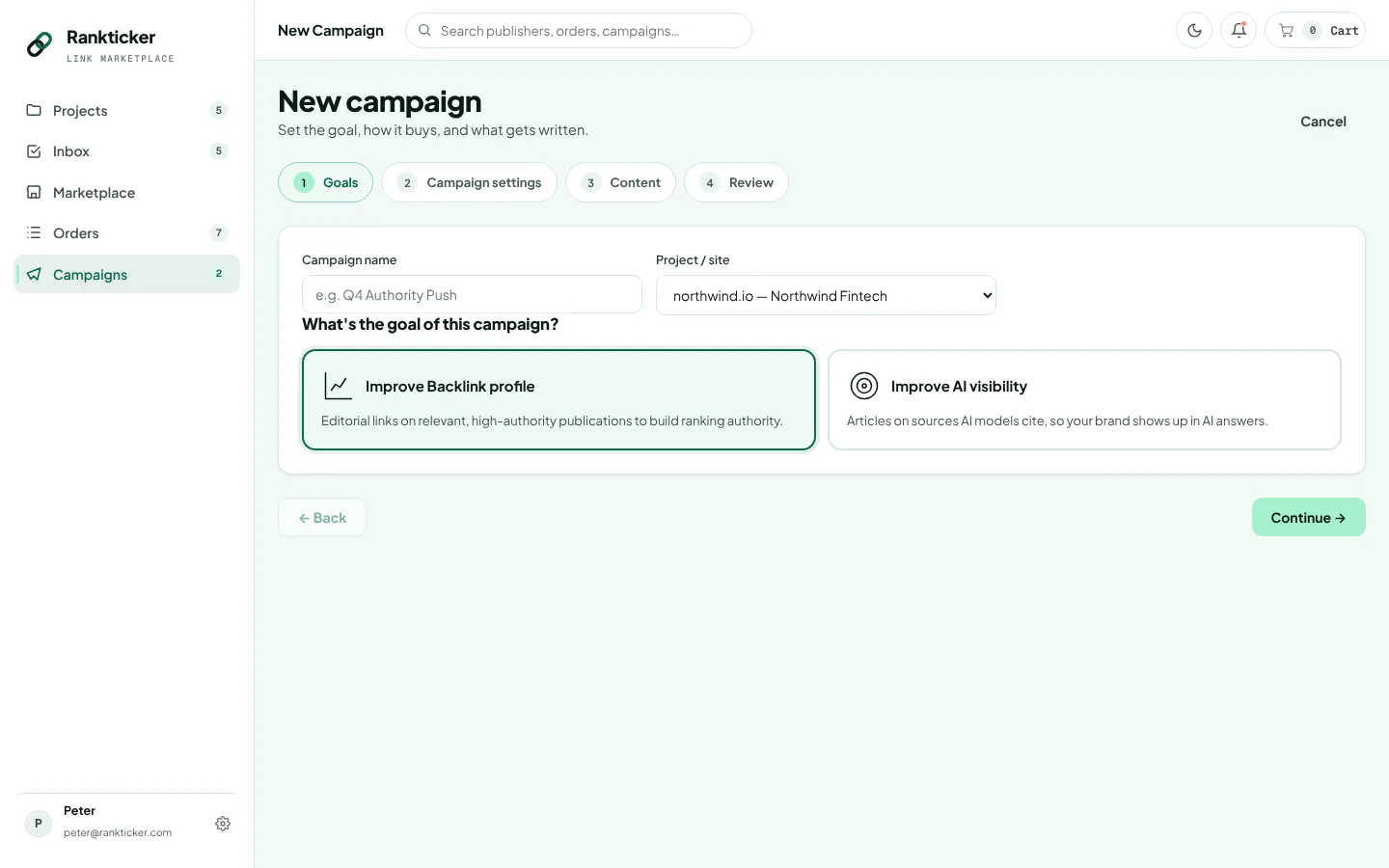
Set "Improve AI visibility" as the campaign goal
When you create a campaign you choose its goal: improve backlink profile, or improve AI visibility. With the AI goal, recommendations lean towards publications cited for your tracked prompts and the formats that suit them, inside your budget, niche, geo and maximum cost per link.
Run it in semi-auto and each recommendation comes with its reasons, so you can see that a site was picked for its Perplexity citations on your topic and its low spam score, then approve or decline. Auto mode places within your rules each cycle. Either way, the AIO performance tab shows whether visibility moves.
More detail on campaigns and AI visibility in the product.
Limits
What we can't promise
We can't guarantee that ChatGPT, Gemini or anything else will cite you. No one outside those companies can, and anyone selling "guaranteed AI citations" is guessing. Models get updated, retrieval changes, and the sources an engine favours can swing within weeks, as the Semrush data shows.
Tracking has limits too. Answers depend on the user, their location, their history and the exact wording. We sample a defined set of prompts on a schedule, which gives you a consistent trend. It does not show you every answer every person sees.
And the usual rules still apply. Google's spam policies ask for paid links to be marked rel="sponsored" or rel="nofollow", and that doesn't change because the goal is AI visibility. A sponsored, clearly disclosed feature on a well-read publication can still put your brand in front of the engines and the people who use them. We cover the detail in paid links and Google's spam policies and link building for AI search.
Start with your prompts
Add a project, list twenty prompts your buyers ask, and see who gets cited before you buy a single placement.
FAQ
Questions about AI visibility
What is AI visibility?
AI visibility is how often your brand appears in answers from AI search tools such as ChatGPT, Google AI Overviews, Perplexity and Gemini, for the prompts that matter in your market. Rankticker reports it as the share of tracked prompts where you are mentioned or cited, broken down by engine.
What is generative engine optimization?
Generative engine optimization (GEO) is the practice of making content more likely to be used and cited by AI answer engines. The term comes from a 2023 research paper by Aggarwal and colleagues, published at KDD 2024, which tested content changes such as adding quotations, statistics and citations.
Can you guarantee my brand gets cited by ChatGPT?
No. Nobody outside the AI companies controls which sources an answer cites, and the sources shift over time. We can show you which publications are being cited for your topics today and help you get your brand onto them.
Which AI engines do you track?
The AIO performance tab reports visibility for ChatGPT, Google AI Overviews, Perplexity and Gemini. The AI flag on marketplace listings can also reflect citations we have seen in Copilot and Claude.
What does the AI flag on a marketplace listing mean?
It means our scans have recorded that publication being cited as a source in AI answers. It tells you the site is in the pool AI engines draw from today. It is not a promise that your article on that site will be cited.
What is an AI Optimized Article?
It is an article format written to be easy for both readers and AI systems to quote: clear entity names, specific facts with sources, short self-contained claims and a predictable structure. It is still a normal article on a real publication, written for that publication's readers.
Do links still matter for AI search?
Probably, but less directly than for rankings. Google says pages need to be indexed and eligible for a snippet to appear as supporting links in AI Overviews, so classic SEO still applies. Ahrefs found brand web mentions correlated more strongly with AI Overview visibility than backlink counts did.
Do paid placements for AI visibility need to be marked as sponsored?
If the placement includes a link, Google's spam policies ask for paid links to carry rel="sponsored" or rel="nofollow". You choose the link attribute when you order. A brand mention without a link is still useful for AI visibility.
Keep reading
Related
Link building for AI search: how publications get cited in ChatGPT, Perplexity and AI Overviews
Link building for AI search: how ChatGPT, Perplexity and Google AI Overviews find sources, what citation research shows, and how to pick publications.
Brand mentions in AI answers: how to measure them and how to earn them
How brand mentions, entities and unlinked citations shape AI answers in 2026, how to measure share of voice and sentiment, and how to get into cited s…
Press releases, SEO and AI visibility in 2026
Do press releases still help SEO and AI visibility in 2026? What Google says about syndication links, how often AI cites releases, and when editorial …
AI visibility tracking
Rankticker product tour
How pricing works
How Rankticker pricing works and what drives backlink prices: fixed prices per format, no subscription in early access, optional extras and campaign b…
See the publishers before you spend a penny
Filter real publications by niche, DR, traffic and price. Every metric and the full price are on the listing.