Policy
Paid links and Google's spam policies: what buyers need to know in 2026
Google's position on paid links is clear and hasn't softened. Buying links to manipulate rankings is link spam, and paid links should carry rel="sponsored" or rel="nofollow". Here is what the policy says, how it's enforced, and how to make decisions about it as a buyer.
TL;DR: Google's spam policies define buying links for ranking purposes as link spam, and allow paid links that carry rel="sponsored" or rel="nofollow". Enforcement is mostly algorithmic: SpamBrain neutralises links and the benefit is gone for good. Manual actions still happen. The site reputation policy can sink the page your placement sits on. In the UK, paid editorial also has to be labelled for readers under the CAP Code. Choose attributes and disclosure deliberately, and judge placements on value you can defend.
We sell placements on real publications, so we have an obvious interest in this subject. That's a reason to be careful with it. We've stuck to what Google's documents actually say, linked each one, and kept our own view separate. We won't tell you any link is safe or undetectable. Nobody honest can.
What the link spam policy says
Google's spam policies, last updated in August 2026, define it in one sentence: "Link spam is the practice of creating links to or from a site primarily for the purpose of manipulating search rankings." The examples that follow include:
- Buying or selling links for ranking purposes, including exchanging money, goods, services or free products for links or for posts that contain links.
- Excessive link exchanges and partner pages built only for cross-linking.
- Advertorials, sponsored articles, guest posts or press releases with links that pass ranking credit or use optimised anchor text.
- Text ads and text links that don't block ranking credit.
- Widely distributed footer and template links, low-quality directory links, and keyword-rich links in widgets or forum signatures.
Then the exception. Buying and selling links for advertising or sponsorship is fine when the links are qualified with rel="nofollow" or rel="sponsored". Google isn't against paid placements. It's against paid placements that pretend to be editorial votes.
Note the word "primarily". The policy is about intent, which Google infers from patterns. That's why the same link can be harmless on one site and part of a scheme on another.
rel="sponsored", "nofollow" and "ugc"
Google's documentation on qualifying outbound links asks for links that are advertisements or paid placements to be marked rel="sponsored". rel="nofollow" is still acceptable for paid links, though sponsored is preferred. rel="ugc" is for user-generated content such as comments and forum posts. You can combine values, for example rel="sponsored nofollow".
Since September 2019, Google has said these attributes work as hints about which links to consider or exclude for ranking, and from March 2020 for crawling and indexing too. A hint is Google's call, not yours. You shouldn't count on a sponsored link passing anything, and you shouldn't count on it passing nothing either.
Who adds the attribute? The publisher, technically. But in its July 2021 reminder on qualifying links, Google said "excessive sponsored and guest posting without proper link tags" could lead to algorithmic and manual actions, which puts buyers in the frame as well.
How Google enforces it
Algorithmic: SpamBrain and spam updates
Google's ranking systems guide names SpamBrain as one of its spam detection systems. When it announced the December 2022 link spam update, Google said SpamBrain could "detect both sites buying links, and sites used for the purpose of passing outgoing links", and that credit passed by unnatural links would be lost as they were neutralised.
The spam updates documentation spells out the consequence: ranking benefits from spammy links that have been neutralised "cannot be regained". If a site does improve, Google says its systems may learn that "over a period of months".
Spam updates have been frequent. From Google's Search Status Dashboard:
| Update | Started | Duration or status |
|---|---|---|
| December 2022 link spam update | 14 December 2022 | Finished 12 January 2023 |
| August 2025 spam update | 26 August 2025 | About four weeks |
| March 2026 spam update | 24 March 2026 | About a day |
| June 2026 spam update | 24 June 2026 | About two days |
| August 2026 spam update | 18 August 2026 | About three days |
| September 2026 spam update | 24 September 2026 | Google said up to two weeks; global, all languages |
Google doesn't usually say which spam practices each general update targets. Four so far this year is a reason to watch the publications you buy from, not only your own site.
Manual actions
Human reviewers still issue penalties. Search Console's manual actions report includes "Unnatural links to your site", for "a pattern of unnatural, artificial, deceptive, or manipulative links pointing to your site". The fix is removal first, disavow for what can't be removed, then a reconsideration request with documentation. Google warns that disavowing everything without trying to remove links "might lead to rejection".
The disavow tool itself is narrower than its reputation. Google's disavow guidance says most sites won't need it, and recommends it only when you have a considerable number of spammy, artificial or low-quality links and they have caused, or likely will cause, a manual action.
The site reputation policy
This one catches buyers out because it's about the host site, not your link. Google introduced it as "site reputation abuse" in March 2024 and began enforcing it that May. The current text, now called the site reputation policy, applies where third-party content is published on a host site mainly because of that host's existing ranking signals. Google's examples include sponsored payday-loan reviews on an educational site and a low-quality "best casinos" page on a medical site.
Having third-party content isn't a violation in itself. The policy excludes wire services, syndicated news, user-generated content, editorial columns, and affiliate links handled properly. Google looks at whether the content is presented consistently with the host, its quality, stated authorship, editorial oversight and whether it's duplicated elsewhere.
The current version also draws a regional line. Outside the EEA, affected pages may get a manual action. Inside the EEA, they may be treated as separate from the main domain and ranked on their own merits.
For a buyer, the risk is simple. If you buy into a "partner content" section on a big, trusted site that exists to rank third-party commercial pages, the whole section can disappear from results. Your placement goes with it. Look for paid content that fits the host's subject, carries real bylines and gets edited.
What this means if you buy placements
Here's the honest version. A followed link bought to improve rankings is link spam under Google's policy, whatever the format. Some buyers accept that risk. If you do, accept it knowingly, and understand that the most likely downside is probably the quiet one: the link gets neutralised and you've lost what you paid. A manual action is less likely and much worse.
| Practice | Google's position | Typical consequence | Our view |
|---|---|---|---|
| Paid placement with rel="sponsored", labelled for readers | Allowed | None | Default for brand-sensitive and YMYL sites |
| Paid followed link, relevant publication, natural anchor | Link spam if bought for ranking | Link may be neutralised; manual action possible | A risk decision for the buyer; never call it safe |
| Paid followed links with exact-match anchors at volume | Named as link spam | Neutralisation; manual action risk rises | Avoid |
| Links from sites that sell to everyone | SpamBrain targets sites passing outgoing links | Links ignored; site may drop | Avoid |
| Placements in off-topic "partner" sections of big sites | Site reputation policy | Page or section removed or demoted | Avoid |
| PBNs and link farms | Link spam | Neutralisation, manual actions | Never |
Whichever attribute you choose, the things that make a placement worth having are the same. A relevant publication with real readers sends referral traffic. A mention in good company builds brand searches. And AI engines read the text on the page, so a well-described brand mention on a publication they cite counts whether the link is followed or not. Ahrefs found branded web mentions correlate with AI Overview visibility at 0.664, against 0.218 for backlink count.
For health, finance and legal brands we'd lean firmly toward sponsored attributes and labelled content. The downside of a problem is bigger there, and so is the reputational cost of looking like you hide your advertising. Our health and wellness page covers what that looks like in practice. For the checks on the publisher side, see our backlink evaluation guide and how to spot PBNs and link farms. Anchors deserve their own care too; see our anchor text strategy.
Disclosure in the UK: the CAP Code
The rel attribute is a signal to machines. Readers need a label, and in the UK that's a legal and regulatory matter, separate from Google.
The ASA's guidance on advertisement features says paid content styled like editorial must be obviously identifiable as marketing under CAP Code rules 2.1 and 2.4. The trigger is a payment or "other reciprocal arrangement", which covers money, free products and commission. If the brand also has editorial control over the content, the CAP Code applies. Responsibility sits with both the marketer and the publisher.
On labels, the CAP Code names "Advertisement feature" as appropriate, and "Ad", "Advert" or "Advertising" are likely to work if shown upfront and prominently. The ASA generally advises against "sponsored" on its own, because it's "open to varied interpretation". And even paid content outside the CAP Code's remit has to make the payment clear to consumers under consumer protection law, which the CMA enforces.
- Decide the link attribute for each placement before you order, and record it
- For UK audiences, make sure paid articles carry an upfront label such as "Advertisement feature" or "Ad"
- Check the host site's paid content fits its subject and has real bylines and editing
- Keep anchors natural, especially on followed links
- Watch your Search Console manual actions report and the publications you've used after each spam update
- Keep a record of what you bought, from whom, with what attribute, in case you ever need to clean up
How Rankticker handles attributes and disclosure
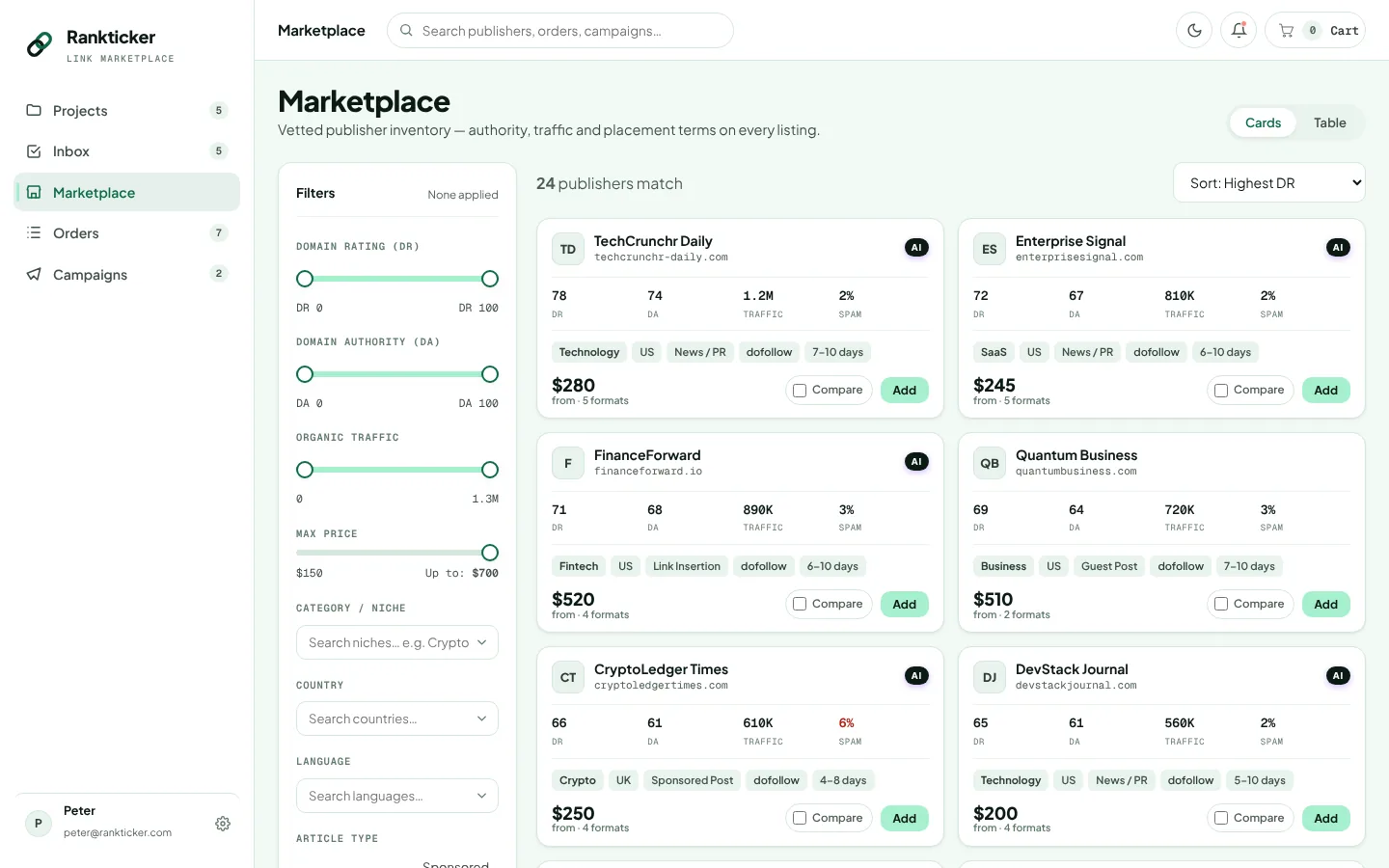
You choose. The marketplace filters by link type (dofollow, nofollow, sponsored), and every publisher profile states the link attribute for each format and whether paid content is labelled. The same profile flags the share of sponsored outbound links and any outbound links into grey niches, so you can see who else the site sells to. Our vetting page explains which sites we accept and which we turn away.
We don't promise rankings, and we don't describe any link as Google-safe. After publication, the Live Link Tracker checks the attribute along with the anchor and the target URL, so you'll know if a publisher changes it. Questions about a specific case go to hello@rankticker.com.
FAQ
Questions about paid links Google spam policy
Are paid links against Google's guidelines?
Buying or selling links for ranking purposes is link spam under Google's spam policies. Paid links that carry rel="sponsored" or rel="nofollow" are allowed, because they are treated as advertising rather than an attempt to pass ranking credit.
What happens if Google detects paid links to my site?
Usually the links are neutralised by systems such as SpamBrain, and any ranking benefit is lost and can't be regained. In more serious cases Google can issue an 'unnatural links to your site' manual action, which you see in Search Console.
Do I need to disclose paid articles in the UK?
Yes. The ASA says paid advertisement features must be obviously identifiable as marketing, with a clear label such as 'Advertisement feature' or 'Ad' shown upfront. The ASA advises against relying on 'sponsored' alone.
Should I use the disavow tool for paid links?
Google says most sites don't need it. It recommends disavowing only when you have a considerable number of spammy or artificial links that have caused, or likely will cause, a manual action, and only after trying to get them removed.
Is a sponsored link worth paying for?
It can be, on a relevant publication with real readers. It can bring referral traffic and brand exposure, and AI engines read the brand mention in the text whatever the link attribute. Judge it on the publication, not on whether the link is followed.
Keep reading
Related
How to evaluate a backlink in 2026: the signals that matter
How to evaluate a backlink in 2026: relevance, real traffic, TF:CF, outbound links, indexation, placement, anchor, attribute, permanence and AI citati…
Anchor text strategy in 2026: distribution, types and how to plan anchors per page
Anchor text strategy for 2026: branded, naked URL, partial and exact match anchors, what Penguin and SpamBrain changed, and example mixes for each pag…
How to spot PBNs, link farms and sponsored post factories: a 2026 checklist
A 2026 checklist for spotting PBNs, link farms and sponsored post factories: traffic patterns, outbound links, footprints, expired domains and TF:CF.
Digital PR vs guest posts vs link insertions: which format fits which job
Digital PR vs guest posts vs link insertions: when each format fits, what drives cost, risks, turnaround and AI visibility value, with a comparison ta…
Health and wellness link building
Health link building for clinics, healthtech and wellness brands: YMYL trust, ASA health claim rules, expert-led placements, anchors and AI visibility…
Frequently asked questions
Answers on buying backlinks with Rankticker: formats, pricing, content, delivery, link tracking, vetting, AI visibility, refunds and selling as a publ…
See the publishers before you spend a penny
Filter real publications by niche, DR, traffic and price. Every metric and the full price are on the listing.