Backlinks you can check before you buy
Search real publications, see every metric and the price up front, and track each link after it goes live. Rankticker is a backlink marketplace and link building platform, in early access in 2026.
How it works
From search to a live, checked link in four steps
Most link sellers send a spreadsheet and a total. We show you the publication, its numbers and its price, and you decide.
Search the marketplace
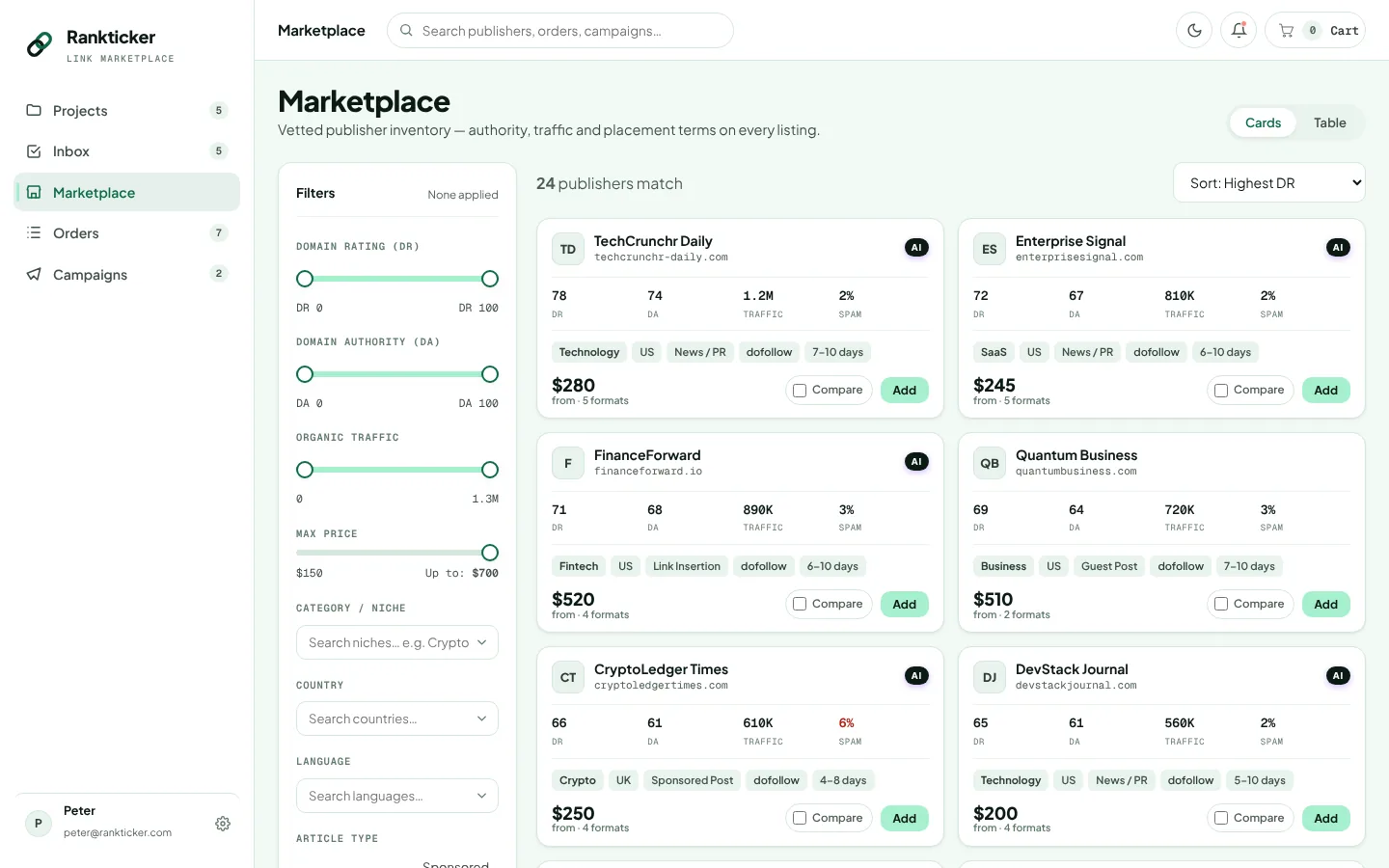
Filter by DR, DA, organic traffic, maximum price, niche, country, language, article type and link type. Switch between cards and a sortable table when you're comparing forty sites at once.
Check the publisher
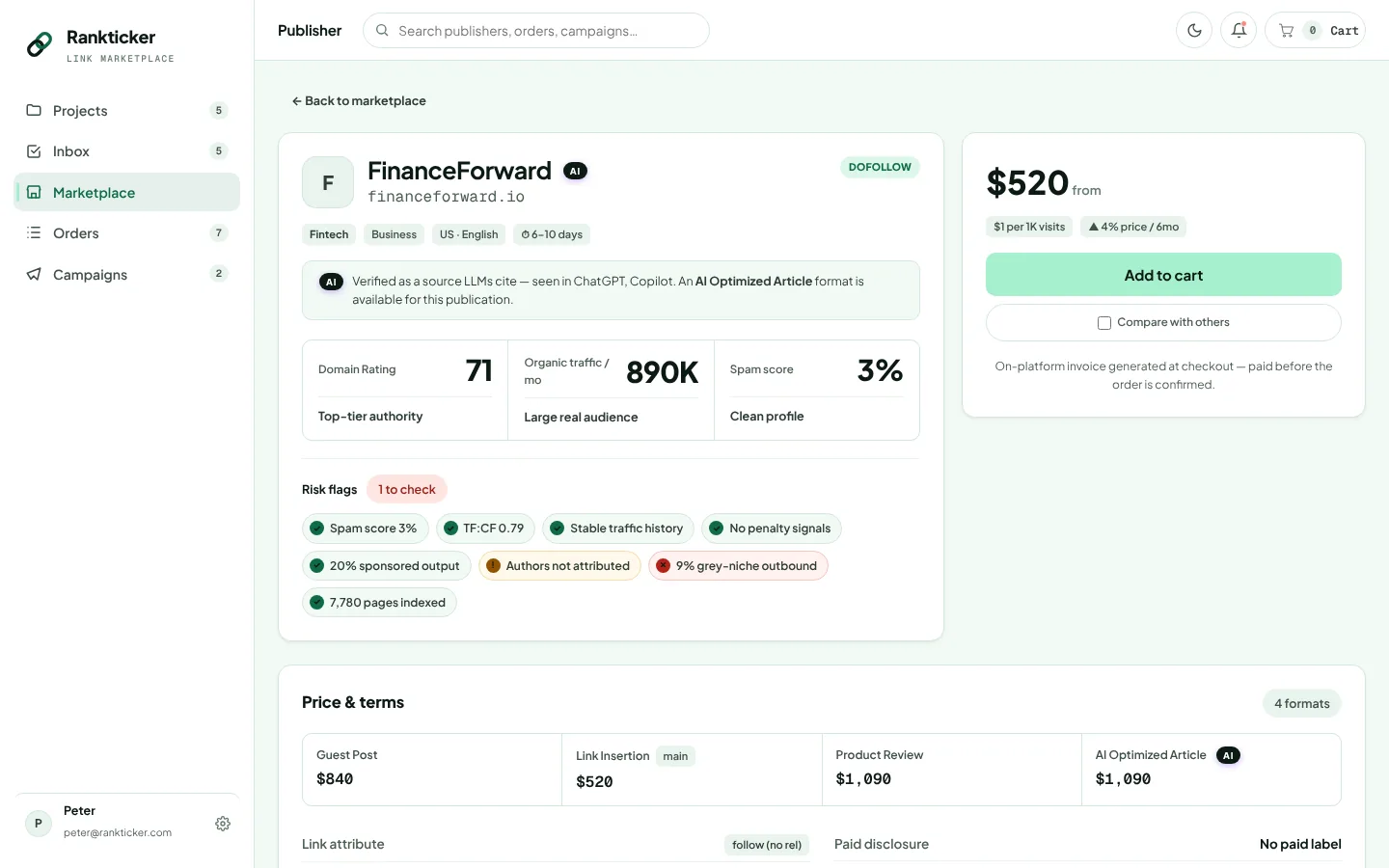
Open the profile. You get TF:CF, spam score, traffic trend, the share of outbound links that are sponsored, author attribution, and the price and terms for each format. If it's close between two, put them side by side and compare the numbers line by line.
Order and brief
In the cart, set the project, target URL, anchor text, article type and length. Write it yourself or let our writers do it. Pay by card against an on-platform invoice.
Track it to live and after
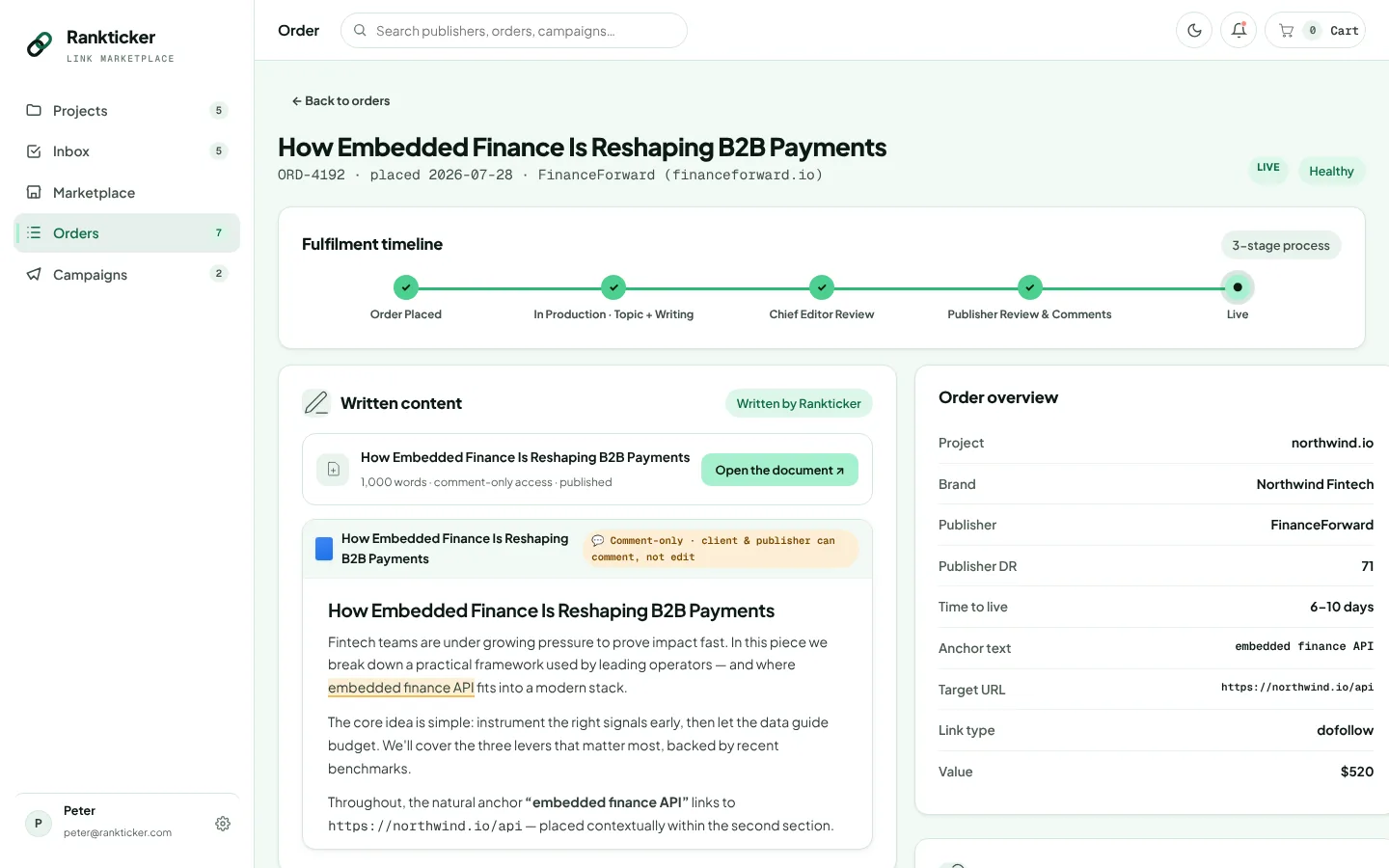
Each order moves through production, chief editor review and publisher review. When it goes live, the link tracker checks the page, the anchor, the target and the rel attribute, and keeps checking. If a check fails months later, the link lands in your inbox flagged for review.
Product
What's in the app
Early access means we're still adding to it. Everything below already works.
Publisher profiles that show the risk
A DR 60 site can still be a link farm. So the profile shows the signals we'd check by hand before buying: spam score, the TF:CF ratio, whether traffic is rising or falling, how much of the site's outbound linking is sponsored, whether posts carry an author, outbound links into grey niches, and how many pages are indexed.
Then the terms: link attribute, anchor policy, word count, turnaround, how long the link is meant to stay up, and whether the publisher shows a paid disclosure. How we vet publishers.
Marketplace
Vetted publishers in card or table view, with filters for metrics, price, niche, geography and format.
Ordering
Configure each placement per project: target URL, anchor, article type, length, revisions, rushed delivery.
Content
Drafts in an editor you can comment on, written by us or supplied by you, with revision requests in one place.
Order tracking
A timeline for every order, from order placed to live, and an inbox for anything that needs you.
Link monitoring
Ongoing checks on live links: page up, anchor present, target resolves, page indexed, attribute unchanged.
Campaigns
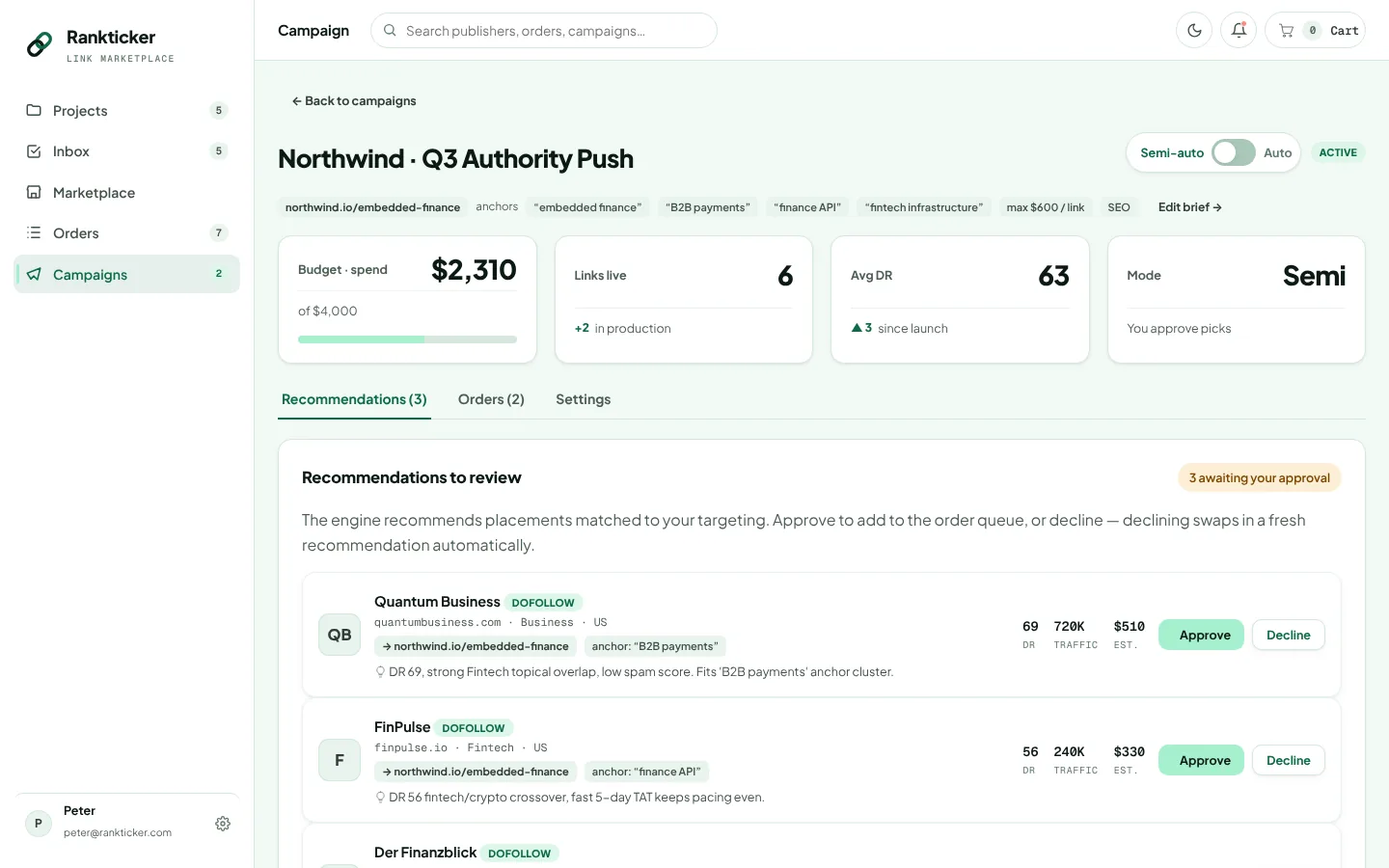
Set a monthly budget and rules. Run it on auto, or approve each recommended placement yourself.
Campaigns that explain their picks
Give a campaign a budget, target URLs, anchors, keywords, a geo and a maximum cost per link. In semi-auto mode it recommends placements and tells you why, for example "DR 69 · strong fintech topical overlap · low spam score". You approve or decline. In auto mode it places links each cycle inside the rules you set.
Projects pull it together, with DR and organic traffic trends, referring domains and keyword positions on the SEO performance tab.
AI visibility
See which publications AI answers cite
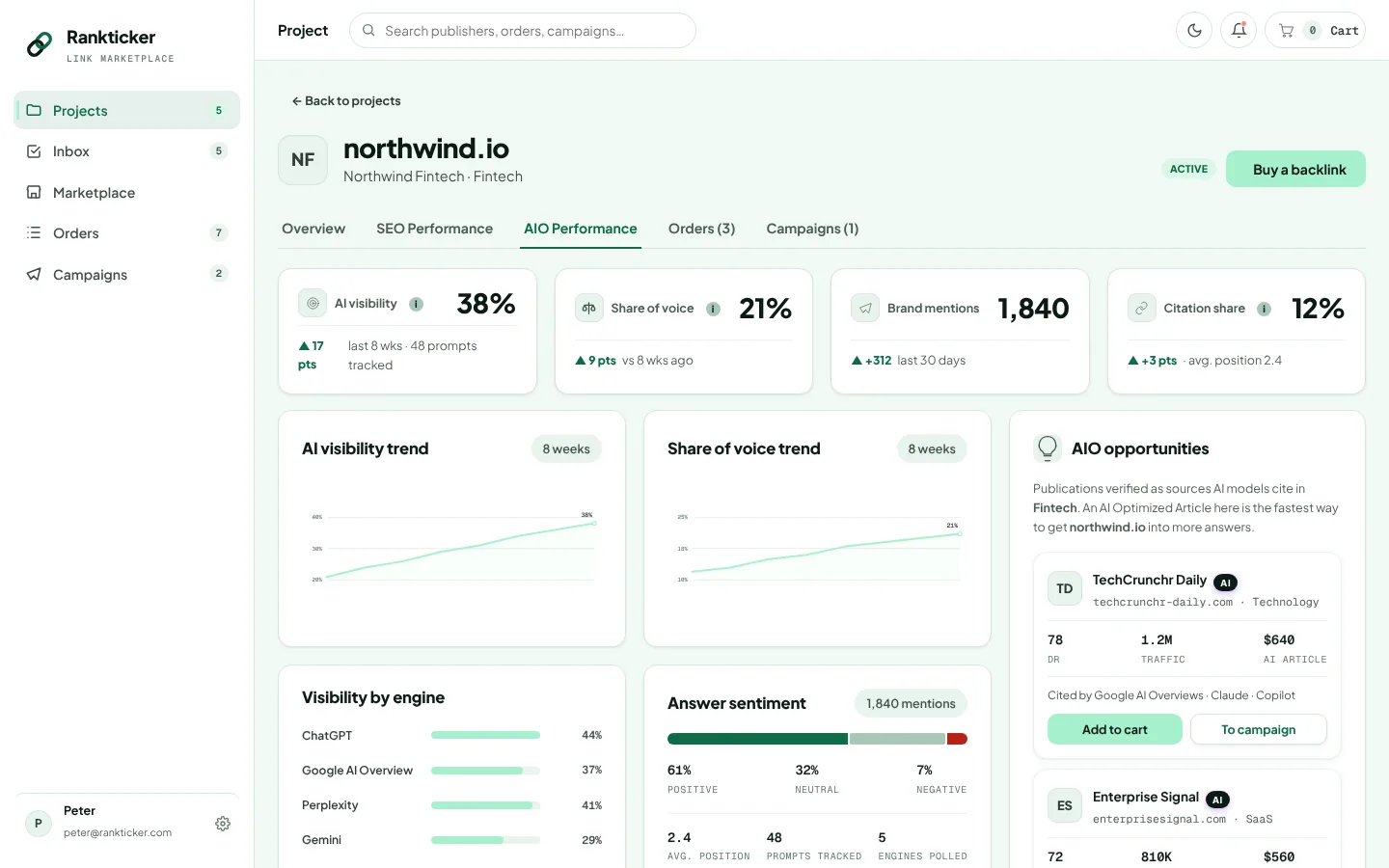
ChatGPT, Google AI Overviews, Perplexity and Gemini all pull answers from web pages, and a lot of those pages sit on third-party publications. We track prompts in your niche, measure how often your brand shows up and who gets cited, then flag those publications with an AI badge in the marketplace.
So if a trade magazine keeps turning up as a source for "best payroll software UK", you can see it, check it, and buy a feature or review there. We can't guarantee a citation. You do get to place content where the citations already come from.
Publishers
List your publication and set your own prices
Price each format yourself, accept or decline each request, and mark orders live when they are.
The publisher portal shows your revenue, open requests and payouts. It also shows what buyers in your niche are looking for and how comparable sites price, which helps when you're guessing what to charge for a link insertion versus a full article. We review sites before they go live in the marketplace, and we turn some down.
Use cases
Built around topical fit
A link from a site in your field does more than a bigger number from a site that isn't. Start from your industry.
SaaS
Reviews, comparisons and expert pieces on software and business publications.
Fintech
Finance and business titles that handle regulated topics with care.
Ecommerce
Product reviews and gift guides that send buyers as well as signals.
Agencies
One project per client, clear costs per placement, proof you can forward.
Health and wellness
Publications with named authors and editorial standards for YMYL topics.
Legal
Legal and business press for firms that need credible, local coverage.
Travel
Destination and travel titles with real readers and seasonal traffic.
Cybersecurity
Technical and IT publications that security buyers actually read.
Real estate
Property and local news sites for agents, developers and proptech.
Local businesses
Regional UK publications and directories that matter in a town.
Edtech
Education and parenting titles for learning products and platforms.
All industries
Seventeen use cases, from insurance to food and drink.
Our stance
Paid links and Google, plainly
Google's spam policies list "buying or selling links for ranking purposes" as link spam. The same page says paid links are fine when they carry rel="sponsored" or rel="nofollow". We won't tell you our links are Google-safe or undetectable. Anyone who does is selling something else.
Vetting is where we spend most of our time. We keep out sites whose traffic fell off a cliff after a core update and never came back, blogs where most outbound links point at casinos and payday lenders, author-less content farms, and groups of sites that share an owner, a template and the same twenty advertisers. A site with good numbers can still fail on any of those. When we're unsure, it stays out.
What we will do is vet publishers, show you what we found, and let you choose the link attribute and whether disclosure appears. The case for a placement on a real publication is the readers it sends and the topical relevance it adds. There's also a fair chance AI systems pick it up as a source. If you want the longer version, read paid links and Google's spam policies.
Guides
Latest guides
How to evaluate a backlink in 2026
The checks we run before any site goes into the marketplace.
How to spot PBNs and link farms
Traffic shapes, outbound patterns and other giveaways.
Link building for AI search
What changes when ChatGPT and AI Overviews do the reading.
Topical relevance vs Domain Rating
When a smaller site in your niche is the better buy.
Start with a search
Filter for your niche, open a few profiles and compare prices before anything goes in the cart.
FAQ
Questions about backlink marketplace
What is Rankticker?
Rankticker is a backlink marketplace with a managed service behind it. You search vetted publishers, see their metrics and prices per format, order placements, follow each order through writing and publisher review, and keep tracking the link once it is live.
Can I buy backlinks in the UK with Rankticker?
Yes. Prices on the website are in pounds sterling and the company behind Rankticker is registered in England and Wales. The marketplace also lists publishers in other countries and languages, which you can filter by.
Do I see the price before I order?
Yes. Every listing shows a starting price, and the publisher profile shows the price and terms for each format, such as a guest post, link insertion, product review or AI Optimized Article. You configure and check the order in the cart before paying.
Will buying links improve my rankings?
We don't promise rankings and nobody honestly can. What you get is a placement on a real, relevant publication, with the metrics shown before you buy and the link checked after it goes live. Google asks for paid links to be marked rel="sponsored" or rel="nofollow", and you choose the link attribute when you order.
Who writes the content?
Either Rankticker's writers or you. If you supply your own article, switch on the supply-own-content option in the cart. Either way the draft goes through our chief editor and then the publisher before it goes live.
What happens if a link is removed?
If a link is removed or changed within the link permanence period stated on the listing, we ask the publisher to restore it. If it isn't restored within 14 days, you get a replacement placement of equal value or a credit.
Keep reading
Related
The link building platform built around how you buy links
Rankticker is a link building platform and backlink marketplace: vetted publishers with risk flags, fixed prices, editorial content and live link trac…
AI visibility you can measure and act on
Track your AI visibility across ChatGPT, AI Overviews, Perplexity and Gemini, see which publications they cite, and place content on those sources.
How pricing works
How Rankticker pricing works and what drives backlink prices: fixed prices per format, no subscription in early access, optional extras and campaign b…
Sell guest posts and sponsored content on your terms
Sell guest posts and sponsored posts on your site through Rankticker. Set your own prices and editorial rules, accept or decline requests, get paid mo…
How to evaluate a backlink in 2026: the signals that matter
How to evaluate a backlink in 2026: relevance, real traffic, TF:CF, outbound links, indexation, placement, anchor, attribute, permanence and AI citati…
See the publishers before you spend a penny
Filter real publications by niche, DR, traffic and price. Every metric and the full price are on the listing.