Use cases
Ecommerce link building
Online stores earn links to blog posts and the homepage easily enough. The hard part is getting authority onto category pages, and getting it there before the season starts.
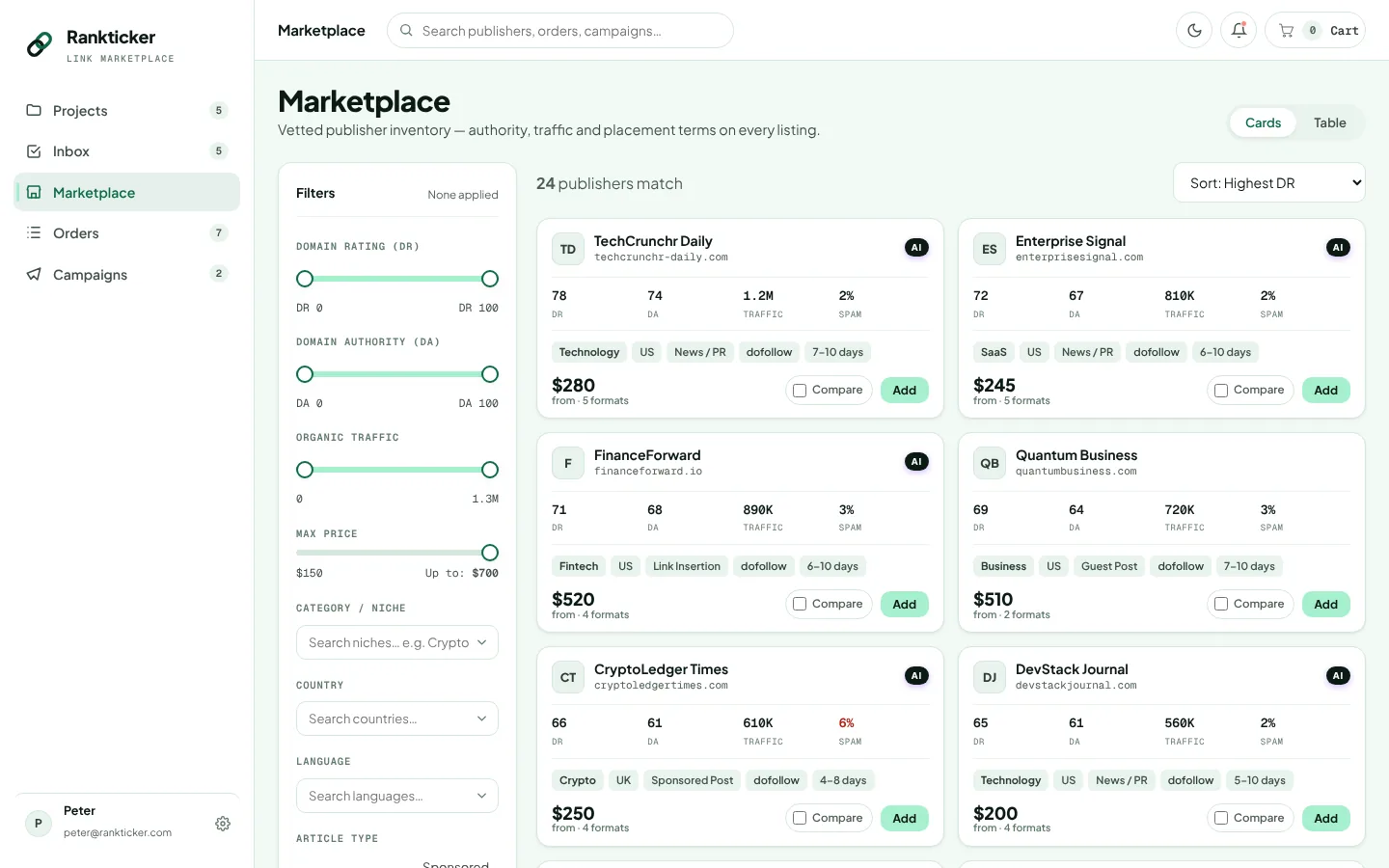
Find publishers in this nicheSee how it works
The problem
Where ecommerce links go missing
Category pages make the money and attract almost no links. Nobody writes an article and thinks "I should link to /womens/boots/waterproof/". They link to the homepage, a blog post, or a product they liked.
Product pages have their own problem: they don't last. A jacket is discontinued, the URL is redirected to the category or deleted, and the links built to it are wasted or diluted. Stores that link-build to product URLs end up paying for the same authority twice.
Then there is timing. When does your year actually peak? Black Friday, Christmas, back to school, the first warm weekend of garden season. A link ordered in the second week of November is probably too late for this year's peak, because it has to be written, reviewed, published and crawled before it counts for anything. Seasonal stores need to plan links like they plan stock.
The SERPs are also full of affiliate buyer's guides, which means you are often competing with publishers who earn commission every time a reader clicks through to one of your competitors, and the awkward part is that those same guides are frequently where your links need to be.
Placements
Formats that fit online retail
Product reviews
Send the product and let the reviewer use it. Google's guidance on reviews asks for evidence of first-hand use, measurements and comparisons with alternatives, so a reviewer who has handled the thing writes a better page for everyone.
Gift guides and seasonal roundups
Publications plan these weeks or months ahead. Get in early and the guide often stays live and gets refreshed every year with your link in it.
Link insertions in buyer's guides
The most direct route to a category page. Check the guide's own traffic and whether it already links to five of your competitors.
Hobby and specialist blogs
A climbing blog with 20,000 monthly readers often sends more buyers to a climbing shop than a general lifestyle magazine ten times its size.
Data-led PR works for stores with useful data: price tracking across a category, search trends from your own site, return reasons. Local news still helps retailers with physical shops.
Targets and anchors
Build to URLs that will still exist next year
Rank your target pages by revenue and by how close they are to page one. Category and subcategory pages first. Then buying guides that link internally to those categories. Then evergreen seasonal hubs, such as /black-friday/ rather than /black-friday-2026/, so the authority carries over each year.
Link to product pages only for hero products you expect to sell for years.
For anchors, mix brand names, plain URLs and descriptive category phrases ("waterproof walking boots for women"). Product names make natural anchors in reviews. Exact-match head terms like "walking boots" should be rare, and never the same one across a run of placements in the same month.
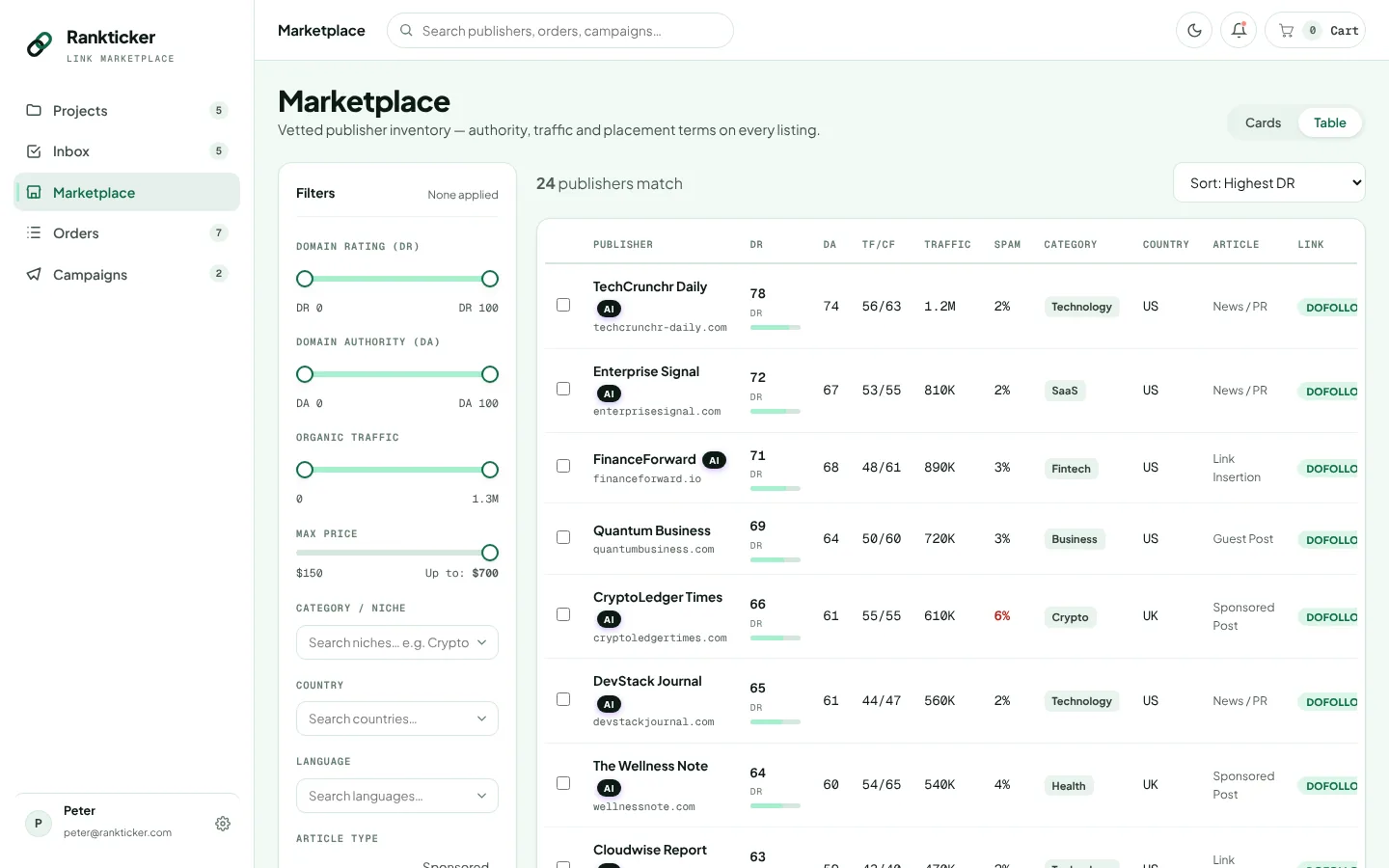
In the table view you can sort by traffic and price, compare TF:CF and spam score across a shortlist, and filter the article type to product review.
In Rankticker
Setting up a store campaign
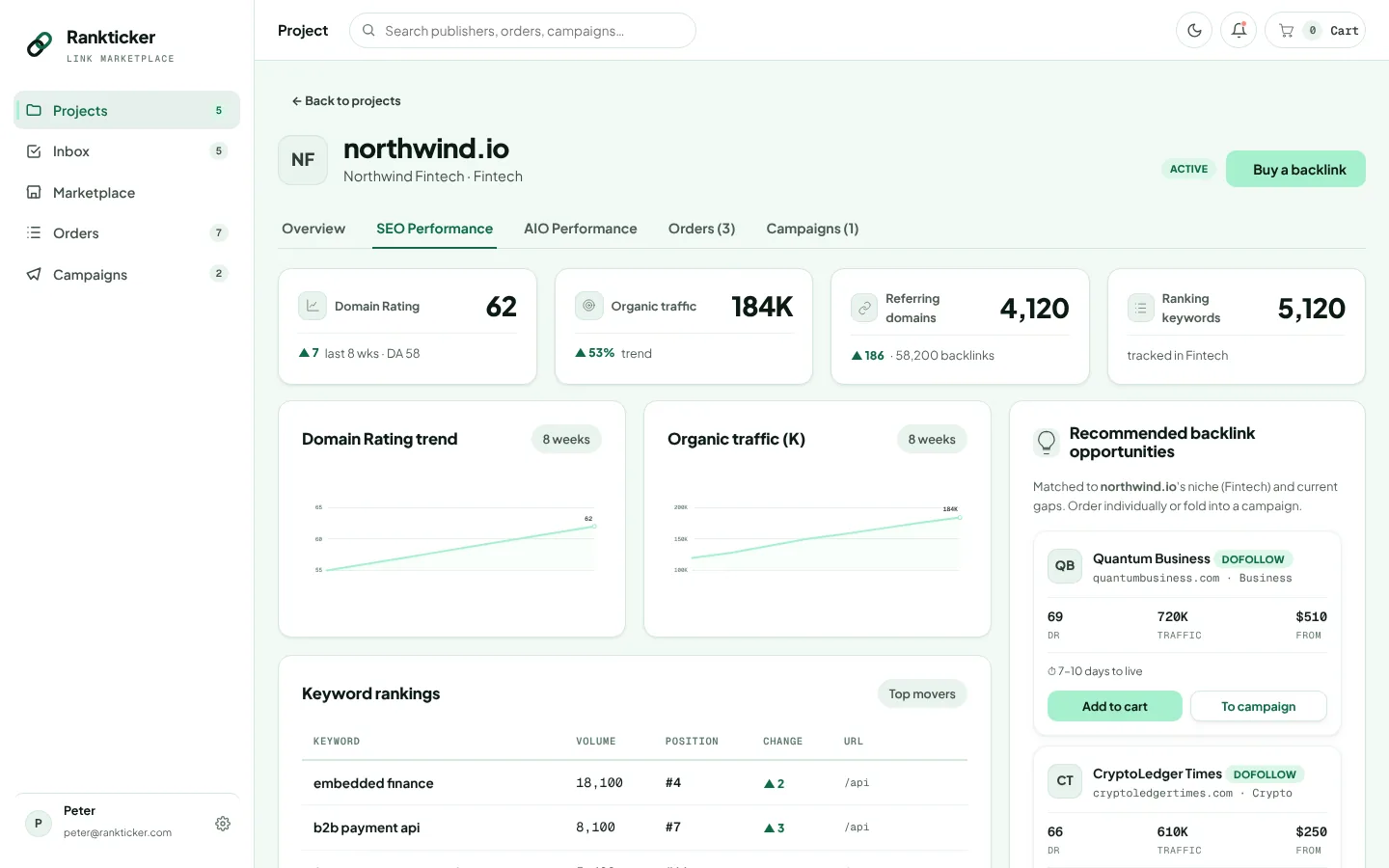
Filter the marketplace by your product niche rather than a broad "shopping" category, and by the countries you actually ship to. Use the turnaround figure on each listing to work back from your peak date. Each project's SEO Performance tab tracks referring domains and keyword positions, and recommends backlink opportunities matched to the gaps in your profile.
For seasonal stores, raise the campaign's monthly budget two or three months before peak and lower it after. Auto mode works well for steady category building through the year. Semi-auto is better for gift guide season, when you want to choose each placement yourself.
Example only: a UK outdoor clothing retailer shipping to the UK and Ireland. Objective: improve backlink profile. Monthly budget £2,000 to £3,000 for most of the year, raised to £5,000 from August to October. Targets: six category pages, two buying guides. Anchors: about half branded or URL, the rest descriptive category phrases and product names, with very few exact-match head terms. Max cost per link £300. Filters: outdoors and sport niches, English, DR 25+, organic traffic 3,000+, product review and link insertion formats. Illustrative figures, not a quote.
AI visibility
What shoppers ask AI before they buy
Shopping prompts carry constraints: "best waterproof jacket under £150 for hiking in Scotland", "is [store] legit", "[brand] vs [brand] running shoes for flat feet", "which retailers deliver garden furniture before the bank holiday". The answer names products and stores, and cites the pages it built the recommendation from.
Those pages are mostly buyer's guides, review sites, video reviews and forum threads. Profound's citation study found Reddit and YouTube among the most cited domains in Google AI Overviews. You can't buy your way into a Reddit thread, and you shouldn't try. You can get your products reviewed on editorial sites that AI answers already cite, which is what the AI badge in the marketplace marks. More on this in link building for AI search.
Ecommerce link building checklist
- Prioritise category pages by revenue and current position
- Use evergreen URLs for seasonal hubs
- Only link to product pages with a long shelf life
- Book gift guide placements well ahead of peak
- Send real products for reviews and let reviewers say what they think
- Label sponsored reviews as ads, per the ASA's advice on advertisement features, and use rel="sponsored"
- Never commission fake reviews; it is a banned practice under Schedule 20 of the DMCC Act 2024
- Check link health after site migrations and range changes
Google's guidance on writing reviews is worth sending to any reviewer before they start. And paid links should carry rel="sponsored" or rel="nofollow" under Google's spam policies; you pick the attribute on each order.
FAQ
Questions about ecommerce link building
Can you build links directly to ecommerce category pages?
Yes, through link insertions in buyer's guides and through product reviews that mention the range. It is harder than linking to a blog post, so many stores also link to buying guides that pass authority to categories through internal links.
When should seasonal ecommerce link building start?
Earlier than most teams think. Placements take time to write, review and go live, then time to be crawled. For a November peak we would aim to have most links live by early autumn.
Should I link to individual product pages?
Only for products with a long shelf life. Product URLs that go out of stock or get discontinued often end up redirected or deleted, and the link value goes with them.
Is it fine to pay for product reviews?
Paid or gifted reviews must be clearly labelled as advertising, and the links should carry rel="sponsored". Under UK law it is a banned practice to commission fake consumer reviews, so never ask for invented customer experiences.
Which Rankticker filters matter most for a store?
Niche, country and article type. Filter to the product categories you sell, the countries you ship to, and the product review format, then use turnaround time to plan seasonal orders.
Keep reading
Related
Travel link building
Travel link building timed to booking peaks: destination-relevant placements, evergreen targets, ASA and ATOL rules, anchors and AI prompts travellers…
Fashion and beauty link building
Fashion and beauty link building for UK brands: gift guide timing, product reviews, target pages, ASA rules on claims and filters, and a sample campai…
How to budget a monthly link campaign, and what link velocity really means
How to set a monthly link building budget in 2026: sizing the gap, true cost per link, link velocity myths, pacing, max cost rules and auto vs semi-au…
Digital PR vs guest posts vs link insertions: which format fits which job
Digital PR vs guest posts vs link insertions: when each format fits, what drives cost, risks, turnaround and AI visibility value, with a comparison ta…
Marketplace
Rankticker product tour
See the publishers before you spend a penny
Filter real publications by niche, DR, traffic and price. Every metric and the full price are on the listing.