Link evaluation
Topical relevance vs Domain Rating: what to pay for in 2026
DR tells you how strong a site's backlink profile is. It tells you nothing about whether the site has any business linking to you. Here is how we weigh the two.
TL;DR: Domain Rating measures backlink strength and nothing else. Google's own documentation says its link systems work out what pages are about, and leaked API docs show site-level topic scores. Use DR as a floor, then buy on relevance: what the site ranks for, who writes it, and where its other links go.
Put two sites in front of a payroll software company. One is a DR 78 general news site that published posts about casinos, CBD gummies and remortgaging in the same week. The other is a DR 38 blog run by two payroll accountants, with 6,000 monthly organic visits from searches like "P11D deadline" and "salary sacrifice pension". We would take the second almost every time, and pay more for it if we had to.
That choice still surprises some buyers. Why does anyone sort by DR first? Because it is the first number on every listing, and one number is easy to compare. So this piece covers what DR actually measures, why relevance carries more of the weight, and how to judge relevance without spending an afternoon on every site.
What Domain Rating measures, and what it leaves out
Ahrefs defines DR as a score that shows the strength of a website's backlink profile compared to the others in its database, on a 0 to 100 scale. Its inputs are links. A site's rating is split equally among the domains it links to, so a site that links out to thousands of domains passes less to each one.
Two things follow from that. DR has no idea what a site is about or whether anyone reads it. And because it is built only from links, anyone selling links can raise it by buying links. A DR 60 site with 300 visits a month is usually a site whose DR was manufactured.
Ahrefs says as much in its own help article, which tells readers to check whether a site gets organic traffic and is topically relevant, and not to judge a site on its authority score alone. DR is a reasonable proxy for "has this domain attracted links". It was never meant as a buying signal by itself.
Why relevance carries more weight than raw authority
Google has never published a "relevance score" for links, and we would be wary of anyone who claims to know the exact weighting. But the public evidence points in one direction.
What Google says
Google's ranking systems guide describes its link systems in one line: Google has "various systems that understand how pages link to each other as a way to determine what pages are about". Note the purpose. Links are used to work out what a page is about, as well as how important it is. A link from a payroll publication says something about your payroll page. A link from a page that also links to an online casino says much less.
The idea is old. Taher Haveliwala's Topic-Sensitive PageRank paper, presented at WWW 2002, computed a separate PageRank vector for each of 16 top-level Open Directory categories, so a page's importance could be judged relative to a subject. Nobody outside Google knows how much of that survives today; probably very little in its 2002 form. It does show that topic-biased link scoring has been standard information retrieval thinking for more than twenty years.
What the 2024 documentation leak showed
In May 2024 Rand Fishkin and Mike King published analyses of Google's leaked Content Warehouse API documentation, and Google confirmed the documents were authentic while warning against inaccurate assumptions (summary on Wikipedia). Two attributes matter here. siteFocusScore is described as a number denoting how much a site is focused on one topic. siteRadius measures how far a page's embedding deviates from the site's embedding. In plain terms, Google stores how tightly a site sticks to its subject and how far each page wanders from it.
King's reading of the leak goes further on links, arguing that when a link does not match the site it points to, it is demoted, and that Google looks for relevance on both sides of a link. That is his interpretation, and the documentation does not show weights. We treat the leak as evidence of what Google measures, not proof of how much each measure counts.
What AI systems seem to reward
The AI side points the same way. Google says AI Overviews and AI Mode may use query fan-out, running related searches across subtopics to find supporting pages. A source has to be on the subtopic to be found. And in Ahrefs' study of 75,000 brands, branded web mentions had a 0.664 correlation with AI Overview brand visibility, while DR sat at 0.326 and raw backlink count at 0.218 (Ahrefs, 2025). Correlation, not cause, as the author says. Still, if DR were the thing that mattered, you would expect it nearer the top. We cover the AI side properly in brand mentions in AI answers.
Relevance works at four levels
"Is this site relevant" is too blunt a question. We look at four layers, and a placement can pass one and fail another.
- Site. What the publication covers, what it ranks for, who reads it. A UK personal finance site is relevant to a fintech app even if it has never covered your exact product.
- Section and author. Large publishers have strong sections and dumping grounds. A link in a newspaper's money section, written by its personal finance reporter, is a different asset from a link in the same paper's untagged "partner content" folder.
- Page. The article your link sits in should be about something your target page helps with. This is where
siteRadiusbites: a payroll post on a home décor blog is a page that wanders a long way from its site. - Link context. Anchor text and the sentence around it. Descriptive, natural anchors in a paragraph that discusses the topic do more than a keyword anchor bolted into an unrelated sentence. Our anchor text guide covers ratios.
Site-level relevance gets most of the attention. In our experience page-level relevance is where most bought links fail, usually because the buyer accepted whatever topic the publisher suggested.
How to judge relevance in practice
You don't need a model of Google's embeddings to do this. You need about ten minutes per site and the discipline to check the same things every time.
- Pull the site's top 20 organic keywords and top pages. If most of its traffic comes from topics unrelated to its stated niche, it is a general site whatever the About page says.
- Read the titles of the last 30 posts. Count how many you'd describe as editorial versus obviously commissioned for a link.
- Check where those posts link out. Outbound links to casino, CBD, payday loan or essay-writing sites in a "business" blog tell you who the real customers are.
- Look for named authors with a history on the subject, ideally with bylines elsewhere.
- Compare Majestic's Topical Trust Flow categories with your own. A cooking blog whose strongest topical trust is in Gambling has been bought into.
- Confirm that the category your article would sit in exists, has editorial posts in it, and gets traffic.
- Ask the publisher what they decline. Sites that accept every niche at the same price are selling a link, not an audience.
We use a simple scoring grid to keep this consistent across a shortlist. It is our working rubric, not an industry standard.
| Signal | Strong | Weak | Walk away |
|---|---|---|---|
| Organic keywords | Mostly in your topic or adjacent topics | Mixed, with a clear core | Mostly unrelated, or almost none |
| Recent posts | Editorial, written for readers in the niche | Some sponsored, labelled | Majority link-led posts on any subject |
| Outbound links | Sources, tools and brands in the niche | Occasional commercial links | Grey niches, or several commercial links per post |
| Authors | Named, with subject history | Named, generic | "Admin" or stock-photo personas |
| Topical Trust Flow | Top category matches yours | Adjacent category | Top category unrelated or adult/gambling |
| Traffic vs DR | Traffic in line with authority | Low but stable | High DR, near-zero or collapsing traffic |
Where DR still earns its place
We don't ignore DR. It is a decent first filter. A DR 8 site with no referring domains of note is unlikely to be crawled often or to pass much of anything, and in some niches the floor needs to be higher still. The mistake is letting DR do the second job, ranking candidates against each other, when it was only fit for the first.
Here is how we'd rank the four combinations for a typical commercial site. The order of the middle two is a judgment call; we'd argue for it but wouldn't fight over it.
| Combination | Typical value | Notes |
|---|---|---|
| High relevance, solid DR, real traffic | Best | Expensive and limited. Worth the wait. |
| High relevance, modest DR, real traffic | Very good | Often the best value on a marketplace. Niche blogs, trade titles, associations. |
| Adjacent relevance, high DR, real traffic | Good | National press, broad business titles. Strong for brand and AI citations. |
| Low relevance, high DR, low traffic | Poor | The classic overpriced link. Often a sign of a link-selling operation. |
Before buying anything at the bottom of that table, read our checklist for spotting PBNs and link farms.
Relevant links work better on a relevant site
Topical authority is a property of your site too. If your blog has one post on a topic and you buy five links to it, the links are pointing at a thin target. Google's siteFocusScore cuts both ways: a site with a clear core subject, and pages that stay close to it, gives inbound links something coherent to reinforce.
So before a campaign, map the cluster you want to rank for. Build the hub page and the supporting pages, link them to each other properly, and then point external links at the hub and two or three of the strongest supporting pages. Links spread across random blog posts on unrelated topics are hard to justify on any model of how Google works.
The same applies to AI answers. Systems that fan a question out into subtopics will find a site that covers the subtopics. A single landing page with a lot of links pointing at it is a weaker candidate than a set of pages that actually answer the follow-up questions.
Doing this in Rankticker
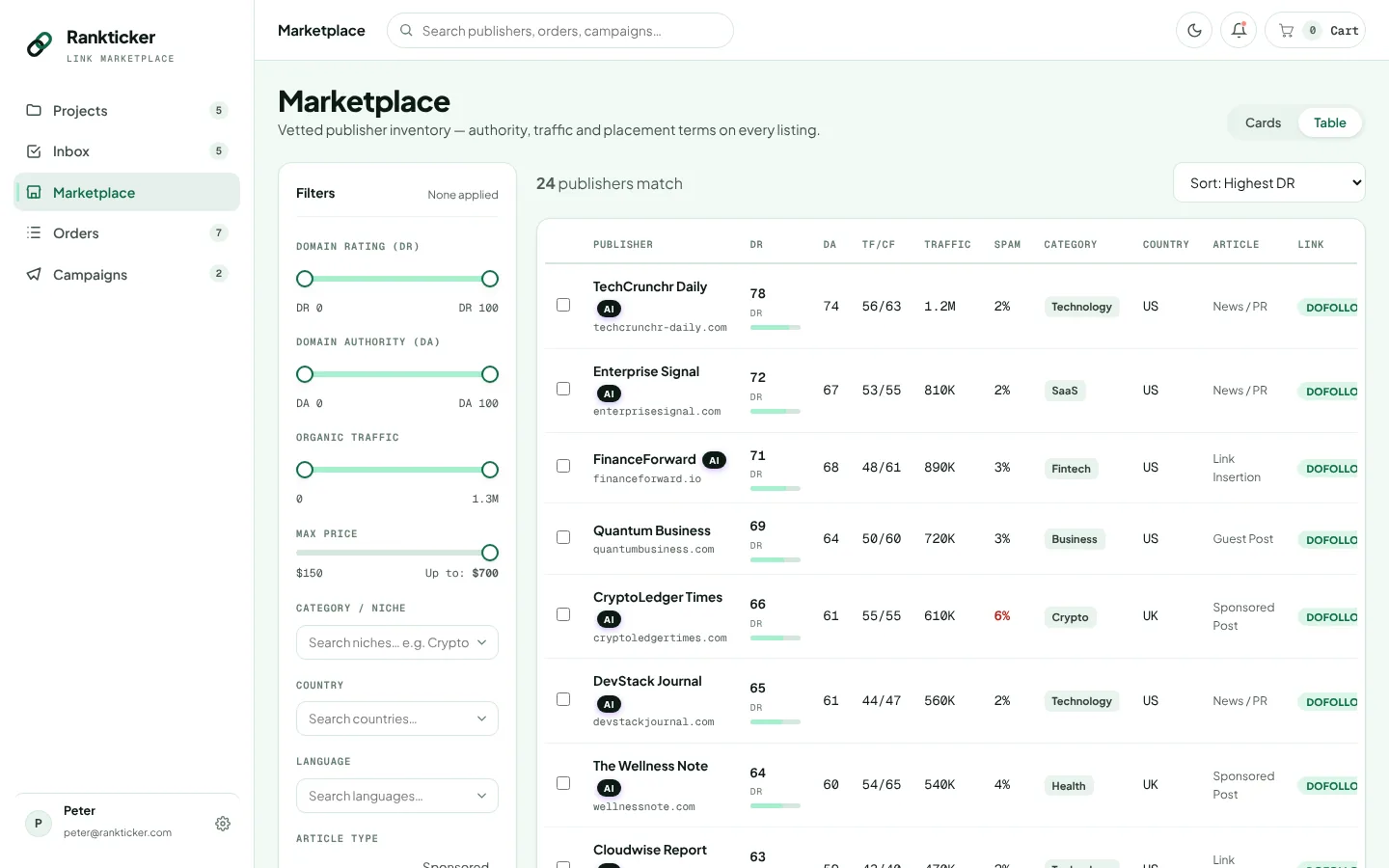
The marketplace lets you filter by category, country and language before you look at DR, so you start from relevant publications. Table view shows DR, DA, TF/CF, organic traffic and spam score side by side, which makes the "high DR, no traffic" pattern obvious at a glance.
Each publisher profile carries risk flags from our vetting, including the TF:CF ratio, traffic trend, sponsored-outbound share and grey-niche outbound links. Those cover most of the checklist above. You still need to read the site; the flags tell you where to look first.
If you run a campaign, recommendations explain why each publisher was picked, for example "DR 69 · strong fintech topical overlap · low spam score", and the SEO Performance tab lists backlink opportunities matched to your project's niche and current gaps (see SEO tracking). We match on topic first. If you work in a regulated vertical, the fintech page shows how that plays out, and our backlink evaluation guide covers the checks that go beyond relevance.
FAQ
Questions about topical relevance vs domain rating
Is Domain Rating a Google metric?
No. Domain Rating is an Ahrefs metric calculated only from backlinks. Google does not use it, and it says nothing about a site's topic or traffic.
Can a low-DR site be a better link than a high-DR site?
Often, yes. A DR 35 site written for your industry, with real organic traffic and editorial standards, usually beats a DR 75 general site that publishes sponsored posts on any subject.
How do I check a site's topical relevance quickly?
Look at the keywords and pages that bring it organic traffic, read its last 20 to 30 posts, check where its outbound links go, and compare Majestic Topical Trust Flow categories with your own niche.
Does topical relevance matter for AI visibility too?
It appears to. AI systems pull sources that match the subject of the question, and Ahrefs found branded web mentions correlated far more strongly with AI Overview visibility than Domain Rating did.
Should I ignore DR completely?
No. Use it as a floor to screen out very weak sites, then decide on relevance, traffic and editorial quality.
Keep reading
Related
How to evaluate a backlink in 2026: the signals that matter
How to evaluate a backlink in 2026: relevance, real traffic, TF:CF, outbound links, indexation, placement, anchor, attribute, permanence and AI citati…
How to spot PBNs, link farms and sponsored post factories: a 2026 checklist
A 2026 checklist for spotting PBNs, link farms and sponsored post factories: traffic patterns, outbound links, footprints, expired domains and TF:CF.
Anchor text strategy in 2026: distribution, types and how to plan anchors per page
Anchor text strategy for 2026: branded, naked URL, partial and exact match anchors, what Penguin and SpamBrain changed, and example mixes for each pag…
Link building for SaaS
Link building for SaaS: which publications move comparison and feature pages, how to set anchors, and how to get cited when buyers ask AI for software…
Fintech backlinks
Fintech backlinks from finance publications that hold up to YMYL scrutiny: formats, FCA promotion rules, anchors and AI visibility for money brands.
See the publishers before you spend a penny
Filter real publications by niche, DR, traffic and price. Every metric and the full price are on the listing.