AI visibility
Link building for AI search: how publications get cited in ChatGPT, Perplexity and AI Overviews
AI engines don't rank your page. They retrieve a handful of sources, read them and write an answer. Your job is to be in the sources they read, and that is mostly a question of which publications mention you.
TL;DR: Each AI engine retrieves sources differently, and most citations no longer come from Google's top 10. Research points to third-party mentions, comparison lists, statistics and quotations as the things that get brands into answers. Pick publications by checking whether they're already cited for your prompts, whether AI crawlers can reach them, and whether your brand will appear in the body text. DR comes after that.
Classic link building asks one question about a publication: will a link from here help my page rank? For AI search the question changes. Will an engine retrieve this page when someone asks about my category, and will my brand be in the text it reads?
Those overlap less than you'd think.
How each engine finds its sources
All the major engines do some version of the same thing. They turn your prompt into one or more search queries, pull back candidate pages, and write an answer from the ones they pick. The differences are in where the candidates come from.
Google AI Overviews and AI Mode
Google's documentation on AI features says AI Overviews and AI Mode may use "query fan-out", issuing multiple related searches across subtopics and data sources. To be a supporting link, a page has to be indexed and eligible to show in Search with a snippet. Google says there are no extra requirements beyond that.
Fan-out changes which pages get cited. In July 2025, Ahrefs found 76% of AI Overview citations came from pages in the top 10. Its March 2026 update, across 863,000 keyword SERPs and 4 million cited URLs, put the figure at about 38%, with roughly 31% of cited URLs not ranking in the top 100 at all. Ahrefs says part of the drop could come from better citation detection on its side, and points to Gemini 3 taking over AI Overviews in January 2026 as a possible cause. Either way, ranking for the head term is no longer the main route in.
ChatGPT
OpenAI's help centre says ChatGPT search typically rewrites a prompt into one or more targeted queries and sends them to search providers it partners with, and it names Microsoft among them. To be eligible, a site has to let OAI-SearchBot crawl it. OpenAI's crawler documentation is direct: sites that opt out of OAI-SearchBot "will not be shown in ChatGPT search answers", except as navigational links.
Ahrefs studied 15,000 long-tail prompts and found that only 12% of URLs cited by ChatGPT, Gemini and Copilot ranked in Google's top 10 for the same prompt. For ChatGPT specifically the overlap was around 8%.
Perplexity
Perplexity runs its own crawler. Its bot documentation says PerplexityBot exists "to surface and link websites in search results on Perplexity" and isn't used to train foundation models. In the same Ahrefs study, Perplexity had the closest match with Google: 28.6% of its citations were in Google's top 10.
Gemini and Copilot
Less public detail here. Ahrefs found Copilot had the highest overlap with Bing's results, which fits with Microsoft's search stack. For planning purposes we treat Gemini as close to Google and Copilot as close to Bing, and we check rather than assume.
| Engine | Where candidates come from | Crawler access to check | What it means for publication choice |
|---|---|---|---|
| Google AI Overviews / AI Mode | Google index, with query fan-out | Googlebot; page must be indexed and snippet-eligible | Publications that rank for subtopics around your category, not only the head term |
| ChatGPT search | Partner search providers, including Microsoft | OAI-SearchBot allowed in robots.txt | Sites that block OAI-SearchBot won't be cited in search answers |
| Perplexity | Its own index | PerplexityBot | Closest to Google rankings of the assistants Ahrefs measured |
| Copilot | Bing, judging by Ahrefs' overlap data | Bingbot | Bing visibility of the publication matters |
What the research says about cited sources
Four findings shape how we pick publications.
AI engines lean hard on third-party sources. A September 2025 paper by Mahe Chen, Nick Koudas and colleagues, Generative Engine Optimization: How to Dominate AI Search, found "a systematic and overwhelming bias towards Earned media" over brand-owned and social content, in contrast to Google's more balanced mix. Your own blog is the weakest place to make your case.
Comparison lists dominate commercial prompts. Glen Allsopp at Ahrefs analysed ChatGPT's sources for 750 top-of-funnel prompts about software, products and agencies, and found "best X" lists made up 43.8% of cited page types. Brands placed higher on those lists were more likely to be recommended. 79.1% of the cited lists had been updated in 2025, so freshness counts. One uncomfortable detail: 35% of the cited lists sat on low-authority domains, many of them questionable. Ahrefs expects that to shrink, and so do we.
A lot of what gets cited is out of reach. Ahrefs' look at ChatGPT's 1,000 most-cited pages found Wikipedia alone was 29.7% of them and homepages 23.8%. Only 32.3% were pages a marketer could realistically pitch or influence. News and media pages were 5.2%. The influenceable slice is small, which is the argument for being precise about which publications you buy from.
Content format affects whether a source gets used. The original GEO paper by Aggarwal and colleagues, presented at KDD 2024, tested rewriting methods on its GEO-bench dataset. Adding quotations lifted visibility by about 41% on its position-adjusted word count measure, and adding statistics by about 31%. Keyword stuffing scored below the baseline. Those are lab results on a test engine, so treat the percentages loosely. The direction makes sense, though: specific numbers and named sources are easy for an engine to lift into an answer.
Brand mentions vs links
For AI answers the mention does more of the work than the link. Ahrefs' study of 75,000 brands measured how different factors correlate with being mentioned in AI Overviews:
| Factor | Spearman correlation with AI Overview brand mentions |
|---|---|
| Branded web mentions | 0.664 |
| Branded anchors | 0.527 |
| Branded search volume | 0.392 |
| Domain Rating | 0.326 |
| Referring domains | 0.295 |
| Number of backlinks | 0.218 |
Correlation isn't cause, and big brands win on every row. Still, the order is telling. Being talked about by name, across many sites, tracks AI visibility much more closely than piling up links. Branded anchors come second, which is a nice side effect of good anchor practice anyway.
Three practical consequences. The brand name has to be in the body text near the link, described in words an engine can reuse ("Rankticker, a link building marketplace" beats a bare anchor). The link attribute matters much less here: an engine reading the page sees the mention whether the link is followed, nofollow or sponsored. And unlinked mentions count. More on that in how brand mentions get into AI answers.
How to pick publications for AI visibility
- Write 30 to 50 prompts your buyers actually use. Mix category questions ("best payroll software for small UK firms"), comparisons and problem questions. Leave out your brand name.
- Run each prompt several times on each engine. AI answers vary a lot from run to run; SparkToro's research found less than a 1 in 100 chance of getting the same brand list twice. One run tells you very little.
- Record every cited domain and URL. Count how often each domain appears across runs and engines.
- Check access. Is the site indexed in Google and Bing? Does its robots.txt allow OAI-SearchBot and PerplexityBot? A publication that blocks them can still be good for Google, but it won't feed those assistants.
- Look at the cited pages themselves. Comparison lists, data roundups, expert explainers? That tells you which format to buy: an insertion into an existing list, a new data-led article or an expert contribution.
- Then apply the usual quality checks from our backlink evaluation guide. A cited site that sells to every casino affiliate is still a bad neighbour.
- The publication is cited for prompts in your category, on more than one engine
- Recent articles are indexed, and AI crawlers aren't blocked
- Your brand name appears in the body copy, with a one-line description
- The article includes specific numbers, named sources or a quote from someone at your company
- For list content, the publisher updates it and you know where you'll sit
- The page will stay live and unchanged; monitor it
What to put in the brief
Once you've chosen the publication, the article itself decides whether an engine has anything useful to lift. We'd write the brief around the things the research rewards, and keep it short enough that a busy editor reads it.
Give the writer one or two numbers they can cite, with the source. Your own data is best if you have it: a survey, a benchmark from your product, a price index. Third-party data works too, as long as it's linked. Then give them a quote from a named person at your company, with a job title, saying something a competitor wouldn't. "We think most payroll errors in small firms come from holiday pay on irregular hours" is quotable. "We're passionate about helping businesses" isn't.
Describe your brand the same way every time. If one article calls you a "link building platform", another a "backlink marketplace" and a third an "SEO agency", an engine has three weak associations instead of one strong one. Pick the category phrase you want to own and use it in the brief, the anchor plan and your own site.
Ask where the article will sit and how it gets found. A piece buried four clicks deep with no internal links may get indexed slowly or not at all. A piece linked from the publication's category hub and a related evergreen guide will probably be crawled within days, and it has a better chance of turning up in the sub-queries that fan-out generates.
Last, ask the editor whether they update content. For list articles this is the whole game. A "best tools" list refreshed every quarter keeps getting cited; one frozen in 2024 slowly drops out.
What doesn't carry over from classic link building
DR as the main filter. A DR 85 news site that never appears for your prompts does less for AI visibility than a DR 50 trade publication that turns up in every second answer.
Exact-match anchors. They add policy risk and do nothing for an engine that reads the sentence around the link.
Volume for its own sake. Twenty placements on sites that AI engines ignore move nothing on the AI side. Five on sites they cite can. Our format comparison covers which placement types tend to get picked up, and measuring link building ROI covers how to track share of voice without fooling yourself.
How to do this in Rankticker
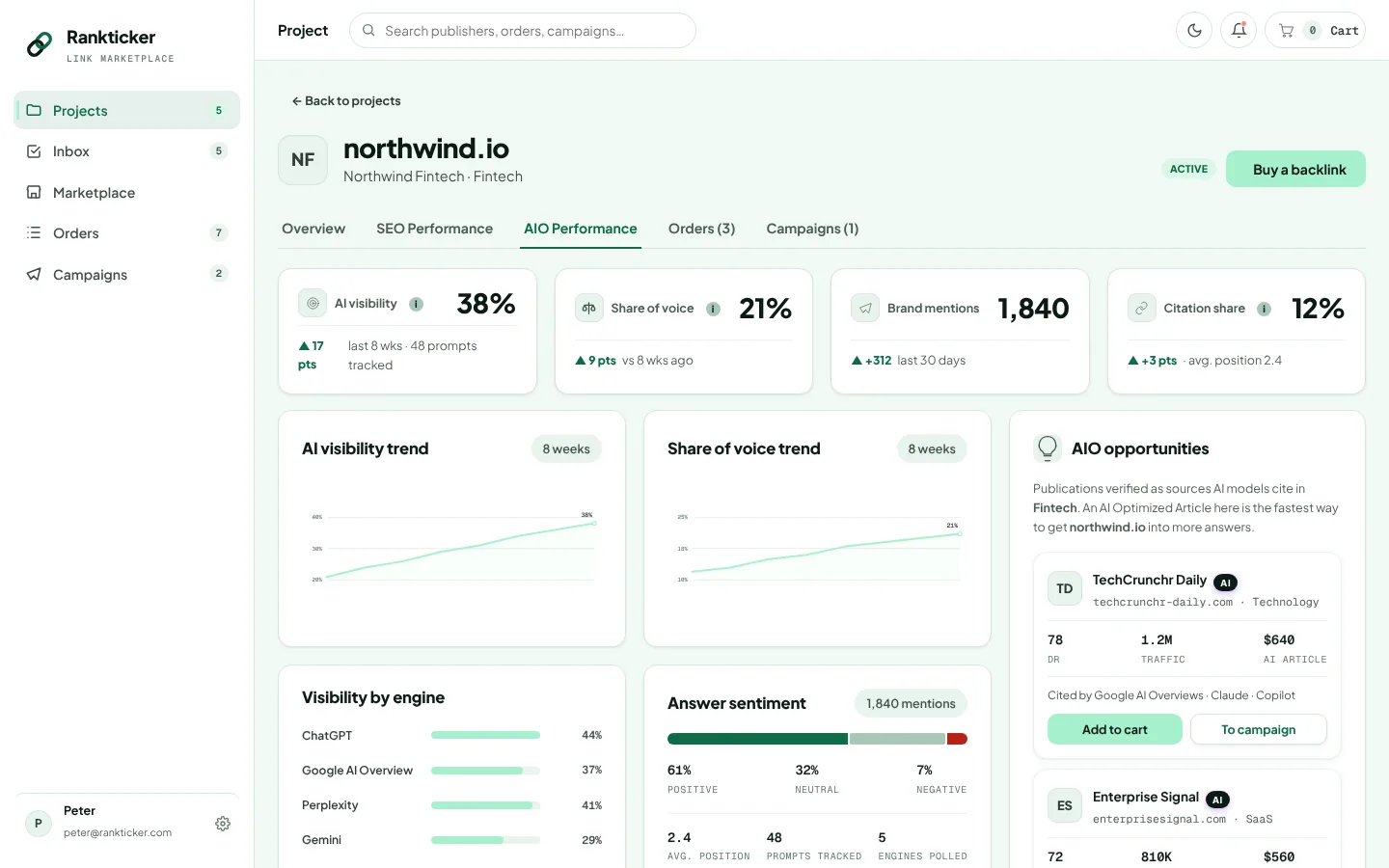
Listings marked AI in the marketplace are publications we've verified as sources that ChatGPT, Google AI Overviews, Perplexity, Gemini, Copilot or Claude cite. In each project, the AIO Performance tab tracks your AI visibility, share of voice, brand mentions and citation share by engine, plus answer sentiment for the prompts you track. Its AIO opportunities list shows publications cited in your niche that you can buy from directly.
If you'd rather not pick by hand, set up a campaign with the objective "improve AI visibility" and a monthly budget, and approve or decline each recommendation. The AI visibility page explains how the tracking works.
FAQ
Questions about link building for AI search
Do backlinks help with AI search visibility?
Indirectly. Ahrefs found branded web mentions correlate with AI Overview brand visibility far more strongly than backlink counts (0.664 vs 0.218). Links on cited publications help because they come with a mention in text that AI engines retrieve.
Do AI engines only cite pages that rank in Google's top 10?
No. Ahrefs' March 2026 data found about 38% of AI Overview citations come from Google's top 10, and an August 2025 study found only about 12% of URLs cited by ChatGPT, Gemini and Copilot ranked in the top 10 for the same prompt.
Does a nofollow or sponsored link still count for AI visibility?
AI engines read page text, so the brand mention and context are visible whatever the link attribute. Google asks for paid links to be marked sponsored or nofollow, and that doesn't stop the publication from being retrieved and cited.
How do I find which publications AI engines cite in my niche?
Run the prompts your buyers would use across ChatGPT, Perplexity, Gemini and Google AI Overviews, several times each, and record the cited domains and URLs. Publications that recur across runs and engines are your shortlist.
Keep reading
Related
AI visibility you can measure and act on
Track your AI visibility across ChatGPT, AI Overviews, Perplexity and Gemini, see which publications they cite, and place content on those sources.
Brand mentions in AI answers: how to measure them and how to earn them
How brand mentions, entities and unlinked citations shape AI answers in 2026, how to measure share of voice and sentiment, and how to get into cited s…
How to evaluate a backlink in 2026: the signals that matter
How to evaluate a backlink in 2026: relevance, real traffic, TF:CF, outbound links, indexation, placement, anchor, attribute, permanence and AI citati…
Digital PR vs guest posts vs link insertions: which format fits which job
Digital PR vs guest posts vs link insertions: when each format fits, what drives cost, risks, turnaround and AI visibility value, with a comparison ta…
How to measure link building ROI: a framework for SEO and AI visibility
How to measure link building ROI: leading vs lagging indicators, referring domains, rankings, traffic, conversions, AI share of voice and attribution …
Link building for SaaS
Link building for SaaS: which publications move comparison and feature pages, how to set anchors, and how to get cited when buyers ask AI for software…
See the publishers before you spend a penny
Filter real publications by niche, DR, traffic and price. Every metric and the full price are on the listing.