Link evaluation
How to evaluate a backlink in 2026: the signals that matter
DR tells you how strong a site's link graph is. It says nothing about whether a placement will be read, indexed, kept or cited by an AI answer. These are the checks we run before a link goes in the cart.
TL;DR: Judge the page and the publication, not the DR. Check topical fit first, then whether the site has real and stable organic traffic, a sane TF:CF ratio, a modest share of sponsored outbound links and indexed recent posts. Then look at the link itself: where it sits, its anchor, its attribute, how long it will stay live, and whether AI engines already cite that publication for your topics.
Most link buying still starts with a DR filter. It's a fine first cut. Ahrefs itself describes Domain Rating as a purely link-based measure that doesn't account for backlink spam, and says some sellers have found ways to inflate it. So a DR 70 site can be a respected trade title or a domain that sells a link to anyone with a card.
The checks below are the ones that separate those two. They're in the order we run them, because the early ones kill most candidates and save you time on the rest.
Topical relevance comes first
Google's guide to its ranking systems says it has "various systems that understand how pages link to each other as a way to determine what pages are about". Its link documentation puts it more bluntly: Google uses links as a signal for the relevancy of pages. A link from a site about your subject says something about your subject. A link from a general news blog that also covers gardening, crypto and wedding dresses says much less.
Check relevance at three levels:
- The site. What does it rank for? Pull its top organic keywords and read the first 50. If a cybersecurity blog's best traffic comes from casino reviews, the relevance you're paying for has already been sold to someone else.
- The section or category your article will sit in, and whether it gets internal links from the rest of the site.
- The paragraph. A link to a payroll tool inside a paragraph about payroll compliance is relevant. The same link dropped into a "useful resources" list at the bottom isn't, really.
We go deeper on the trade-off in topical relevance vs Domain Rating. Short version: a DR 45 site that lives in your niche usually beats a DR 75 generalist.
Real organic traffic, and which way it's going
Traffic estimates from Ahrefs, Semrush and similar tools are models. They're still the best outside view of whether Google trusts a site. You want three things from them.
First, a number that isn't tiny relative to the site's link profile. Lots of referring domains and very little traffic is a pattern you see on sites built to sell links. Second, the trend over 12 to 24 months. Overlay the curve on Google's ranking update history. A site that fell off a cliff during the August 2025 spam update (26 August to 21 September 2025) or the March 2026 spam update has told you something. A slow, steady decline is less alarming but still worth a question. Third, the geography. A UK fintech buying a link for UK rankings gets less from a site whose readers are mostly in India or the US.
Check the specific page too, if it's a link insertion. Ahrefs found that 96.55% of pages in its index get no traffic from Google. A strong domain can host plenty of pages nobody visits.
TF:CF ratio, and why it beats either number alone
Majestic's glossary defines Citation Flow as a 0 to 100 score that predicts influence from how many sites link to a URL, and Trust Flow as a quality score built from distance to a set of manually reviewed, trusted seed sites. Neither is a Google metric. The relationship between them is still useful.
When Citation Flow is high and Trust Flow is low, the site has lots of links but few that trace back to trusted sources. That's the shape of a profile built on directories, comment spam, PBNs and link swaps. Majestic doesn't publish a cut-off. Our own rule of thumb: we get cautious when TF is below about half of CF, and we look hard at anything below a third. A ratio near 1 isn't proof of quality either. Use it as a filter, then look at the actual referring domains. Our guide to spotting PBNs and link farms covers the manual checks.
Outbound links and sponsored saturation
Google has been specific about this one. When it announced the December 2022 link spam update, it said SpamBrain could "detect both sites buying links, and sites used for the purpose of passing outgoing links". Its spam updates documentation adds that once spammy links are neutralised, the ranking benefit they gave is lost and "cannot be regained".
So the seller's habits become your problem. Look at:
- The ratio of linked-to domains to referring domains. A site that links out to 12,000 domains and is linked from 900 is a distribution channel.
- The share of recent posts that are clearly paid: thin "guest" articles, five commercial links per post, topics that wander far from the site's subject.
- Outbound links into grey niches (casino, payday loans, CBD, adult). A few in the archive is normal for big publishers. A steady stream in the last three months is a sign the site will sell to anyone.
- "Write for us" pages with price lists. Not damning by themselves, but they tell you who else is buying.
Indexation
Google's own documentation on AI features says a page has to be indexed and eligible to be shown with a snippet to be a supporting link in AI Overviews or AI Mode. The same logic applies to the page carrying your link: if Google never indexes it, it can't rank, can't send search traffic and can't be cited.
Search for five or six of the site's most recent article URLs. If posts from the last few weeks are missing, the site has a crawl budget or quality problem. Check whether sponsored posts sit in a separate folder that looks orphaned from the main navigation. That's common on sites that know they sell too much.
Editorial quality and author attribution
Read three recent articles, all the way through. Would an editor in your industry be embarrassed to appear next to them? That test catches more than any metric.
Then look at bylines. Google's guidance on creating helpful content asks whether it's "self-evident to your visitors who authored your content" and whether pages carry a byline where one might be expected. Sites with real, named writers and author pages are run as publications. Sites where every post is by "Admin" or a stock-photo persona are run as inventory.
Where the link sits on the page
A link inside the body copy, near related text, is the placement you want. Links in author bios, "sponsored resources" boxes and footers are worth far less. Google's spam policies list "widely distributed links in the footers or templates of various sites" as link spam, so sitewide placements carry risk as well as little value.
Count the other outbound links in the same article. One link to you plus two citations to a government source and a study looks like writing. Your link plus four other commercial links looks like what it is.
Anchor text
The same spam policy names "optimized anchor text" in guest posts and press releases as an example of link spam. Ask what anchors the publisher allows. Some require branded or naked URL anchors; some let you choose. A publisher that happily accepts any exact-match phrase you send is probably accepting the same from everyone. Plan your anchors per target page; there's a full method in our anchor text strategy guide.
Link attribute
Google's documentation asks site owners to mark paid placements with rel="sponsored", with rel="nofollow" still acceptable. Followed links that were bought to manipulate rankings fall under the link spam policy. We don't pretend otherwise, and we don't call any placement "safe". Our piece on paid links and Google's spam policies sets out the risks in detail.
Decide the attribute before you evaluate the price. A sponsored link on a well-read, relevant title still brings referral visits, a brand mention in context and, often, AI citations. A followed link on a site nobody reads brings close to nothing, whatever its DR.
Permanence
Links disappear. Ahrefs' link rot study found that 66.5% of links to the 2 million sites it sampled had rotted since January 2013. Pew Research found that 23% of news webpages contained at least one broken link. Pages get pruned, sites get redesigned, editors remove links when they audit old content.
Ask for the publisher's stated link lifetime in writing, and what happens if the link disappears. Then don't rely on the promise. Monitor the page: whether it's live, whether your anchor is still there, whether the link still points to your URL without a redirect chain, and whether the attribute has changed.
AI citation status
Nobody ran this check three years ago. We think it now matters about as much as traffic, and probably more for brands in categories where buyers ask an assistant before they ever open a search results page. If ChatGPT, Perplexity or Google's AI Overviews already cite a publication when people ask about your category, a placement there puts your brand into the material those engines retrieve.
The data points that way. In Ahrefs' study of 75,000 brands, branded web mentions correlated with AI Overview visibility at 0.664, while the raw number of backlinks correlated at 0.218. Correlation, not cause, and Ahrefs says so. But it suggests where your brand is mentioned matters more for AI answers than how many links you have. We cover this in link building for AI search and on our AI visibility page.
To check, run the prompts your buyers would use, several times each and across engines, and record which domains get cited. A publication that appears again and again for your prompts is worth more than its metrics suggest.
A scoring sheet you can copy
| Signal | What to check | Good sign | Red flag |
|---|---|---|---|
| Relevance | Site keywords, category, paragraph | Ranks for terms in your niche | Top traffic from unrelated or grey-niche terms |
| Organic traffic | Level, 24-month trend, country split | Stable or growing, right market | Cliff during a spam update |
| TF:CF | Majestic Trust Flow vs Citation Flow | TF at least half of CF | TF under a third of CF |
| Outbound links | Linked domains vs referring domains, sponsored share | Outbound links mostly editorial citations | Most recent posts carry paid links |
| Indexation | Recent URLs in Google | New posts indexed within days | Recent posts missing |
| Editorial quality | Three recent articles, bylines | Named authors with history | "Admin" bylines, spun text |
| Placement | Body vs bio, footer, resource box | In body, near related copy | Sitewide or bio-only |
| Anchor | Publisher anchor policy | Natural anchors, editor reviews them | Any exact-match phrase accepted |
| Attribute | Followed, nofollow, sponsored | Matches your policy and disclosure | Unclear or changes after publication |
| Permanence | Stated lifetime, monitoring | Lifetime in writing, live checks | "12 months" with no follow-up |
| AI citations | Is the site cited for your prompts? | Cited repeatedly across engines | Never cited for anything in your niche |
Before you pay, run through this short list:
- The site ranks for terms in your niche, and the article topic fits your target page
- Organic traffic is real, in your market, and didn't collapse in a recent spam update
- Trust Flow isn't far below Citation Flow
- Most recent posts aren't paid placements
- Recent articles are indexed
- The link goes in the body, with an anchor you'd be comfortable explaining to Google's webspam team
- You've agreed the link attribute and whether paid content is labelled
- You have a way to know if the link disappears
How to run these checks in Rankticker
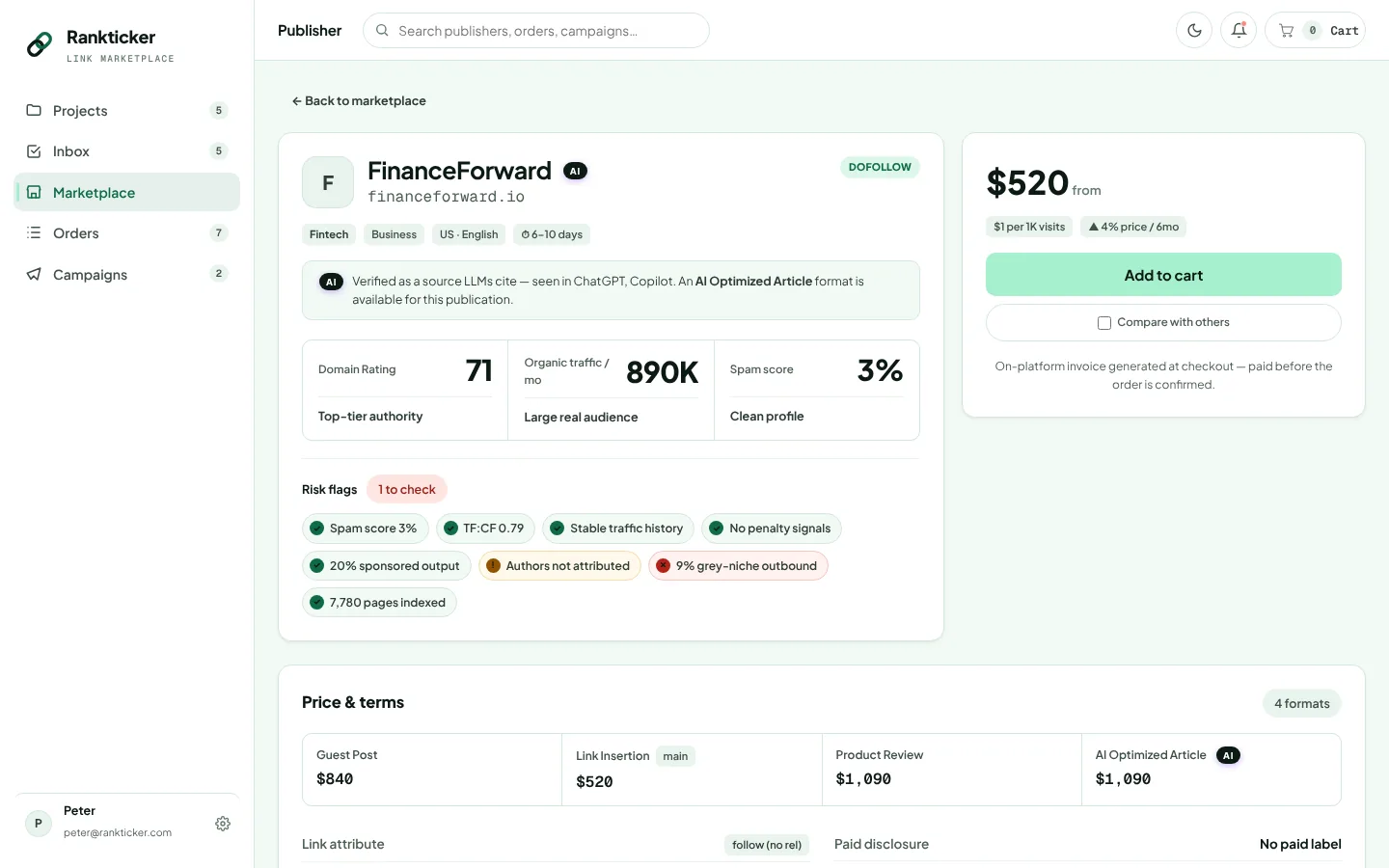
Every publisher in the Rankticker marketplace shows DR, DA, TF/CF, organic traffic and spam score in the listing, and you can filter on each. Open a publisher profile and the risk flags are already there: spam score, TF:CF ratio, traffic trend, share of sponsored outbound links, author attribution, grey-niche outbound links and pages indexed. The same profile lists the terms per format, including link attribute, anchor policy, links per post, link lifetime and whether paid content is labelled. Our vetting standards explain how sites get in.
Publications marked AI are ones we've verified as sources that AI engines cite. After an order goes live, the Live Link Tracker keeps checking that the page is live and indexed, the anchor is present, the link points to your URL and the attribute hasn't changed.
FAQ
Questions about how to evaluate a backlink
What is a good TF:CF ratio for a backlink?
There is no official threshold because Trust Flow and Citation Flow are Majestic metrics, not Google ones. We get cautious when Trust Flow is below roughly half of Citation Flow, because it usually means plenty of links but few from trusted sites.
Is Domain Rating enough to judge a backlink?
No. Ahrefs describes DR as a purely link-based measure that does not account for link spam or traffic. Use it to shortlist, then check relevance, real organic traffic, outbound link patterns and indexation.
Should I avoid nofollow or sponsored links?
Not if the publication is relevant and read. Google asks for paid links to carry rel="sponsored" or rel="nofollow", and those placements can still bring referral traffic, brand mentions and AI citations.
How do I check if a publisher's pages are indexed?
Search Google for a handful of recent article URLs from the site, and look at whether its category and author pages show up. A site where recent posts are missing from the index is a poor place for a link.
Keep reading
Related
Topical relevance vs Domain Rating: what to pay for in 2026
Why topical relevance beats raw Domain Rating when you buy links in 2026, how Google reads link context, and a practical checklist for judging relevan…
How to spot PBNs, link farms and sponsored post factories: a 2026 checklist
A 2026 checklist for spotting PBNs, link farms and sponsored post factories: traffic patterns, outbound links, footprints, expired domains and TF:CF.
Anchor text strategy in 2026: distribution, types and how to plan anchors per page
Anchor text strategy for 2026: branded, naked URL, partial and exact match anchors, what Penguin and SpamBrain changed, and example mixes for each pag…
Link building for AI search: how publications get cited in ChatGPT, Perplexity and AI Overviews
Link building for AI search: how ChatGPT, Perplexity and Google AI Overviews find sources, what citation research shows, and how to pick publications.
Link building for agencies
White label link building for agencies: a project per client, budgets with cost caps, client approvals, link monitoring and reporting data for every a…
See the publishers before you spend a penny
Filter real publications by niche, DR, traffic and price. Every metric and the full price are on the listing.