Link building for startups
A new domain has no authority, a small budget and a team with ten other priorities. The good news: the first links matter most, and they don't have to be expensive if you pick them well. Here's how we'd spend a startup's first link building budget.
Find publishers in this nicheSee how it works
Free links first
Before you spend anything, collect the links that come with being a real company. Each takes an email or a form:
- Investor and accelerator portfolio pages
- Integration and partner directories for every tool you plug into
- Founder bios on podcasts, events and communities you've taken part in
- Launch platforms and the directories your buyers actually browse
- Customers who'll write a short case study
These are mostly branded links to your homepage. That's fine. They tell Google who you are. What they don't do is help your product and use-case pages rank, which is where paid placements come in.
Startup and business publications on Rankticker
Live listings on 30 October 2026, tagged startups, entrepreneurship or small business.
| Segment | Publications | Median starting price |
|---|---|---|
| Startup, entrepreneurship and small business | 8,065 | $95 |
| Same, DR 50+ | 1,239 | $338 |
| Same, based in the United States | 1,649 |
Where we'd spend the first $1,000
Not on one DR 80 placement. On four to six links from mid-authority publications your customers actually read, each pointing at a different page that needs to rank: the main product page, two use-case pages, a comparison page. Add one PR article when you have real news, such as a launch, a round or a customer number, so there's something credible for investors, journalists and AI assistants to find.
Then keep going. A steady few links a month looks natural and compounds. A burst of thirty in one week, followed by nothing, looks like what it is. Our guide to budget and link velocity has the detail.
Anchors on a young domain
Mostly your brand and your URL. A new site with a high share of exact-match commercial anchors is one of the clearest patterns of bought links. Keep descriptive anchors for a minority of placements, and vary them.
Letting a campaign do it
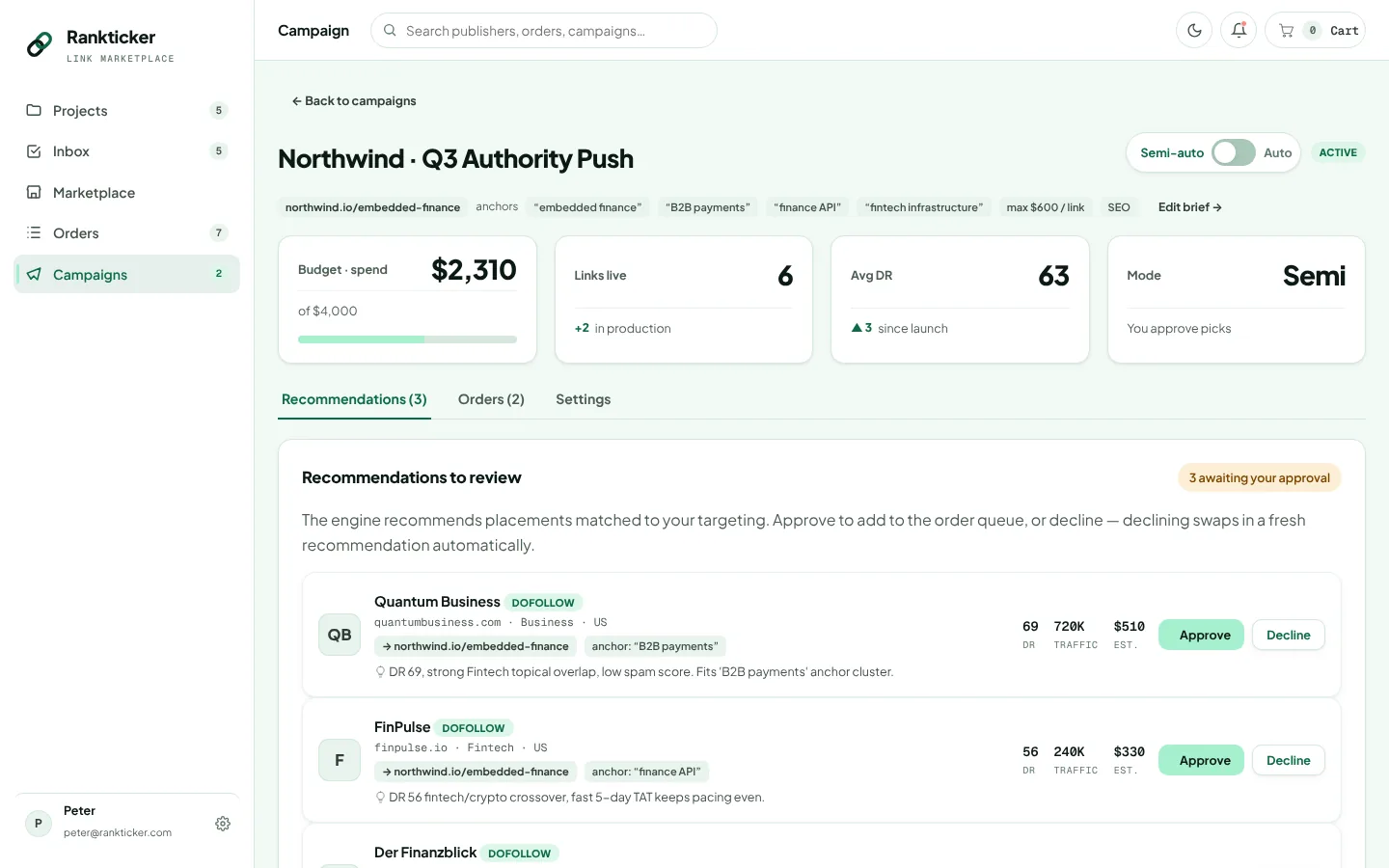
Founders rarely have time to shortlist publishers. A Rankticker campaign takes a monthly budget, a maximum cost per link and your niches, scans your site daily, and recommends the placements with the highest expected impact. Approve each one in semi-auto mode, or let it run. There's no subscription during early access; you pay the publisher's price per placement, plus $65 when our editors write the article.
Building software? Read link building for SaaS and tech guest posts next.
Questions about startup link building
When should a startup start link building?
Once you have pages worth linking to: a clear homepage, product pages and at least one useful piece of content. Before that, links have nowhere useful to point.
How much should a startup spend on links?
Enough to be consistent. A few hundred to a few thousand dollars a month, spread over steady placements, usually beats one big burst. On 30 October 2026 the median starting price for startup and business publications on Rankticker was $95.
What links should a new startup get first?
The free ones that prove you exist: founders' profiles, integration partners, investor portfolio pages, launch platforms and relevant directories. Then paid placements on publications your customers read, pointed at product and use-case pages.
Can link building help a startup appear in AI answers?
It can help. AI assistants cite publications they trust when they recommend products. A mention on a site that ChatGPT or Perplexity already cites gives you a better chance of being named. Listings with an AI badge are verified AI sources.
Related
Link building for SaaS
Link building for SaaS: which publications move comparison and feature pages, how to set anchors, and how to get cited when buyers ask AI for software…
Tech guest posts that developers and buyers read
Tech guest posts on 14,600+ technology, software, AI and cybersecurity publications. Choose by name, check readers and price, then track the link.
PR articles on news sites you can name
Publish PR articles, paid news and press releases on news and industry sites you choose. See each outlet's traffic, price and labelling terms first.
How to budget a monthly link campaign, and what link velocity really means
How to set a monthly link building budget in 2026: sizing the gap, true cost per link, link velocity myths, pacing, max cost rules and auto vs semi-au…
Link building for AI search: how publications get cited in ChatGPT, Perplexity and AI Overviews
Link building for AI search: how ChatGPT, Perplexity and Google AI Overviews find sources, what citation research shows, and how to pick publications.
Campaigns
Rankticker product tour
See the publishers before you spend a penny
Filter real publications by niche, DR, traffic and price. Every metric and the full price are on the listing.