Campaign planning
How to budget a monthly link campaign, and what link velocity really means
Most link budgets start with a number someone picked and work backwards. Start from the gap you need to close, price it honestly, and pace it by what you can vet.
TL;DR: Size the budget from the gap in relevant referring domains between your page and the pages that rank. Price it on the true cost of each link that stays live and indexed, which is higher than the sticker price. Ignore "link velocity" as a metric; Google says it isn't one. Pace by how many placements you can vet and brief well, and cap what you'll pay per tier of relevance and traffic.
A typical brief says "we have £2,000 a month for links". Then someone works out how many links that buys, and the campaign becomes a race to fill the quota. It's backwards. The budget should come out of the plan, and the plan should come out of the gap.
Start from the gap, not the number
Pick the pages you want to move. For each one, look at the pages ranking in the top five for its main terms and count their referring domains. Then cut that count down to the ones that are relevant, editorial and getting traffic. Raw referring domain counts include a lot of scraper sites and directory junk, and you're not trying to match those.
Here is an illustrative example, not a benchmark. A comparison page has 12 relevant referring domains. The pages above it have between 35 and 55. Call the gap 30. Spread over nine months, that's three or four placements a month for that page. Do the same for your other priority pages and add them up.
Two adjustments. Your own content may be the real problem; links won't drag a thin page past a better one, so fix the page first. And if AI visibility is part of the goal, add a second list: the publications that engines cite for your prompts. Those are worth budgeting for separately, whatever their DR. We explain how to build that list in brand mentions in AI answers.
What links cost in 2026
Public price data is thin and skewed to the US. The most useful recent set we know of is BuzzStream's analysis of its vendor database of more than 500,000 guest post sites (BuzzStream, link building pricing). The figures are in US dollars.
| Format | BuzzStream figure (USD) | What you get | Best used for |
|---|---|---|---|
| Guest post, bought direct from the site | $295 average | New article, your link in context | Relevant niche publications |
| Guest post, through a vendor | $461 average | Same, with sourcing and often writing | Scale, when you can't source yourself |
| Link insertion | $179 average | Your link added to an existing, indexed article | Pages that already rank for adjacent terms |
| Digital PR | $1,250 to $1,500 per unique link, excluding syndication | Editorial coverage from a campaign | Authority, brand mentions, AI citations |
Averages hide a lot. A relevant UK trade title with real readers will cost a multiple of a generic blog with the same DR, and it should. Which format to buy depends on the page and the goal more than on the average price.
Cost per link is the wrong denominator
The sticker price counts every order. It should count only the links still doing their job. We work with a true cost per link:
true cost per link = (placement fees + content + revisions + your team's time) ÷ links live, indexed and unchanged after six months
Some placements never go live. Some go live and drop out of the index. Some get edited, redirected or turned nofollow without notice. If one in five of a cheap vendor's links fails over six months, a £120 link really costs £150 before you count the time spent chasing. Run the numbers on your own history; the failure rate differs a lot between suppliers, and it's usually the cheap ones that fail. Our guide to measuring link building ROI takes this further, into rankings and revenue.
Putting a monthly number on it
Once you have the gap and a realistic cost per link, the monthly figure mostly writes itself. Say the gap analysis calls for ten placements a month across three priority pages. Price them at your true cost per link for the tiers you expect to buy (more on tiers below), add content if publishers don't write it, and you have the core budget.
Then split it. We'd usually put the large majority into placements that serve the ranking plan, a separate slice into publications cited by AI engines in your niche, and hold back 10 to 20% as a reserve. The reserve matters more than it sounds. Good opportunities don't arrive on a schedule: a strong trade title opens a slot, a journalist wants a comment, a competitor's citation source starts taking contributed pieces. Without a reserve you either miss them or blow next month's plan.
What if the number you get is far above what the business will spend? Then cut scope, not quality. Drop to one or two priority pages and close those gaps properly. Ten cheap links spread across eight pages will move none of them; four good links on one page might move it. The same logic applies to agencies quoting clients. A small budget is fine if the page list shrinks to match it.
Link velocity: myths and what's real
"Don't build links too fast or Google will penalise you" is one of the most repeated rules in SEO. There is very little behind it.
Where the idea came from
Google's 2003 patent application "Information retrieval based on historical data" says a "spiky rate of growth in the number of back links" may be a factor in scoring documents, and that it can signal an attempt to spam. That patent is the root of most velocity talk. A patent shows what Google's engineers considered in 2003. It doesn't show what runs today.
What Google has said since
Search Engine Journal's review of the claim found no evidence that Google uses a signal called link velocity. It quotes John Mueller saying "it's not so much a matter of how many links you get in which time period", and reports Gary Illyes calling link velocity a "made-up term". In April 2024 Illyes went further at a conference in Bulgaria: "We need very few links to rank pages… Over the years we've made links less important." He later said he shouldn't have said it, which is probably the most honest thing anyone at Google has said about links.
What's real
Speed itself isn't the problem. What a burst usually contains is. Twenty paid posts in a fortnight, on unrelated sites, with exact-match anchors, looks like exactly what it is, and Google's link systems are built to spot link schemes whatever pace they arrive at. A news story that earns 40 links in a week looks like news.
Practitioners still prefer steady growth. In Whitespark's 2026 Local Search Ranking Factors survey of 47 contributors, "sustained influx of links over time (rather than bursts)" ranked 34th for local organic results. Quality and authority of inbound links ranked 3rd (Whitespark). That is expert opinion rather than Google data. The order still looks right to us: what you get matters far more than how fast.
Pacing a monthly campaign
The real limit on pace is your ability to vet publishers, write decent briefs and review content. A campaign that buys 30 links a month with a team that can only review ten properly will end up with 20 links nobody checked.
| Phase | Months | Focus | Anchors |
|---|---|---|---|
| Calibrate | 1 to 2 | Fewer, highly relevant placements; test suppliers; set your cost baseline | Mostly brand and URL |
| Build | 3 to 6 | Steady monthly volume to priority pages and their clusters | Brand, partial-match, descriptive |
| Extend | 7 onwards | New clusters, AI-cited publications, digital PR | Mixed, with exact match kept rare |
A few rules we'd hold to:
- Keep a steady monthly spend rather than spending a quarter's budget in one week.
- Spread placements across publishers. One link per publisher per quarter is a good default, unless a site is unusually strong and relevant.
- Keep exact-match anchors rare. The anchor text guide has the ratios we use.
- Point most links at pages that deserve them: the hub and its best supporting pages, not whichever page is closest to converting.
- Review results monthly, but judge them over a quarter at least.
Max cost per link rules
A ceiling stops a campaign paying a premium for DR alone. Tier it by what you actually value, then set a cap per tier. The caps below are placeholders. Set yours from your own cost history.
| Tier | Criteria | Cap |
|---|---|---|
| A | Core topical match, real organic traffic, cited by AI engines in your niche | Highest cap; worth waiting for |
| B | Core or adjacent topic, real traffic, clean risk flags | Standard cap |
| C | Adjacent topic, modest traffic, otherwise clean | Low cap; fill gaps only |
| None | Off-topic, high DR, little traffic | Don't buy at any price |
See topical relevance vs Domain Rating for how we judge the criteria.
Auto vs semi-auto
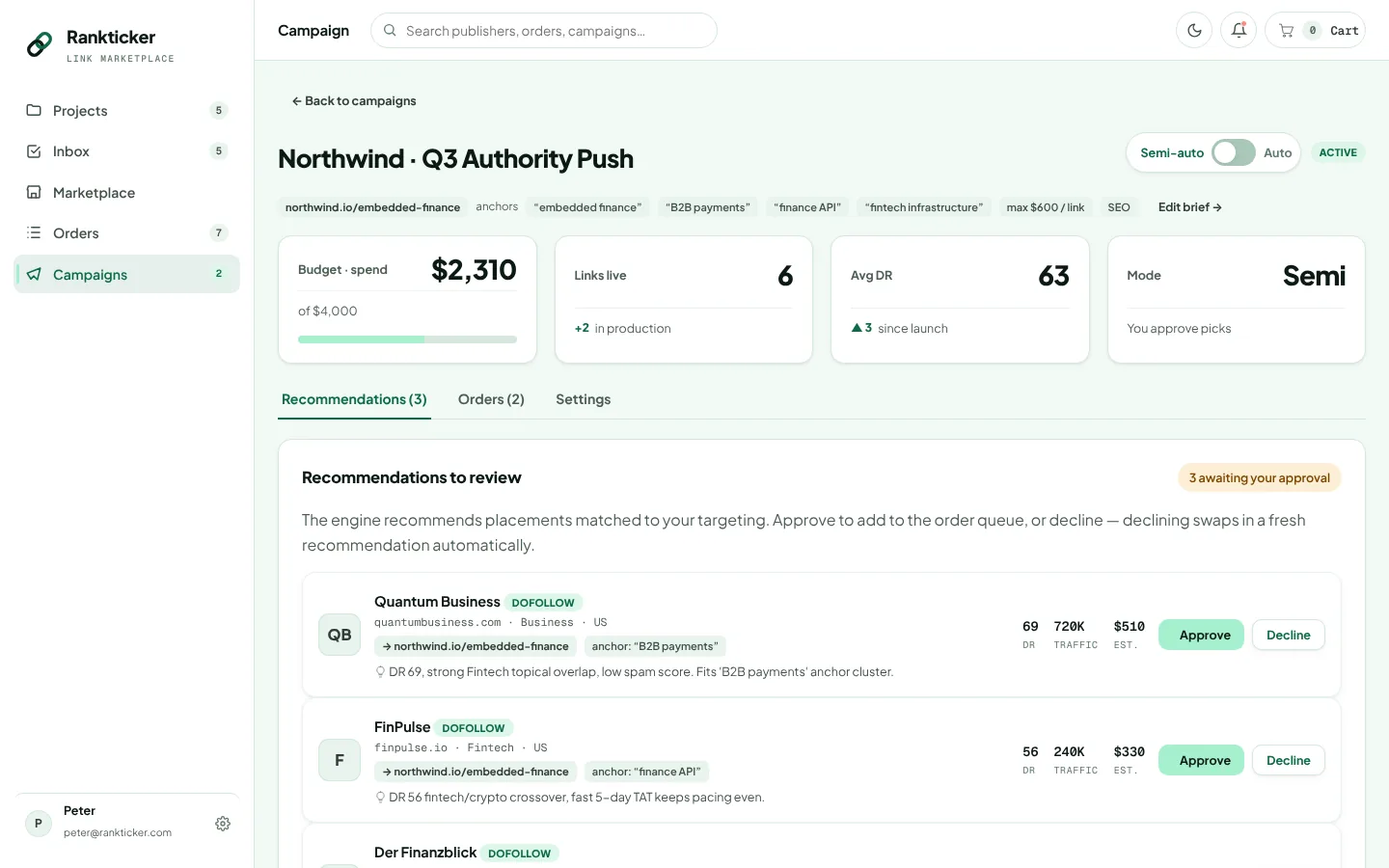
Once the rules are written, you can let a system place within them or review each recommendation yourself. We'd start almost everyone on review.
| Semi-auto | Auto | |
|---|---|---|
| How it works | The system recommends placements; you approve or decline each one | The system places links each cycle within your rules |
| Good for | First months, regulated niches (finance, health, legal), brand-sensitive anchors | Established campaigns where you'd approve nearly every recommendation anyway |
| Risk | Slower; approvals pile up if nobody owns them | Rules that are too loose spend money on weak placements |
| Switch when | You've approved most recommendations unedited for two or three cycles | Back to semi-auto when results or targets change |
Agencies running many clients tend to mix the two: auto for mature accounts with tight rules, semi-auto for new and regulated ones. The agencies page covers that set-up.
Doing this in Rankticker
Campaigns take the plan above as settings: a monthly budget, an objective (improve backlink profile or improve AI visibility), target URLs, anchors, keywords, geo, niche, a max cost per link and a brief. Choose Auto or Semi-auto per campaign. In semi-auto, each recommendation shows why the publisher was picked, such as "DR 69 · strong fintech topical overlap · low spam score", and you approve or decline it.
The project overview tracks spend, live links and pending orders, and the Live Link Tracker on each order keeps checking that the link is live, indexed and unchanged. That gives you the denominator for true cost per link without a spreadsheet. See pricing for how fees work.
FAQ
Questions about link building budget
How much should I spend on link building per month?
Work it out from the gap between your target pages and the pages that rank, counted in relevant referring domains, then price that gap at realistic per-link costs. A fixed percentage of marketing spend tells you nothing about what the site needs.
Is link velocity a Google ranking factor?
There is no evidence Google uses a metric called link velocity. Google's Gary Illyes has called it a made-up term. What does matter is whether a burst of links looks bought, which is about the links themselves rather than their speed.
How many links per month is safe?
No number is safe or unsafe on its own. A steady pace you can vet properly, with natural anchors on relevant sites, matters far more than the count.
What is a max cost per link rule?
A ceiling you set per placement, usually tiered by relevance and real traffic, so a campaign never pays a premium for a high DR alone.
Should I run a campaign on auto or semi-auto?
Use semi-auto while you calibrate, and in regulated or brand-sensitive niches. Switch to auto once the rules produce recommendations you'd approve without edits.
Keep reading
Related
How to measure link building ROI: a framework for SEO and AI visibility
How to measure link building ROI: leading vs lagging indicators, referring domains, rankings, traffic, conversions, AI share of voice and attribution …
Anchor text strategy in 2026: distribution, types and how to plan anchors per page
Anchor text strategy for 2026: branded, naked URL, partial and exact match anchors, what Penguin and SpamBrain changed, and example mixes for each pag…
Topical relevance vs Domain Rating: what to pay for in 2026
Why topical relevance beats raw Domain Rating when you buy links in 2026, how Google reads link context, and a practical checklist for judging relevan…
How pricing works
How Rankticker pricing works and what drives backlink prices: fixed prices per format, no subscription in early access, optional extras and campaign b…
Link building for agencies
White label link building for agencies: a project per client, budgets with cost caps, client approvals, link monitoring and reporting data for every a…
See the publishers before you spend a penny
Filter real publications by niche, DR, traffic and price. Every metric and the full price are on the listing.