Anchor text
Anchor text strategy in 2026: distribution, types and how to plan anchors per page
Anchor text still tells Google and readers what a page is about. It's also the easiest pattern for a spam system to spot. Plan it per target page, from the page outward, and keep the exact-match share small.
TL;DR: Branded, naked URL and descriptive anchors should make up most of any profile. Partial match does the topical work. Exact match is a small seasoning on commercial pages, never the default. Plan anchors per target page, start from the profile you already have, and compare with what ranks. Branded anchors have a second benefit in 2026: they correlate strongly with AI Overview visibility.
Anchor text has a strange reputation. Ten years ago it was the lever. Then it was the thing that got sites hit. Now it's mostly treated as a ratio to stay inside. We think that framing misses the point. An anchor is a short description of the page it points to, written by someone else, and the job is to make those descriptions accurate and varied.
The anchor types
Using Rankticker as the example brand, with a target page about link building for SaaS companies:
| Type | Example | What it signals | Risk |
|---|---|---|---|
| Branded | Rankticker | Entity, brand association | Very low |
| Branded + descriptor | Rankticker's SaaS link building service | Brand and topic together | Low |
| Naked URL | rankticker.com/use-cases/saas/ | Little topic signal; looks natural | Very low |
| Generic | this guide, here | Almost nothing | Low, but wasted |
| Descriptive / long-tail | how SaaS teams buy placements on trade publications | Topic, in natural language | Low |
| Partial match | link building for SaaS startups | Topic plus a variation of the target term | Moderate in volume |
| Exact match | SaaS link building | The target query itself | High in volume |
| Image | Alt text of a linked logo or chart | Whatever the alt text says | Low |
What Penguin taught, and what changed after it
Google launched the webspam update that became known as Penguin on 24 April 2012. Its announcement said it affected about 3.1% of English queries noticeably and named link schemes alongside keyword stuffing. Sites built on thousands of exact-match anchors fell overnight, and the industry learned to fear the ratio.
In September 2016 Google made Penguin part of its core algorithm. It said the system now "devalues spam by adjusting ranking based on spam signals, rather than affecting ranking of the whole site". In December 2022 it added that SpamBrain could neutralise unnatural links, and that any credit passed by them is lost.
So the typical outcome of an over-optimised profile today is quieter. The links just stop counting, and you've paid for nothing. Manual actions haven't gone away, though. Google's manual actions report still lists "unnatural links to your site", and its spam policies name "optimized anchor text" in guest posts and press releases as an example of link spam.
Google's guidance for anchors on your own site applies to anyone writing them. Its link best practices ask for anchor text that is "descriptive, reasonably concise, and relevant", warn against cramming in every related keyword, and suggest reading the anchor out of context to see if it still makes sense.
What the data says
The best public study is old but still useful. Ahrefs looked at 384,614 pages ranking for 19,840 keywords and measured how anchor types correlated with position. Exact-match anchors had a median correlation of about 0.19, partial and phrase match about 0.14, random anchors effectively zero. Joshua Hardwick, who wrote it, concluded anchor text played a "rather insignificant role" in rankings by 2019. Weak, positive and probably confounded by everything else a well-linked page has. That's roughly our view too.
The newer number is more interesting. In Ahrefs' 2025 study of 75,000 brands, branded anchors had a 0.527 correlation with AI Overview brand mentions, second only to branded web mentions at 0.664. For comparison, the number of backlinks was 0.218. Branded anchors used to be the boring filler that kept your ratios safe. They now look like one of the better predictors of whether AI answers mention you. We cover the AI side in link building for AI search.
Plan anchors from the page outward
Most anchor plans are written at domain level: 40% branded, 20% naked, and so on. That's the wrong unit. Google ranks pages, and a homepage with 300 branded links tells you nothing about whether your pricing page has 12 exact-match anchors pointing at it.
- Export the current anchors for each target page. Search Console's Links report shows top linking text, but it's a sample capped at 1,000 rows per table, so a third-party index helps.
- Classify them into the types above.
- Look at the three to five pages that rank above you for the target query. Classify their anchors the same way. That's your reality check, and it varies a lot by niche.
- Set a mix for the next quarter's new links to that page, from the table below, adjusted toward what the ranking pages show.
- Write each anchor to fit its article. Assign the type, not the exact phrase, and let the writer find wording that reads naturally.
Example mixes by page type
These are starting points for new links over a quarter, not targets for the whole profile. Adjust them toward the pages that already rank in your niche.
| Page type | Branded / branded + descriptor | Naked URL | Descriptive / long-tail | Partial match | Exact match | Generic |
|---|---|---|---|---|---|---|
| Homepage | 60–70% | 15–20% | 5–10% | 0–5% | 0% | 5% |
| Product or service page | 30–40% | 10–15% | 20–25% | 15–20% | 0–5% | 5% |
| Ecommerce category page | 25–35% | 10% | 20–25% | 20–25% | 0–5% | 5–10% |
| Blog guide or resource | 15–20% | 5–10% | 40–50% | 20–25% | 0–5% | 5% |
| Data study or report | 30–40% (often "a study by Brand") | 10% | 40–50% | 5–10% | 0% | 5% |
| Local service page | 40–50% (brand + town) | 10–15% | 15–20% | 15–20% | 0–5% | 5% |
A few notes on the table. The homepage gets no exact match because it rarely needs one; its relevance comes from the brand. Guides take mostly descriptive anchors because that's how editors link to them in real life ("this breakdown of UK payroll deadlines"). Data studies earn anchors like "according to a 2026 survey by [your brand]", which are branded and descriptive at once. For category pages in ecommerce, partial match does most of the work, and anchors that name the product type ("waterproof walking boots for women") read naturally.
Velocity matters as much as the mix. Ten exact-match anchors spread over a year read differently to ten in a fortnight. We cover pacing in link building budget and velocity.
Write the sentence, then the anchor
The best anchors come from the sentence around them. If the paragraph is about how fintech start-ups pass FCA financial promotions checks, a link on "financial promotions rules for start-ups" is accurate and specific. Forcing "fintech marketing agency" into the same paragraph is obvious to anyone reading it, and probably to a classifier too.
The surrounding text is also what AI engines read. Ahrefs found surrounding keywords had no measurable ranking effect in its 2019 study, so don't stuff the paragraph either. But for AI answers, a sentence that names your brand and says what you do ("Rankticker, a marketplace for buying placements on vetted publications") is reusable in a way a bare anchor isn't.
Anchors by placement format
The format limits what's believable. In a guest post or sponsored article you usually get one or two links, and the editor will often reject a commercial anchor in the body. Branded or descriptive anchors get through review faster and read better. In a link insertion, the anchor has to fit a paragraph someone else wrote months ago, so partial match and descriptive phrases drawn from that paragraph work best. Digital PR coverage mostly arrives branded or as a naked URL, because journalists cite companies, not keywords, which makes PR the easiest way to keep a profile's branded share high. Product reviews tend to link the product name, which is branded by definition.
That's why the mix and the format plan should be made together. If a quarter is mostly insertions into existing guides, you'll have more partial match than you think. If it's mostly PR, you can afford a couple of sharper anchors elsewhere.
Fixing a profile that's already over-optimised
Where do you start if a page already has a third of its anchors as exact match? Not with the disavow tool, usually. Google's own disavow documentation says most sites won't need it, and recommends it only when you have a considerable number of spammy or artificial links and they have caused, or likely will cause, a manual action. Disavowing your best links because their anchors look keyword-heavy can do more harm than the anchors did.
The steps we'd take, in order:
- Check Search Console for a manual action. If there's one, follow the reconsideration process: remove what you can, disavow what you can't, document both.
- If there's no manual action, ask the publishers you have a relationship with to change the anchor to branded or descriptive text. Most editors will, especially on paid placements.
- Shift new links toward branded and descriptive anchors for that page for a quarter or two.
- Watch the page's rankings for its main terms and for long-tail variants. We'd look at the long tail first; it usually reacts before the head term does, if anything reacts at all.
Common mistakes
- Sending the same keyword-rich anchor to every publisher in a campaign. Google's 2017 warning about large-scale article campaigns named keyword-rich links back to the author's site as a warning sign.
- Planning at domain level while one commercial page quietly collects most of the exact match.
- Anchors that don't match the target page. A "best CRM for estate agents" anchor pointing at a homepage confuses everyone.
- Over-correcting with "click here" and "website". It's safe and nearly useless.
- Forgetting anchors you already have. Old directory links and footer credits count toward the profile.
- Choosing a publisher that accepts any anchor you send. That's a signal about everyone else's anchors on the same site, which we cover in our backlink evaluation guide.
One more. If your paid placements carry rel="sponsored" or rel="nofollow", as Google's policy asks, anchor risk drops, but anchor quality still matters for readers, referral clicks and AI engines. Write them as carefully.
Planning anchors in Rankticker
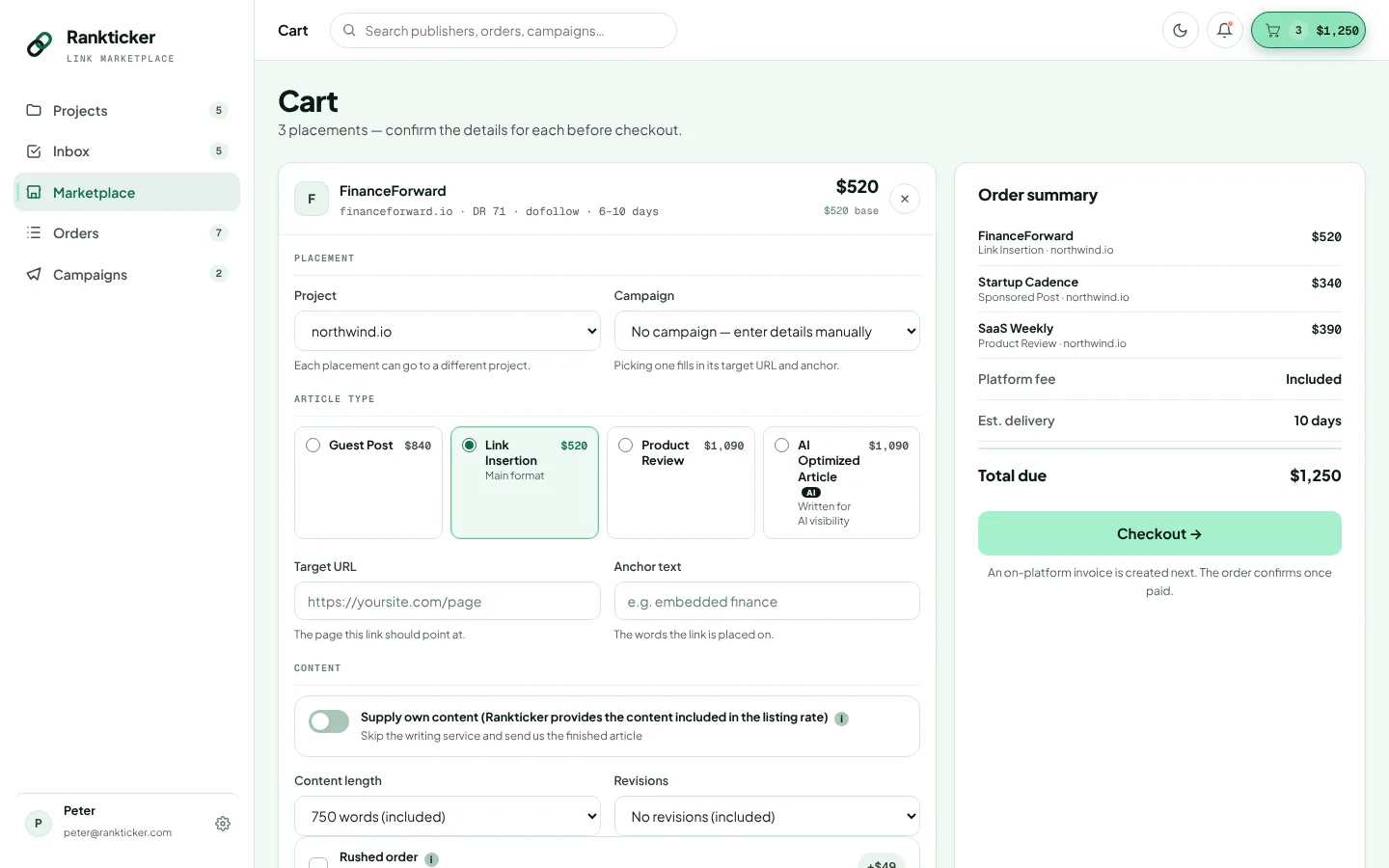
Each placement in the cart has its own target URL and anchor text, set per project, so you can apply a page-level plan as you order. Publisher profiles show each site's anchor policy before you buy. In a campaign, you list the target URLs and the anchors you're happy to use, and recommendations stay inside those rules. After publication, the Live Link Tracker checks that the anchor is still present and the link still points to your page.
FAQ
Questions about anchor text strategy
What percentage of anchors should be exact match?
Google publishes no ratio. Ahrefs notes that SEO advice usually lands between about 1% and 5%. We plan exact match as a small minority on commercial pages and close to zero on the homepage, and we check it against the pages already ranking for the term.
Are branded anchors good for SEO?
They're the safest anchor type and they help AI visibility. In Ahrefs' study of 75,000 brands, branded anchors had a 0.527 correlation with AI Overview brand mentions, second only to branded web mentions.
Can over-optimised anchor text get a site penalised?
Yes. Google's spam policies list optimised anchor text in guest posts and press releases as link spam. Since Penguin became part of the core algorithm in 2016 the usual result is that the links are devalued, but manual actions for unnatural links still exist.
Should I use the same anchor on every guest post?
No. Repeating one keyword-rich anchor across many sites is the pattern Google's 2017 guidance on large-scale article campaigns warned about. Vary anchors and write them to fit each article.
Keep reading
Related
How to evaluate a backlink in 2026: the signals that matter
How to evaluate a backlink in 2026: relevance, real traffic, TF:CF, outbound links, indexation, placement, anchor, attribute, permanence and AI citati…
Paid links and Google's spam policies: what buyers need to know in 2026
Paid links and Google's spam policies in 2026: the link spam text, rel="sponsored", manual actions, SpamBrain, site reputation policy and UK ASA discl…
How to budget a monthly link campaign, and what link velocity really means
How to set a monthly link building budget in 2026: sizing the gap, true cost per link, link velocity myths, pacing, max cost rules and auto vs semi-au…
Topical relevance vs Domain Rating: what to pay for in 2026
Why topical relevance beats raw Domain Rating when you buy links in 2026, how Google reads link context, and a practical checklist for judging relevan…
Ecommerce link building
Ecommerce link building that reaches category pages: product reviews, gift guides, seasonal timing, anchors and AI shopping prompts, plus an example c…
Link building glossary
Link building glossary with 58 SEO backlink terms defined for practitioners, from anchor text and DR to TF:CF ratio, rel="sponsored", GEO and AI citat…
See the publishers before you spend a penny
Filter real publications by niche, DR, traffic and price. Every metric and the full price are on the listing.