Measurement
How to measure link building ROI: a framework for SEO and AI visibility
Link building is slow, noisy and partly invisible in analytics. That doesn't make it unmeasurable. It means you need leading indicators you can check monthly, lagging ones you judge quarterly, and honest caveats about attribution.
TL;DR: Measure link building in layers. Delivery (links live, indexed, healthy) and leading indicators (referring domains, ranking keywords for target pages, AI citations) move within weeks. Lagging results (positions, organic clicks, conversions, AI share of voice) take months. Set baselines before the first order, compare target pages with similar pages that got no links, and treat attribution as an estimate. AI-driven visits are partly invisible in analytics.
The usual link building report is a spreadsheet of URLs and DRs. It proves something was bought. It doesn't say whether the money did anything, and that's the question a finance director, a client or a founder actually asks.
Answering it properly takes some setup before the campaign starts. Most of the work is deciding what you'll measure, on which pages, against what baseline.
Why link ROI is hard to pin down
Four reasons, and they compound.
The lag is long. Ahrefs tracked 2 million pages and found only 5.7% reached the top 10 for at least one keyword within a year. Links speed that up, but you're still measuring over quarters.
Links aren't the only input. Content changes, technical fixes, competitors and Google's own updates all move the same rankings. In 2026 so far Google has run a March core update, a May core update and spam updates in March, June and August. Any of those can swamp the effect of a quarter's placements.
Some links stop counting. Google's spam updates documentation says that when its systems neutralise spammy links, the benefit they gave is lost and can't be regained. A link can be live, indexed and worthless at the same time.
And a growing share of the value never becomes a click. Pew Research found Google users clicked a traditional result in 8% of visits when an AI summary appeared, against 15% without one, and clicked a link inside the summary in about 1%. BrightEdge reported that a year after AI Overviews launched, impressions were up more than 49% while click-through was down nearly 30%. If your brand is named in the answer, you've had exposure that analytics won't record.
Leading and lagging indicators
| Indicator | Type | What it tells you | When to expect movement | Where to measure |
|---|---|---|---|---|
| Links live, indexed, anchor and attribute intact | Delivery | You got what you paid for | At go-live, then continuously | Link monitoring |
| Referring domains to target pages | Leading | The profile is growing where you planned | Weeks | Ahrefs, Semrush, Search Console Links report |
| Referral sessions from placements | Leading | Real people read and click | Days | Analytics, referral channel |
| Ranking keywords for target pages | Leading | Google associates the page with more queries | 4 to 12 weeks | Rank tracker, Search Console queries |
| AI citations and mentions | Leading | Engines retrieve the publications you used | Weeks, irregular | AI visibility tracking |
| Positions for priority keywords | Lagging | Competitive movement on the terms that matter | 2 to 6 months | Rank tracker |
| Organic clicks to target pages | Lagging | Traffic the rankings produce | 3 to 6 months | Search Console Performance report |
| Conversions and revenue from organic | Lagging | Business value | 3 to 9 months | Analytics, CRM |
| AI share of voice | Lagging | How often you're named against competitors | Quarterly trend | AI visibility tracking across many runs |
The time ranges are our working expectations, not guarantees. Competitive head terms take longer. Long-tail pages on a site with existing authority can move within weeks.
On referring domains: Ahrefs found a clear correlation between the number of sites linking to a page and its traffic, and the same study found 96.55% of pages in its index get no Google traffic at all. Referring domains are a good leading signal. They aren't the result.
A measurement framework
Before the first order, write this down for each campaign. It takes an hour and saves a lot of arguing later.
| Layer | Metric | Baseline to record | Cadence | Example target |
|---|---|---|---|---|
| Spend | Cost per live link; cost per target page | Budget and plan | Monthly | Within planned max cost per link |
| Delivery | % of links live, indexed, correct anchor and attribute | n/a | Weekly | All links healthy; failures replaced |
| Authority | Referring domains to each target page; site DR trend | Current counts | Monthly | Planned referring domains added |
| Visibility | Ranking keywords and positions for a fixed keyword set per page | Positions for the 4 weeks before launch | Fortnightly | Median position up for the set |
| Traffic | Organic clicks to target pages vs control pages | 3 months of clicks, same season last year | Monthly | Target pages outgrow controls |
| Revenue | Organic conversions and value on target pages | 3 months, plus prior year | Quarterly | Payback period agreed with finance |
| AI visibility | Share of voice, citation share and mention rate per engine | A full prompt set run before launch | Monthly, judged quarterly | Share of voice up against named competitors |
Use control pages
This is the single most useful habit we'd recommend. Pick target pages for the campaign, and a matched set of similar pages (same template, similar traffic and rankings) that get no new links. If the target pages climb and the controls don't, you've got a reasonable case. If both climb, it was probably an update, seasonality or something else on the site. It isn't a controlled experiment, but it's far better than looking at a sitewide traffic graph and hoping.
Fix the keyword set
Choose the keywords per target page before you start and don't change them mid-campaign. Otherwise the report drifts toward whichever terms happened to go up.
Turning it into a number
The simplest honest version: incremental organic value on target pages, over a period, divided by what you spent.
A hypothetical example, to show the arithmetic. A SaaS company spends £6,000 over a quarter on placements pointing at three feature pages. Six months later those pages get 1,400 more organic sessions a month than before, and the control pages are flat. The pages convert organic visitors to trials at 2%, and 20% of trials become customers worth £900 in first-year gross margin. That's 28 trials and about 5.6 customers a month, or roughly £5,000 a month in first-year margin. On those numbers the spend pays back in under two months of the uplift. Change any assumption and the answer moves, which is why you write the assumptions down with the finance team first.
Don't give links all the credit. If the pages also got rewritten during the period, say so and split the credit, or don't claim a number at all.
When nothing moves
Say it's month five. The links are live and indexed, referring domains went up as planned, and the target pages haven't budged. What now?
Check the links first, then the pages. Are the linking pages themselves indexed and getting any traffic? A link from a page Google ignores won't do much. Did the publications drop during a spam update after you bought from them? If several did at once, that's your answer, and a reason to tighten how you vet publishers.
If the links look fine, the bottleneck is probably the page. Thin content, a weak match with search intent, or a competitor set with ten times the referring domains will all cap what links can do. Links amplify a page that deserves to rank. They rarely rescue one that doesn't, and we'd rather tell you that in month five than keep selling placements into a page that can't convert them.
Attribution caveats for 2026
AI traffic shows up in odd places. Google says traffic from AI Overviews and AI Mode is reported in Search Console's Performance report under the Web search type, mixed with everything else. Will Critchlow's May 2026 round-up for SearchPilot found AI Overview clicks are indistinguishable from regular organic in GA4, most AI Mode clicks arrive without a referrer and land as Direct, and ChatGPT's web traffic shows a chatgpt.com referrer, with links tagged utm_source=chatgpt.com but no medium, so tagged visits land in Unassigned in GA4's default grouping. ChatGPT's mobile apps mostly show as Direct.
Practical upshot: build a custom channel group for known AI referrers, watch Direct traffic to deep pages (nobody types those URLs), and don't expect the numbers to be complete.
On value per visit, there's one widely quoted figure. Semrush estimated the average AI search visitor is 4.4 times as valuable as a traditional organic visitor, based on conversion rate. It's a projection from a vendor that sells AI visibility tools, built on extrapolated data. We wouldn't put it in a business case. Measure your own.
Measuring AI share of voice without fooling yourself
AI answers are unstable. SparkToro and Gumshoe ran 12 prompts through ChatGPT, Claude and Google's AI almost 3,000 times and found less than a 1 in 100 chance of getting the same list of brands twice. Position in a list meant almost nothing. How often a brand appeared across many runs held up much better.
So run the same fixed prompt set repeatedly, per engine, and report:
- Mention rate: the % of runs where your brand appears
- Share of voice: your mentions as a share of all brand mentions in your competitor set
- Citation share: how often your site or the publications you placed on are cited as sources
- Sentiment of the mentions, read by a person on a sample
- All of it split by engine, because ChatGPT, Perplexity, Gemini and AI Overviews draw on different sources
Then link the trend back to placements. If the publications you bought from start appearing as citations for your prompts, and your mention rate rises in the engines that cite them, you have a plausible causal story. Our guide to link building for AI search covers how to choose those publications in the first place.
Reporting cadence
Monthly: spend, delivery, link health, referring domains, referral sessions, early ranking movement. Quarterly: positions against the fixed keyword set, organic clicks against controls, conversions, AI share of voice, and a decision on what to change. Agencies reporting to clients should agree this split up front; it stops the month-two "where are the results" conversation. More on that on our agencies page, and on pacing spend in link building budget and velocity.
Tracking it in Rankticker
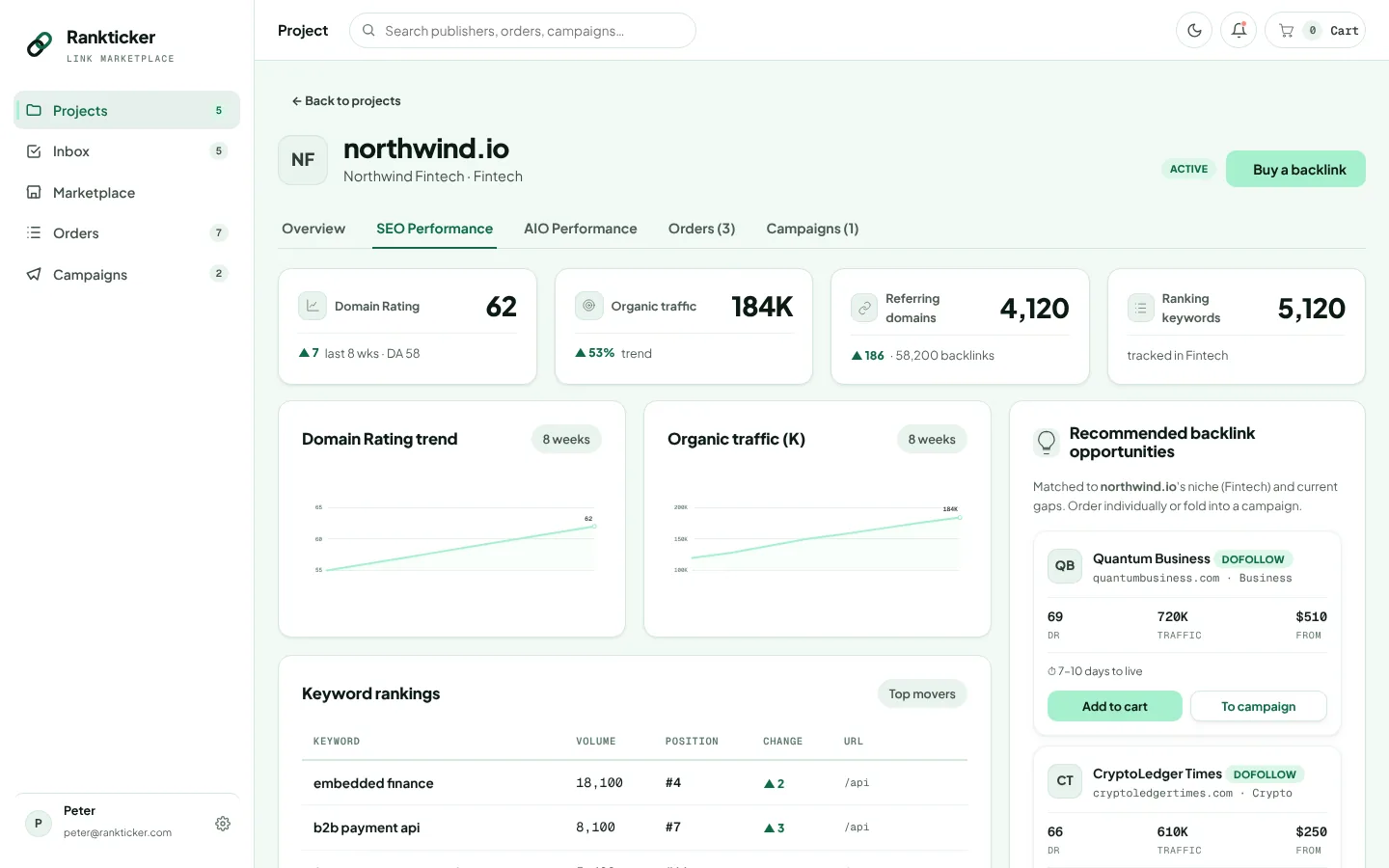
Each project in Rankticker has two performance tabs. SEO Performance shows Domain Rating trend, organic traffic trend, referring domains, ranking keywords and keyword positions with changes, so you can watch leading and lagging indicators in one place. AIO Performance shows AI visibility, share of voice, brand mentions, citation share, visibility by engine (ChatGPT, Google AI Overview, Perplexity, Gemini) and answer sentiment for the prompts you track.
The project overview totals live links, pending orders and spend, and the Live Link Tracker covers the delivery layer: page live, anchor present, correct target, indexed, attribute unchanged. Revenue still lives in your analytics and CRM. We don't try to replace those.
FAQ
Questions about measure link building ROI
How long does link building take to show ROI?
Leading indicators such as live, indexed links and new referring domains show within weeks. Ranking and traffic changes usually take months; Ahrefs found only 5.7% of new pages reached Google's top 10 within a year. Judge revenue impact quarterly, not monthly.
Can I see AI Overview clicks separately in Google Analytics?
No. Google says AI Overviews and AI Mode traffic is included in Search Console's Performance report under the Web search type, and AI Overview clicks look like normal organic visits in analytics.
What is AI share of voice?
The share of tracked AI answers in your category that mention your brand, compared with competitors. Because answers vary a lot between runs, measure it as a percentage across many runs of the same prompts, not from single answers.
Should I measure link building by referring domains?
Use referring domains as a leading indicator, not the result. Ahrefs found a clear correlation between referring domains and organic traffic, but correlation isn't proof, and links can be devalued. Tie the plan to rankings, traffic and conversions on the target pages.
Keep reading
Related
How to budget a monthly link campaign, and what link velocity really means
How to set a monthly link building budget in 2026: sizing the gap, true cost per link, link velocity myths, pacing, max cost rules and auto vs semi-au…
Link building for AI search: how publications get cited in ChatGPT, Perplexity and AI Overviews
Link building for AI search: how ChatGPT, Perplexity and Google AI Overviews find sources, what citation research shows, and how to pick publications.
How to evaluate a backlink in 2026: the signals that matter
How to evaluate a backlink in 2026: relevance, real traffic, TF:CF, outbound links, indexation, placement, anchor, attribute, permanence and AI citati…
Digital PR vs guest posts vs link insertions: which format fits which job
Digital PR vs guest posts vs link insertions: when each format fits, what drives cost, risks, turnaround and AI visibility value, with a comparison ta…
Link building for SaaS
Link building for SaaS: which publications move comparison and feature pages, how to set anchors, and how to get cited when buyers ask AI for software…
Link building for agencies
White label link building for agencies: a project per client, budgets with cost caps, client approvals, link monitoring and reporting data for every a…
See the publishers before you spend a penny
Filter real publications by niche, DR, traffic and price. Every metric and the full price are on the listing.