Link building formats
Digital PR vs guest posts vs link insertions: which format fits which job
The three formats get compared on price per link. That's the least useful comparison. They differ in who controls the content, how long they take, what can go wrong and how often AI engines pick them up.
TL;DR: Digital PR earns coverage you don't control, takes weeks to months and is the strongest for brand mentions and AI citations when it lands. Guest posts give you a new article you largely control, in days to a few weeks. Link insertions put your link on an existing page that may already rank or be cited, and are fastest, but you're a guest in someone else's paragraph. Most programmes use all three. Google treats paid links the same in every format.
A quick definition of each, because marketplaces and agencies use the terms loosely.
Digital PR is earning editorial coverage, usually from journalists, with a story: original data, a survey, expert commentary on the news, a tool or an index. You don't pay the publication. You pay for the research and the outreach, and the journalist decides whether to cover you and whether to link.
A guest post is a new article published on someone else's site, written by you or for you, with one or a few links. When money changes hands it's a sponsored post, whatever the byline says.
A link insertion (sometimes called a niche edit) adds your link to an article that's already live. The page keeps its age, its indexation and whatever rankings it has.
There are neighbours too: product reviews, news and press release placements, and articles written to be cited by AI engines. They behave like one of the three above, so we'll stick to the main formats.
Side by side
| Digital PR | Guest post | Link insertion | |
|---|---|---|---|
| Who writes it | The journalist | You, an agency or the publisher | Already written; you supply a sentence or the editor adapts one |
| Control over context | Low | High | Medium |
| Typical link | Branded or naked URL; often nofollow; sometimes no link at all | One or two contextual links; attribute agreed with the publisher | One contextual link in an existing paragraph |
| Turnaround | Weeks to months, and uncertain | Days to a few weeks, depending on the editorial queue | Often the fastest, sometimes days |
| Main cost drivers | Research, data, design, outreach hours; payment is for effort, not outcome | Publication's traffic and niche, word count, who writes, revisions, rush | The page's traffic and rankings, the publication's authority, niche |
| Main risks | No coverage; coverage without links; story off-brand | Paid-link policy risk; low-quality sites that sell to everyone | Paid-link policy risk; link removed when the page is updated; poor fit with the paragraph |
| AI visibility value | High when it lands on cited news sites; earned media is what AI engines favour | Medium; high if the publication is cited for your prompts | High if the page is already cited, for example a "best X" list |
| Best fit | Brands with a real story or data; YMYL categories; brand building | Topical depth on a specific subject; targeted anchors to guides | Quick relevance on pages that already perform; AI list inclusion |
Digital PR
When it works, nothing else comes close. A data story picked up by national and trade press produces dozens of mentions on sites you could never buy from, mostly with branded anchors, mostly on pages that get indexed fast. For AI visibility it's the format that best matches what engines prefer: a 2025 paper by Chen and colleagues found AI search shows "a systematic and overwhelming bias towards Earned media" over brand-owned and social content.
The problems are cost and variance. You pay for research, design and outreach before anything happens, and a campaign that gets two pieces of coverage costs about the same to run as one that gets forty. Plenty of coverage arrives as unlinked mentions or nofollow links. Those still count for AI answers, which read the text, but they won't show up as new referring domains in your SEO reports.
Two warnings, both about press releases. Google's spam policies list press releases distributed on other sites with optimised anchor text as link spam, so a press release wire is not digital PR. And the site reputation policy explicitly excludes wire and press release services, which is a reminder that Google sees them as a separate thing from editorial coverage. Our piece on press releases for SEO and AI visibility goes into what wires are and aren't good for.
Guest posts
You get a new page on a relevant publication, about the topic you choose, with your link where you want it. That control is the whole appeal. It's the right format when you need topical depth: a fintech brand placing explainers on compliance and payments sites, say, or a SaaS company building a cluster of articles around one feature.
Google's view on guest posting hasn't changed much since 2017. Its post on large-scale article campaigns said guest articles are fine when they inform readers, and listed the warning signs: keyword-rich links back to the author's site, the same or similar content across many sites, and writers who don't know the subject. In 2021 Google added that "excessive sponsored and guest posting without proper link tags" could draw algorithmic and manual actions.
Price follows the publication more than the article. Traffic, niche and authority set the base; word count, who writes it, revisions and rush delivery add to it. Grey niches pay more, and sites that accept them usually tell you something about their outbound link profile. Check every guest post site the way we describe in our backlink evaluation guide. Guest post inventory has the widest quality range of any format.
Link insertions
An insertion skips the wait. The page is already indexed, already has internal links and may already rank. If you choose well, you get relevance from a page Google has had months or years to assess.
For AI visibility, insertions can be the most direct route. Ahrefs found "best X" lists made up 43.8% of the page types ChatGPT cited for commercial prompts, and brands placed higher on those lists were more likely to be recommended. If a list on a respected site already turns up when buyers ask about your category, getting into it, accurately and with a sensible position, is about as close to the answer as you can get.
The risks are specific. The paragraph wasn't written for you, so a forced insertion reads like one. Editors update old content and links go missing; Ahrefs' link rot study found 66.5% of links in its sample had rotted over about nine years. And a page that ranks today may not next quarter. Check the page's own traffic and how many other outbound links it carries. A list with 40 vendor links, all added in the last six months, is a page someone is farming.
Paid insertions are paid links. Same policy, same attribute question as a sponsored post.
What to ask before you order each one
The questions differ by format, because the failure modes differ. For a PR campaign, the useful question is what happens if the story doesn't land. Is there a fallback angle, a second round of outreach, a plan for the data on your own site? Ask the agency how they report unlinked mentions, too. If they only count links, they'll undersell the campaign on the AI side and probably chase the wrong outlets.
For a guest post, ask:
- Who edits it, and do they actually reject things?
- Will it be linked from a category page or other articles, or published as an orphan?
- What attribute will the link carry, and is paid content labelled for readers?
- How many other commercial links will share the article?
For an insertion, the page is the product, so ask about the page. When was it last updated, and will the next update keep your link? How many links were added to it this year? Does it get organic traffic of its own, and is it cited for any prompts you care about? If the seller can't answer, pick a different page.
We'd add one question for all three: how will you know if the link disappears? Placements fail quietly. A link that went missing in month four looks exactly like a link that never worked, unless something is checking.
How the formats show up in your reports
They don't report the same way, which trips people up when they compare them. Guest posts and insertions show up as new referring domains within a few weeks, if the pages get crawled. PR coverage arrives in bursts, with a long tail of syndication and unlinked mentions that link tools miss. AI visibility gains from any of them show up in share-of-voice tracking, not in a backlink report. Our guide to measuring link building ROI sets out which numbers to watch for each.
Choosing by goal
| If your goal is | Lead with | Support with |
|---|---|---|
| Brand mentions in AI answers | Insertions into cited lists; PR on cited news sites | Guest posts on publications cited for your prompts |
| Rankings for a specific guide or category page | Insertions on ranking pages in the topic | Guest posts with descriptive anchors |
| Authority for a new domain | Guest posts on relevant, mid-sized publications | One PR campaign once you have something to say |
| Trust in a YMYL category (finance, health, legal) | Digital PR and expert commentary | Guest posts on specialist trade titles only |
| Local visibility | Local news and community sites | Insertions on local guides |
| Agency client reporting with steady output | Guest posts and insertions on a monthly cadence | Quarterly PR pushes |
For regulated sectors like fintech, we'd keep paid placements to publications whose editors review content properly, and we'd expect them to label paid content. Agencies running several clients at once have a different problem: consistency. Our agencies page covers how to keep formats and standards the same across accounts.
A sensible mix
There's no correct split, and anyone who gives you one without seeing your site is guessing. As an illustration only: a B2B SaaS brand with a modest monthly budget might put most of it into guest posts and insertions on publications cited for its prompts, and save up for one data-led PR campaign a quarter. A brand with a genuinely newsworthy dataset might flip that. What matters more than the ratio is that each placement has a job: a target page, an anchor type, a reason that publication was picked. Budget and pacing are covered in link building budget and velocity.
And don't judge PR on referring domains alone. Some of its best results won't be links at all.
Comparing formats in Rankticker
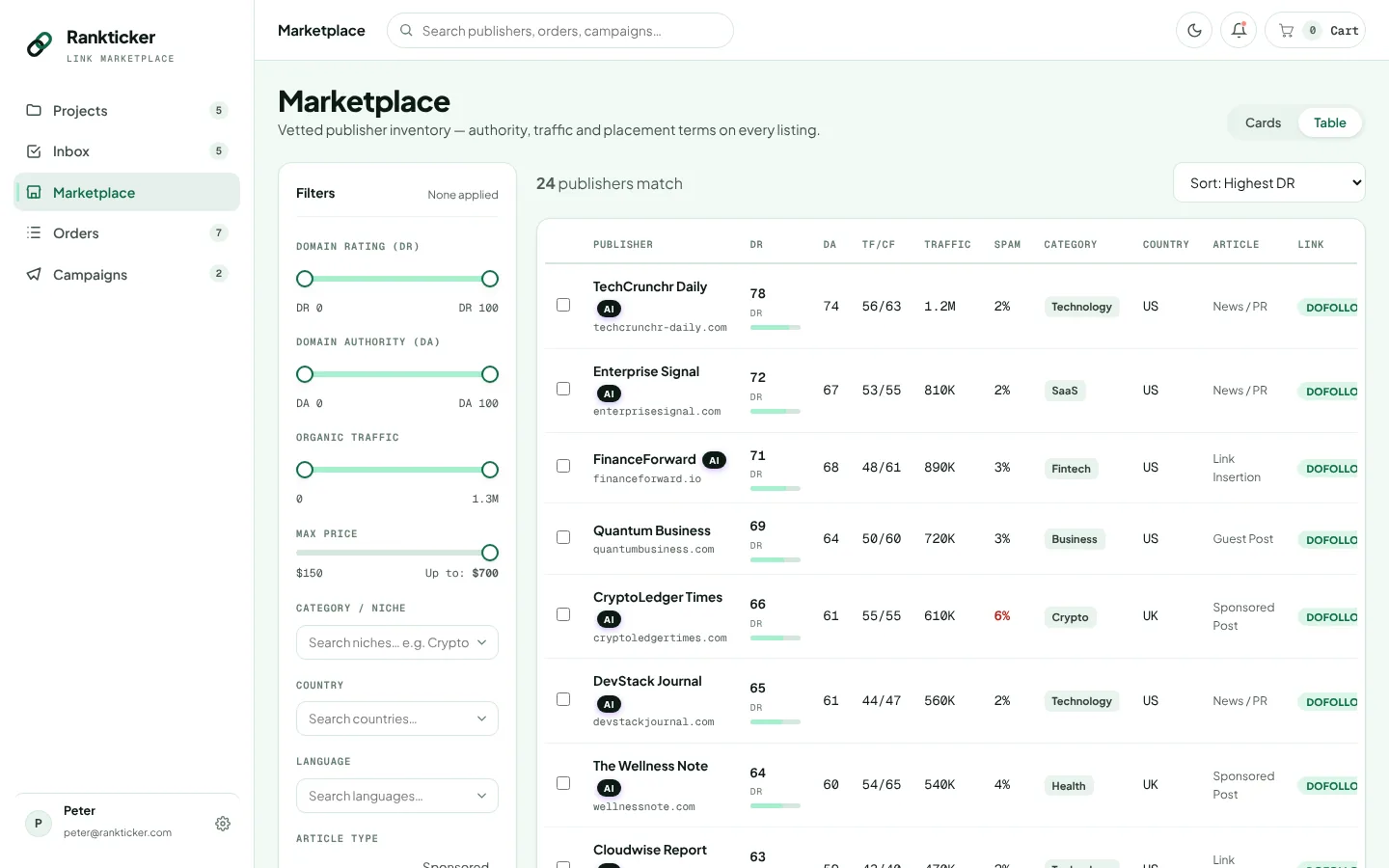
The marketplace filters by article type: guest post, link insertion, sponsored post, news/PR, product review and AI Optimized Article. Each publisher profile prices formats separately and lists the terms for each, including link attribute, links per post, word count, revisions, link lifetime and whether paid content is labelled. You can compare publishers side by side before you buy.
At checkout you choose whether Rankticker writes the article or you supply your own, and every order runs through Chief Editor review and publisher review before it goes live. The content process explains how.
FAQ
Questions about digital PR vs guest posts
Are link insertions better than guest posts?
Neither is better in general. An insertion goes on a page that is already indexed and may already rank or be cited by AI engines, so it can work faster. A guest post gives you control over the whole article and a fresh page that fits your topic exactly.
Does Google treat paid guest posts differently from paid link insertions?
No. Google's spam policies treat links bought to manipulate rankings as link spam whatever the format, and ask for paid links to carry rel="sponsored" or rel="nofollow".
Is digital PR worth it for a small budget?
Usually only if you have a real story or data. A campaign with research, design and outreach costs time and money before any coverage appears, and results are uneven. Smaller budgets often do better with a few well-chosen placements and expert commentary.
Which link building format is best for AI visibility?
Formats that put your brand into pages AI engines already cite. Insertions into cited comparison lists and coverage on news sites that appear in AI answers tend to do the most; a guest post helps if the publication itself is cited.
Keep reading
Related
How to evaluate a backlink in 2026: the signals that matter
How to evaluate a backlink in 2026: relevance, real traffic, TF:CF, outbound links, indexation, placement, anchor, attribute, permanence and AI citati…
Press releases, SEO and AI visibility in 2026
Do press releases still help SEO and AI visibility in 2026? What Google says about syndication links, how often AI cites releases, and when editorial …
Link building for AI search: how publications get cited in ChatGPT, Perplexity and AI Overviews
Link building for AI search: how ChatGPT, Perplexity and Google AI Overviews find sources, what citation research shows, and how to pick publications.
How to budget a monthly link campaign, and what link velocity really means
How to set a monthly link building budget in 2026: sizing the gap, true cost per link, link velocity myths, pacing, max cost rules and auto vs semi-au…
Fintech backlinks
Fintech backlinks from finance publications that hold up to YMYL scrutiny: formats, FCA promotion rules, anchors and AI visibility for money brands.
Link building for agencies
White label link building for agencies: a project per client, budgets with cost caps, client approvals, link monitoring and reporting data for every a…
See the publishers before you spend a penny
Filter real publications by niche, DR, traffic and price. Every metric and the full price are on the listing.