Digital PR
Press releases, SEO and AI visibility in 2026
Wire syndication links do almost nothing for rankings, and AI engines rarely cite the release itself. The coverage a genuinely newsworthy release triggers is a different matter.
TL;DR: Google treats links in distributed press releases as link spam unless they're qualified, so wire syndication adds little SEO value. AI engines cite releases rarely (1.1% of citations in Muck Rack's May 2026 data) and cite journalism often (about 27%). Send a release when you have real news and want journalists to cover it. For links and AI visibility, put the budget into editorial PR and relevant publications.
The pitch for wire distribution has hardly changed in fifteen years. Your release goes out on Monday, and by Tuesday it sits on dozens of syndication partner pages, each with your link in it. The problem is what those pages are worth. Google said in 2013 that it wanted them treated like ads, and its spam policy still names press releases specifically. What's new in 2026 is the AI side, and the data there is more interesting than the SEO story.
What Google says about press release links
Google's link spam policy lists, as an example of link spam, "links with optimized anchor text in articles, guest posts, or press releases distributed on other sites". The same policy says paid and advertising links are fine as long as they carry rel="nofollow" or rel="sponsored".
This isn't new. In 2013 John Mueller said press release links should be treated like advertisements and nofollowed, while links in independent stories that journalists write after reading a release don't need to be (Search Engine Land, July 2013). That distinction is the whole point of this article. The release is an ad. The coverage it prompts is editorial.
Since September 2019, Google has treated nofollow, sponsored and ugc as hints rather than directives. Some SEOs read that as a loophole, a sign that Google might count a few nofollowed release links after all if the page looks good enough, and we think that reading gets it backwards: Google decides what to count, and a link in a syndicated release is about the clearest case of a link it has said not to count.
Why syndication links are worth so little
Set the policy aside and the mechanics still work against you. Syndicated copies are near-identical pages on different domains, and Google picks one version to show. In 2023 Google stopped recommending cross-domain canonicals for syndicated content and said "the most effective solution is for partners to block indexing" of it. In our experience most syndication pages are thin newsroom templates with dozens of outbound links each, and few earn links or traffic of their own.
| Where the link sits | Typical attribute | SEO value | AI visibility value |
|---|---|---|---|
| Wire service page for the release | Often nofollow | Low | Low; occasionally cited |
| Syndication partner copies | Mixed; often nofollow or noindexed | Very low | Very low |
| Your own newsroom page | Internal | Depends on the news; can earn links | Moderate if specific and factual |
| A journalist's story about the news | Editorial, followed or not | High if the outlet is relevant | High; journalism is heavily cited |
| Trade publication coverage | Editorial | High for topical relevance | High in niche queries |
What happens on the AI side
Muck Rack has been tracking what generative AI cites since mid-2025. Its May 2026 report covers more than 25 million links from AI responses (Muck Rack, What Is AI Reading?, May 2026). The headline numbers:
- About 84% of citations came from earned media.
- About 27% were journalism, in line with the 20% to 30% range of its earlier reports.
- Paid and advertorial content was 0.3%.
- Press releases were 1.1%, down from 6% in the December 2025 report and close to the 1.2% seen in July 2025. Muck Rack puts most of the drop down to ChatGPT citing releases less.
The December 2025 spike is instructive. Muck Rack found then that cited releases had about twice as many statistics as other releases, 2.5 times as many bullet points and a 30% higher rate of objective sentences (Muck Rack announcement, December 2025). In other words, the releases that got cited read like reference material. Six months later the share had fallen back to about 1%. We wouldn't plan a strategy around a source type that went from 1% to 6% and back inside a year.
Two more findings matter for timing. Of journalism citations with a known date, 57% were less than 12 months old, and citations peaked in an article's first month. And industry-trend queries cited journalism in 46% of responses, more than twice the rate of how-to and comparison queries. Coverage helps most when it is recent and the question is about where a market is going.
The newsworthiness test
Most releases fail before distribution. They announce a feature update, a webinar or a "partnership" that is really a logo swap. Before writing one, run it past the questions a reporter would ask:
- Would a trade reporter write about this if you weren't paying for distribution?
- Is there a number nobody else has? A funding amount, a customer count you can verify, original survey data.
- Are there named people willing to be quoted and called?
- Is it timely, or tied to something already in the news?
- Does it matter to a specific audience: a region, an industry, a profession?
- Could you pitch it to three named journalists by email, with a one-line reason each should care?
If you can't tick most of these, a release won't earn coverage. It will earn syndication pages.
When a release is the right tool, and when editorial PR is
Releases still have a job. They are the formal record journalists, analysts and investors expect for some kinds of news, and in some regulated settings you have to publish one. They are a poor tool for links or for shaping how AI engines describe you.
| Goal | Press release | Editorial PR | Placement on a relevant publication |
|---|---|---|---|
| Announce funding, M&A, results | Yes, as the record | Yes, for the story behind it | Rarely needed |
| Earn editorial links | Only indirectly | Yes | Yes, labelled as required |
| Get cited in AI answers | Weak | Strong, especially journalism | Good on publications engines cite |
| Shape how engines describe you | Weak | Strong | Good if content is specific and accurate |
| Predictable timing and cost | Yes | No | Yes |
Editorial PR here means data studies, expert commentary offered to journalists, and reactive work answering reporter requests. It's slower and less predictable, and it's what produces the journalism engines cite. Our comparison of digital PR, guest posts and link insertions covers costs and trade-offs.
If you do send one, write it to be quoted
Put the fact in the first sentence. Use real numbers and name people, companies and places. Keep quotes short enough that a reporter can lift them. Publish the canonical version on your own newsroom, where it can earn links and be crawled by AI search bots (check that your robots.txt doesn't block them). Use branded or naked URL links in the release and accept that distributed copies will be nofollowed or ignored.
Then follow up personally with the journalists most likely to care. The distribution list does the least of the work.
Plan what comes after it, too. If citations peak in an article's first month and fade over six, one burst of coverage gives you a few good months in AI answers and then a slow decline. A data piece six weeks later, a customer story in a trade title, a comment on the next big industry report: each puts fresh, dated coverage back into the sources engines read. We'd rather see four modest stories across a year than one launch-day splash and silence.
Measure coverage, not pickups
Wire reports love a big number: hundreds of "pickups" and a "potential audience" in the tens of millions. Ignore it. Almost all of those are the syndication copies discussed above, and a potential audience is a guess about people who never saw the page.
Count three things instead, roughly a month after the news goes out. First, independent stories, meaning articles a journalist wrote with their own words and angle, and which outlets ran them. Second, editorial links and unlinked brand mentions in those stories. Third, whether anything changed in AI answers for the prompts the news should affect, which you can only see if you were tracking those prompts before you sent it. If you weren't, start now, because the next release will need the baseline.
A release that produced two stories in relevant trade titles and one in a regional business section has done well, probably better than most. One that produced 300 pickups and no stories has bought you a report.
A note for UK teams paying for placement
Some publishers will run your news as paid content if a journalist won't. That's legitimate, but in the UK it's advertising, and the CAP Code requires marketing communications to be obviously identifiable. The ASA's guidance on advertisement features expects a prominent upfront label such as "Advertisement feature" or "Ad", and it advises against relying on "sponsored" alone because the word is open to interpretation (ASA, Recognising ads: advertisement features). Both the advertiser and the publisher are responsible. The label and the link attribute are separate decisions, and a paid placement should get both right.
Doing this in Rankticker
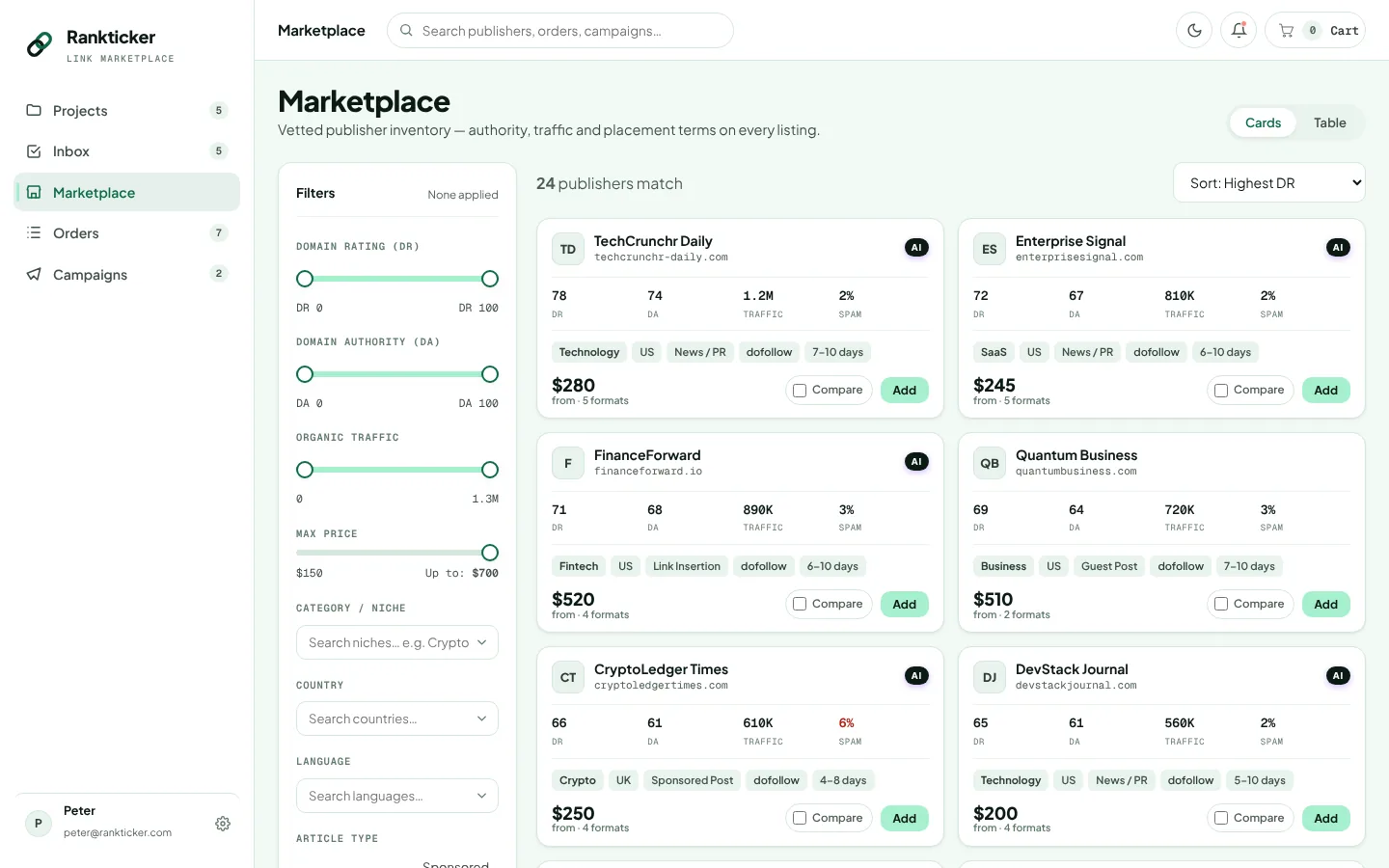
The marketplace has a News/PR article type, so you can filter for publications that take news-style content alongside guest posts and product reviews. Listings with an AI badge are publications verified as sources that ChatGPT, Google AI Overviews, Perplexity, Gemini and other engines cite, and the AIO opportunities list in each project narrows that to your niche. See AI visibility tracking and the AI visibility overview.
You choose the link attribute and whether paid disclosure is shown, and each publisher profile states its own policy. Content can be written by Rankticker or supplied by you, and every order goes through Chief Editor review before the publisher sees it (content). After publication, track whether coverage moved your share of voice in the AIO Performance tab, and read brand mentions in AI answers for how to measure it. If you want Google's position on paid placements in full, start with paid links and Google's spam policies.
FAQ
Questions about press releases SEO
Do press release links help SEO?
Very little. Google's spam policies list optimised-anchor links in press releases distributed on other sites as link spam, and syndicated copies are duplicates of one another. Treat release links as nofollow and judge the release on the coverage it earns.
Should links in press releases be nofollow?
Yes. Google has said since 2013 that press release links should be treated like advertising links, and its current spam policy names press releases specifically.
Do AI engines cite press releases?
Occasionally. In Muck Rack's May 2026 data, press releases made up 1.1% of AI citations, against about 27% for journalism. The share has swung a lot between reports.
When is a press release worth sending?
When you have news a journalist would cover without being paid: funding, acquisitions, results, notable hires or partnerships, launches with named customers, or original data.
What should I do instead of a press release?
For most link and AI visibility goals, editorial PR works better: data studies, expert commentary for journalists, and well-written articles on relevant publications that engines already cite.
Keep reading
Related
Digital PR vs guest posts vs link insertions: which format fits which job
Digital PR vs guest posts vs link insertions: when each format fits, what drives cost, risks, turnaround and AI visibility value, with a comparison ta…
Brand mentions in AI answers: how to measure them and how to earn them
How brand mentions, entities and unlinked citations shape AI answers in 2026, how to measure share of voice and sentiment, and how to get into cited s…
Paid links and Google's spam policies: what buyers need to know in 2026
Paid links and Google's spam policies in 2026: the link spam text, rel="sponsored", manual actions, SpamBrain, site reputation policy and UK ASA discl…
AI visibility you can measure and act on
Track your AI visibility across ChatGPT, AI Overviews, Perplexity and Gemini, see which publications they cite, and place content on those sources.
Link building for SaaS
Link building for SaaS: which publications move comparison and feature pages, how to set anchors, and how to get cited when buyers ask AI for software…
See the publishers before you spend a penny
Filter real publications by niche, DR, traffic and price. Every metric and the full price are on the listing.