AI visibility
Brand mentions in AI answers: how to measure them and how to earn them
AI assistants name brands, cite URLs and describe companies in their own words. Those are three different things, and each needs its own measurement and its own plan.
TL;DR: Mentions of your brand across the web track AI visibility more closely than backlinks or DR do. Measure visibility as a percentage across many prompts and repeated runs, never as a rank. Then find the publications engines actually cite in your niche and get your brand into them, linked or not.
In Ahrefs' study of 75,000 brands, the factor most closely tied to how often a brand appeared in Google's AI Overviews was branded web mentions, with a Spearman correlation of 0.664. Domain Rating came in at 0.326. Raw backlink count, the thing most link building budgets are still built around, scored 0.218 (Ahrefs, 2025).
The gap at the extremes is larger. Brands in the top quarter for web mentions averaged 169 AI Overview mentions. The bottom half averaged between zero and three. The author is careful to say this is correlation, and big brands get mentioned more for reasons that also get them into AI answers. We agree. But if you are deciding where to spend the next pound, it is a hard chart to ignore.
Mentions, citations and entities are three different things
Most AI visibility reporting blurs these together. They behave differently and you fix them differently.
| Term | What it is | Where you see it | What moves it |
|---|---|---|---|
| Brand mention | Your brand named in the answer text | The prose of the answer, often in a list of options | How often and how consistently the web names you in this context |
| Citation | A URL the engine shows as a source | Source cards, footnotes, link pills | Being indexed, being on the subtopic, being on publications the engine trusts |
| Entity description | What the model believes your company is and does | Phrases like "a UK payroll tool for small firms" or "known for high fees" | Consistent descriptions across your site, profiles, press and reviews |
| Sentiment | How the answer frames you | Recommended, listed, caveated, warned against | Reviews, complaints, comparison articles, forum threads |
These can split. A competitor's comparison page can be the cited source for an answer that names you as the expensive option. Your own docs can be cited while a rival is the one recommended. So report on all four.
Unlinked mentions count for more than most SEOs assume
A model reads text. A sentence in a trade publication that says your software "is what most of the accountancy firms we spoke to use for payroll" adds to the association between your brand and that task whether or not the publisher linked it, and whatever rel value the link carries.
That changes how you value placements. A nofollow or rel="sponsored" link on a well-read, relevant publication may do little for PageRank, yet the paragraph around it is exactly the kind of text that shapes how a model describes you. A followed link in an article nobody would quote does neither job well.
There is a limit to this, and it is an uncomfortable one for anyone selling placements, us included. Muck Rack's analysis of more than 25 million links in AI responses found about 84% of citations came from earned media and about 27% from journalism. Paid and advertorial content made up 0.3% (Muck Rack, What Is AI Reading?, May 2026). Sponsored articles rarely become the cited URL. Where they help is in adding accurate, relevant mentions to publications that engines read and do cite for their editorial content. That is the job to buy them for. Don't expect the sponsored page itself to be the footnote.
Measuring share of voice without fooling yourself
AI answers are not stable. In a study run by Rand Fishkin of SparkToro and Patrick O'Donnell of Gumshoe, about 600 volunteers ran 12 identical prompts through ChatGPT, Claude and Google's AI nearly 3,000 times. The chance of getting the same list of brands twice was under 1 in 100. The same list in the same order was closer to 1 in 1,000 (Search Engine Land, January 2026).
So "we rank third in ChatGPT" is a meaningless sentence. What does hold up is frequency: across many prompts and many runs, how often do you appear? The study's authors recommend exactly that.
Build a prompt set that matches how buyers ask
Start with 40 to 100 prompts grouped by intent: category discovery ("best payroll software for UK small businesses"), comparisons ("Brand A vs Brand B"), problems ("how do I run payroll for two employees"), and brand questions ("is Brand A any good"). Use the phrasing your sales team hears. Run each prompt several times per engine, on a schedule, and keep the raw answers.
The metrics worth tracking
| Metric | How to calculate it | What it tells you |
|---|---|---|
| AI visibility % | Answers that mention you ÷ all answers in the prompt set | How often you are in the conversation at all |
| Share of voice | Your mentions ÷ all brand mentions in the category answers | Your slice relative to competitors |
| Citation share | Citations of your domains ÷ all citations in the answers | Whether engines use your content as a source |
| Visibility by engine | Visibility % split by ChatGPT, AI Overviews, Perplexity, Gemini | Where to focus; engines cite very different sources |
| Answer sentiment | Share of mentions that recommend, list neutrally, caveat or warn | Whether being mentioned is helping |
How often to measure, and what counts as a change
Weekly runs are enough for most brands. Daily runs mostly measure the engines' randomness. With a prompt set of 50 and a handful of runs each, a move of two or three points in visibility from one month to the next is probably noise. We'd want to see a shift hold for six to eight weeks, across more than one engine, before crediting it to anything you did. Keep a dated log of placements, launches and coverage so you can line changes up against it later.
For sentiment, keep a log of the attributes engines attach to you. "Good for enterprise", "expensive", "limited integrations". Those phrases come from somewhere, usually reviews and comparison pages, and they tell you which sources to work on.
Why citations still matter for clicks
Pew Research tracked 900 US adults' real Google searches in March 2025. Users clicked a result on 8% of visits to pages with an AI summary and 15% of visits without one, and clicked a link inside the summary on about 1% (Pew Research Center). Seer Interactive's data across 42 client organisations found organic click-through on AI Overview queries was 0.70% when the brand was cited and 0.52% when it was not, roughly 35% higher (Seer Interactive, September 2025). Seer is clear it can't prove the citation causes the lift. Fewer clicks overall, then, and a better share of what's left if you are cited.
Where AI engines get their sources
Google says there are no additional requirements for AI Overviews or AI Mode: a page needs to be indexed and eligible to show with a snippet. Those features may use query fan-out, running related searches across subtopics, which means sources are found through ordinary search on narrower questions.
ChatGPT search is different plumbing. OpenAI's crawler documentation says sites that opt out of OAI-SearchBot "will not be shown in ChatGPT search answers". Check your own robots.txt, and check it on publications you plan to pay for. A publisher that blocks OAI-SearchBot can still be useful for Google, but it won't be a ChatGPT source.
The mix of cited domains also moves fast. Semrush tracked more than 230,000 prompts over 13 weeks in 2025 and saw Reddit go from being cited in close to 60% of ChatGPT responses in early August to about 10% by mid-September (Semrush, November 2025). Any plan that depends on one source type is fragile. We would not build a strategy around Reddit, or Wikipedia, or any single publisher.
Recency matters too. In Muck Rack's May 2026 data, 57% of journalism citations with a known date had been published in the previous 12 months, and citations peaked in an article's first month. A great mention from 2022 is fading. Steady coverage beats one big moment.
How to earn mentions in the sources models use
The work is closer to PR than to traditional link building, though the two overlap more than people think. This is the order we'd do it in.
Run a citation audit
Export every URL cited across your prompt set and group by domain. The ten to thirty publications that recur in your niche are your target list. Note which ones mention competitors and not you.
Fix your entity description
Use the same one-line description of what you do on your homepage, About page, LinkedIn, Crunchbase, Google Business Profile, app store listings and press kit. Models stitch descriptions together; contradictions produce vague answers.
Get into the comparison and "best of" content
Answers to category prompts lean heavily on listicles and comparisons. Reach the editors who maintain them with something concrete: a free account for testing, pricing they can verify, a customer they can call.
Give journalists something to quote
Original data, a named expert with an opinion, fast answers to reporter requests. Muck Rack found industry-trend queries cite journalism in 46% of responses, more than twice the rate of how-to queries.
Place well-written articles on cited publications
Where a publication cited in your niche accepts contributed or sponsored content, use it to put accurate, specific mentions in front of readers. Label it the way the publisher and the law require. The formats guide covers which type fits which goal.
Work on the negatives
If engines call you expensive or hard to set up, find the review threads and comparison pages saying so. Answer them, fix the product, or publish the evidence that the claim is out of date.
Press releases deserve their own note, since they're the default tool many teams reach for here. Their share of AI citations has swung a lot; see press releases, SEO and AI visibility before budgeting for wire distribution.
Doing this in Rankticker
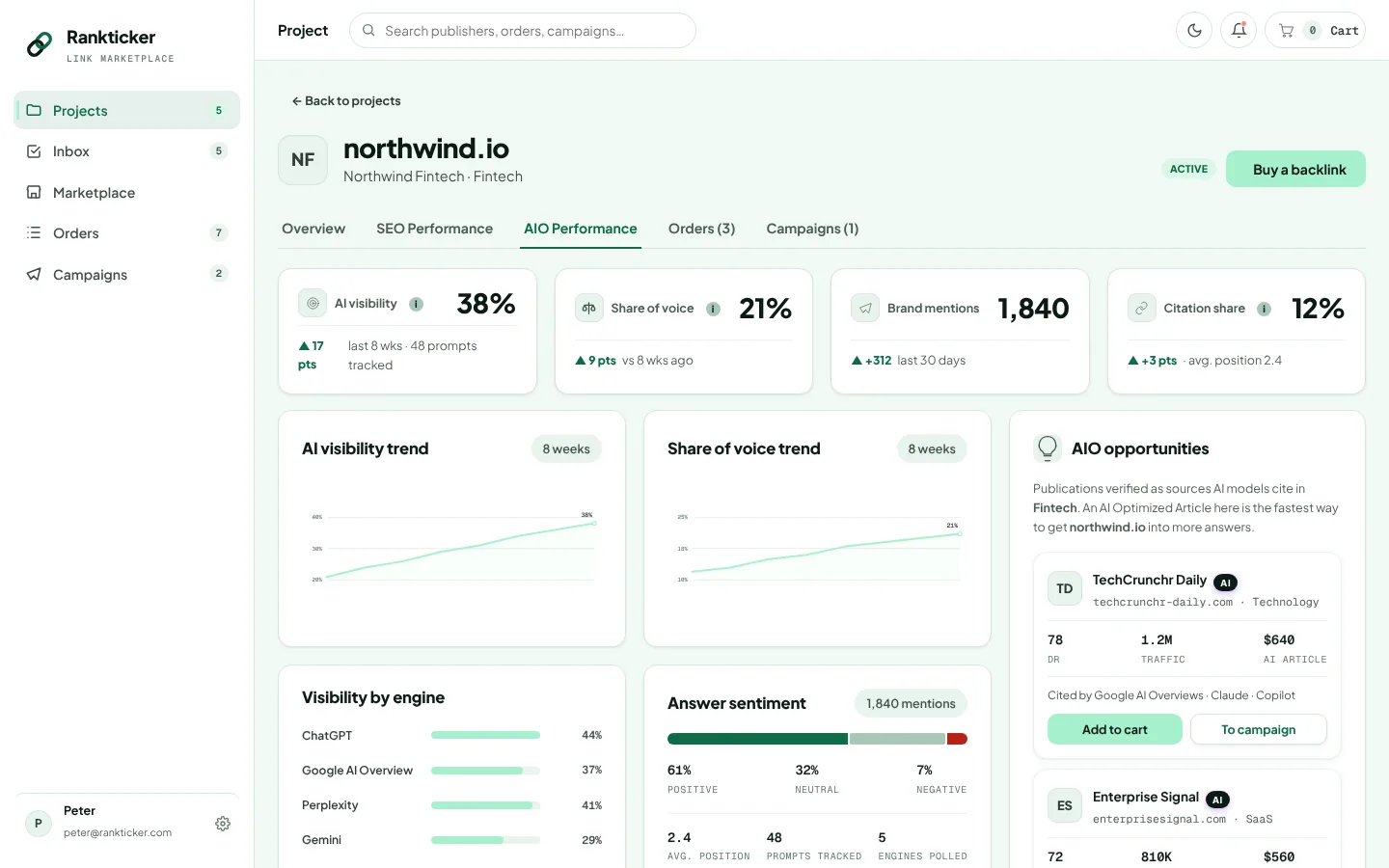
The AIO Performance tab in each project tracks the metrics in the table above: AI visibility %, share of voice, brand mentions, citation share, a visibility trend, visibility by engine (ChatGPT, Google AI Overviews, Perplexity, Gemini), answer sentiment and the prompts tracked. Details are on the AI visibility page and in the product tour.
Below the metrics, AIO opportunities lists publications verified as sources AI models cite in your niche, and you can order from them directly. In the marketplace those publications carry an AI badge. If you'd rather not pick one by one, set up a campaign with the objective "improve AI visibility" and approve the recommendations it makes. For the wider strategy, read link building for AI search.
FAQ
Questions about brand mentions in AI answers
What is the difference between a brand mention and a citation in an AI answer?
A mention is your brand named in the answer text. A citation is a URL the engine shows as a source. You can be mentioned without being cited, and your site can be cited without your brand being recommended.
Do unlinked brand mentions help AI visibility?
They appear to. Language models read text, not link attributes, and Ahrefs found branded web mentions had the strongest correlation with AI Overview brand visibility of any factor it tested.
How many prompts do I need to measure AI share of voice?
Enough to cover the intents that matter to your buyers, run repeatedly. SparkToro and Gumshoe found AI brand lists rarely repeat, so a single run of a single prompt tells you very little.
Can paid placements get my brand cited by AI?
Sometimes, but rarely as the cited URL. Muck Rack found paid and advertorial content made up 0.3% of AI citations in its May 2026 data. The bigger effect is the brand mentions a placement adds to the text models read.
How do I find which sources AI engines cite in my niche?
Run your prompt set across engines, export every cited URL, and group them by domain. The publications that recur are your target list.
Keep reading
Related
AI visibility you can measure and act on
Track your AI visibility across ChatGPT, AI Overviews, Perplexity and Gemini, see which publications they cite, and place content on those sources.
Link building for AI search: how publications get cited in ChatGPT, Perplexity and AI Overviews
Link building for AI search: how ChatGPT, Perplexity and Google AI Overviews find sources, what citation research shows, and how to pick publications.
Press releases, SEO and AI visibility in 2026
Do press releases still help SEO and AI visibility in 2026? What Google says about syndication links, how often AI cites releases, and when editorial …
Digital PR vs guest posts vs link insertions: which format fits which job
Digital PR vs guest posts vs link insertions: when each format fits, what drives cost, risks, turnaround and AI visibility value, with a comparison ta…
Topical relevance vs Domain Rating: what to pay for in 2026
Why topical relevance beats raw Domain Rating when you buy links in 2026, how Google reads link context, and a practical checklist for judging relevan…
See the publishers before you spend a penny
Filter real publications by niche, DR, traffic and price. Every metric and the full price are on the listing.