Use cases
Cybersecurity link building
Security buyers are technical, sceptical and busy. The links that help a security vendor sit on publications practitioners read, attached to research or commentary that would stand up on its own.
Find publishers in this nicheSee how it works
The problem
Security readers can smell marketing
The person evaluating your EDR or email security product might be a SOC analyst who reads vulnerability write-ups for fun. A sponsored post titled "5 reasons cybersecurity matters for your business" doesn't reach that person, and on the sites that publish it, nobody else in the buying group reads it either.
That narrows supply. Security publications worth being on are fewer than in most B2B niches, and the good ones are picky about vendor content. General "tech" blogs are plentiful and will take anything, which is the problem: a site that covers VPN coupons and smart fridges in the same week says nothing useful about your topic.
Security news also moves fast. A major breach or a critical CVE lands, and for a day or two editors want a credible quote from someone who understands it. After that the story is gone. How many vendors have a researcher who can explain a new VPN appliance bug in plain English before lunch? Fewer than you'd think, which is probably why the ones who can get quoted again and again, and why their research pages collect referring domains from publications that would never sell a guest post.
And the claims are risky. "Blocks 100% of ransomware" is the sort of line security buyers mock in Slack channels, and in the UK it is also a claim you need evidence for (more below).
Placements
Formats security editors accept
Threat research
Anonymised findings from your telemetry or honeypots: new phishing kits, ransomware dwell times, attack volumes by sector. The most linkable thing a vendor owns.
Reactive commentary
A named researcher explaining what a new CVE or breach means for defenders. Speed and accuracy matter more than DR.
Security and IT trade press
Bylined technical articles for publications read by security teams, IT managers or MSPs.
Explainers and AI Optimized Articles
"XDR vs SIEM", "what NIS2 means for a UK supplier to EU firms". Neutral, precise, and the format AI answers cite.
Channel publications
For vendors selling through MSPs and resellers: titles aimed at the partner, not the end customer.
Targets and anchors
Point links at research and use cases
Research reports and their landing pages are the natural target for anything data-led. Glossary and explainer pages ("what is DMARC") pick up links easily and pass relevance to product pages through internal links. Use-case pages ("email security for schools", "ransomware protection for law firms") and compliance pages (Cyber Essentials, ISO 27001, DORA, NIS2) match how buyers search when a requirement lands on their desk. Integration pages catch "does it work with Microsoft 365" queries.
Most anchors should be the brand, report titles or plain URLs. Technical terms make good partial-match anchors because they read naturally ("our DMARC explainer"). Avoid exact-match commercial anchors like "best antivirus software" on paid placements; they look bought, and security readers notice.
One more thing on tone. An explainer that stays vendor-neutral until the last few paragraphs, and only then mentions how your product handles the problem, gets accepted by better publications and gets read to the end by the practitioners you're trying to reach.
In Rankticker
Filtering for a technical audience
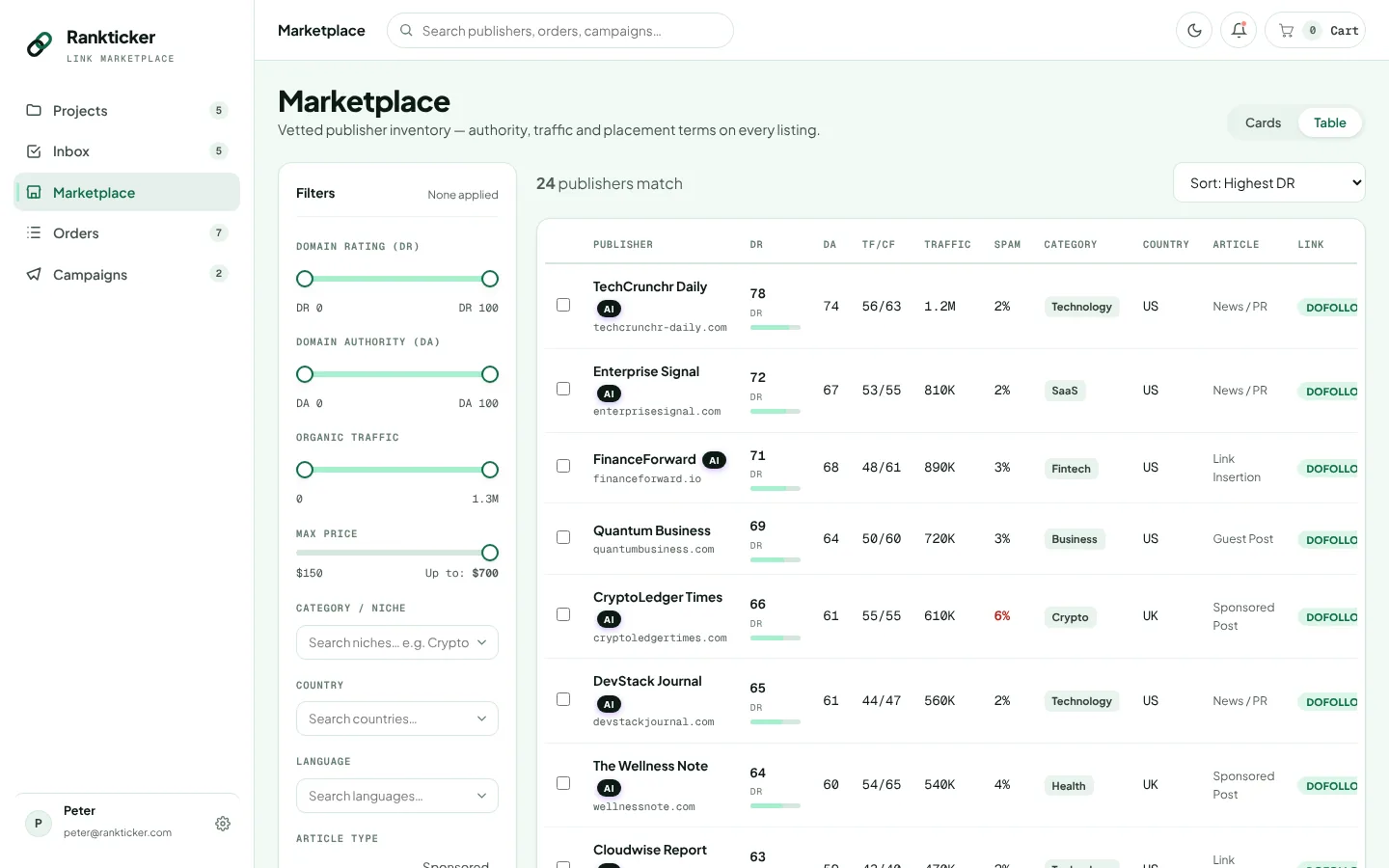
Filter by technology and security niches, then lean on quality signals more than DR. TF:CF tells you whether trust and citation flow are in balance; a site with high CF and very low TF often has a pile of junk links behind it. The sponsored-outbound share on each profile shows how much of a site's linking is paid.
Set country and language to where your pipeline is. A UK vendor selling into the EU needs publications read in Germany or the Netherlands, not just London.
Semi-auto mode suits security marketing teams, who usually want product marketing to approve each placement. Each recommendation shows the reasoning, and your researchers can supply their own content through the cart.
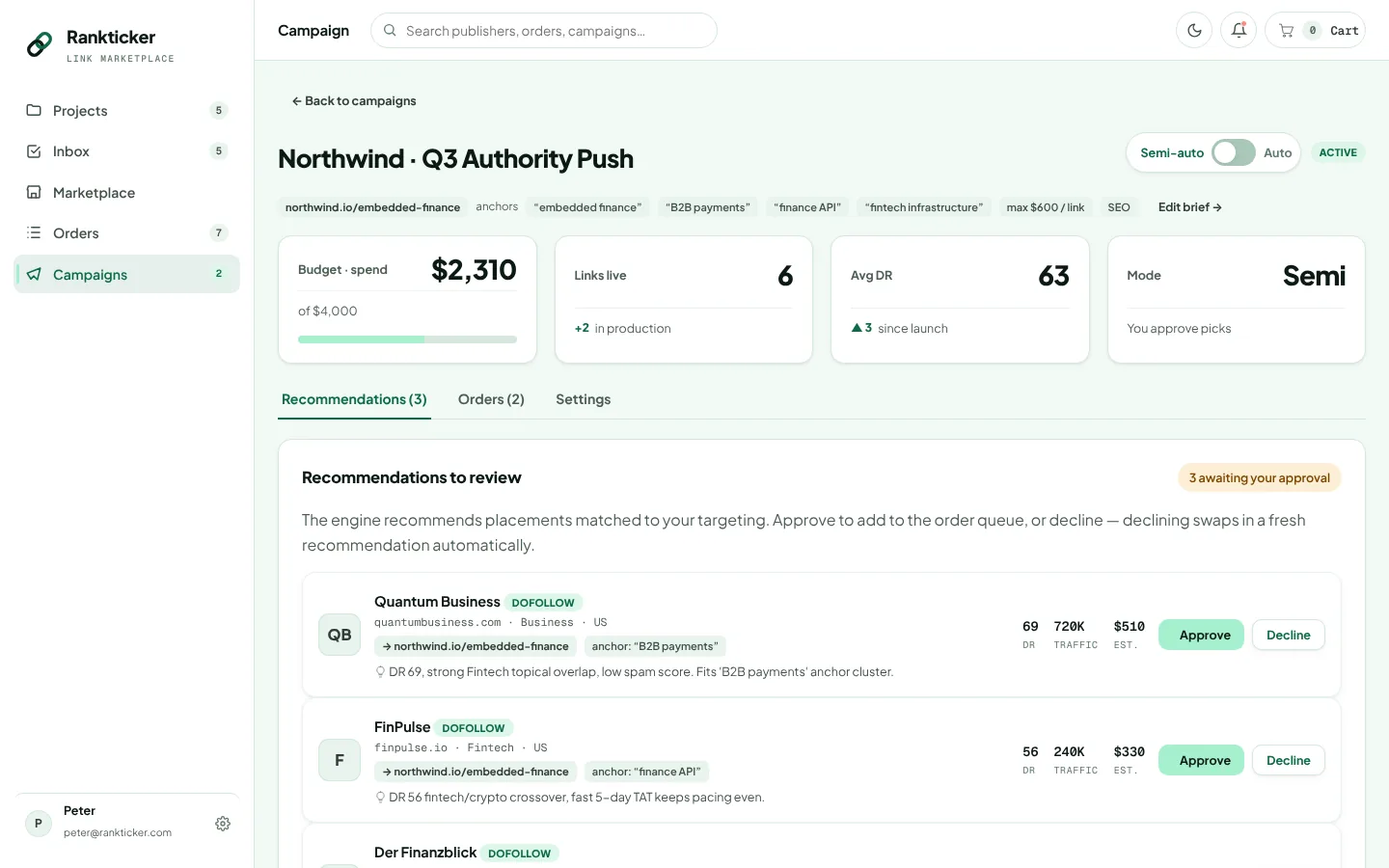
Example only: a UK email security vendor selling to mid-market firms in the UK and EU. Objective: improve AI visibility. Monthly budget £3,000 to £6,000. Geo: United Kingdom, Germany, Netherlands. Targets: annual phishing report, DMARC and BEC explainers, two use-case pages, the Microsoft 365 integration page. Anchors: mostly branded, report titles and URLs, with technical partial matches. Max cost per link £500. Filters: technology niche, English and German, DR 35+, organic traffic 5,000+, AI badge preferred. Illustrative figures, not a quote.
AI visibility
How security buyers use AI assistants
They ask for shortlists and translations of jargon: "best EDR for a 300-person company with no SOC", "alternatives to [vendor] for MSPs", "XDR vs SIEM", "does [product] support Google Workspace". Then they check the answer against people they trust.
Analyst and peer-review sources show up a lot. Profound's analysis of 680 million citations found Gartner among Perplexity's most cited domains, next to Reddit and YouTube. You can't buy an analyst opinion. You can make sure the security press and explainer content AI engines draw on describe your product accurately, and the AI visibility tools track how often you're named and in what tone. See link building for AI search for the method.
Cybersecurity link building checklist
- Keep a researcher on call for breach and CVE commentary
- Publish original research at least once or twice a year
- Hold evidence for objective claims before they appear in any article, as CAP Code rule 3.7 requires
- Don't speculate about named breach victims or publish exploit detail
- Judge publishers on niche overlap and TF:CF before DR
- Build to research, explainer, use-case and compliance pages
- Label sponsored articles and mark paid links rel="sponsored", per Google's spam policies
FAQ
Questions about cybersecurity link building
What content earns links in cybersecurity?
Original threat research, clear explainers and fast expert commentary on breaches and vulnerabilities. Product-led guest posts rarely get past security editors or practitioners.
Which pages should a security vendor build links to?
Research reports, glossary and explainer pages, use-case and compliance pages, and integration pages. Pricing and generic product overview pages rank on brand already.
Do UK advertising rules apply to security claims in sponsored articles?
Yes. The CAP Code requires marketers to hold documentary evidence for objective claims before publication. A claim like 'stops 100% of ransomware' in a sponsored article needs the same proof as on your own site.
Is a high DR tech site enough?
Not on its own. General tech blogs often publish anything. Check niche overlap, traffic trend, TF:CF ratio and sponsored-outbound share, and prefer smaller security publications with real readers.
How do buyers use AI to research security tools?
They ask for shortlists, comparisons and explanations, such as 'XDR vs SIEM for a mid-sized company'. Answers cite analyst and peer-review sources, vendor documentation, security press and community threads.
Keep reading
Related
Link building for SaaS
Link building for SaaS: which publications move comparison and feature pages, how to set anchors, and how to get cited when buyers ask AI for software…
Fintech backlinks
Fintech backlinks from finance publications that hold up to YMYL scrutiny: formats, FCA promotion rules, anchors and AI visibility for money brands.
Topical relevance vs Domain Rating: what to pay for in 2026
Why topical relevance beats raw Domain Rating when you buy links in 2026, how Google reads link context, and a practical checklist for judging relevan…
Digital PR vs guest posts vs link insertions: which format fits which job
Digital PR vs guest posts vs link insertions: when each format fits, what drives cost, risks, turnaround and AI visibility value, with a comparison ta…
Recommendations
Rankticker product tour
See the publishers before you spend a penny
Filter real publications by niche, DR, traffic and price. Every metric and the full price are on the listing.