Use cases · Insurance
Insurance link building
Insurance is a Your Money or Your Life niche with aggregators sitting on the head terms. Links work here when they come from credible finance and consumer titles, and when the copy would pass your compliance team.
Why insurance is harder than most finance niches
Search "car insurance" or "home insurance" and the first page is aggregators, a couple of household-name insurers and a consumer advice site. Those positions are held by brands with years of PR coverage behind them. A broker or an MGA isn't going to buy its way past them with guest posts, and nobody honest should tell you otherwise.
The opportunity sits one level down. Specialist cover (classic cars, landlords, older pets, tradespeople, events, high-value homes) has smaller search volumes, fewer aggregators and buyers who want an expert. That's where links from relevant publications probably do the most for rankings and enquiries.
Google holds these pages to a higher bar. Its guidance on helpful content says that for Your Money or Your Life topics, systems give more weight to content with strong E-E-A-T, and that trust matters most. A link from an anonymous blog with no author and twenty unrelated sponsored posts does nothing for that. A quote from your claims director in a personal finance column does.
Publication types and formats that work
Personal finance and consumer advice
Money sections and consumer titles take expert commentary and explainers: what a policy excludes, how to claim after a flood, what changes at renewal. Expect strict disclosure.
Line-of-business titles
Motoring for car and van cover, property and landlord titles for buildings and rent guarantee, pet publications for pet cover, small business and trade press for commercial lines.
Data-led digital PR
Anonymised claims data is the best asset an insurer has. "Escape of water claims by month" or "the dog breeds with the highest vet claims" gets picked up by national and regional news.
AI Optimized Articles suit the comparison questions people now ask assistants, such as lifetime versus time-limited pet cover. Press releases work for product launches, Lloyd's syndicate capacity, new partnerships and senior hires in the trade press. They rarely work for consumer audiences unless there's data attached.
Seasonality is real, but it's spread across product lines. Travel cover peaks with holiday booking in January and again before summer. Home claims follow storms and freezes. Pet and car cover renew all year. Plan placements line by line.
Where to point links, and with what anchors
Point most links at guides and specialist product pages: "what home insurance covers for subsidence", "classic car insurance for cars over 25 years old", "public liability for electricians". Claims guides earn natural links too, because journalists cite them after weather events. Quote pages rarely attract editorial links. Why would a journalist link to a form? We wouldn't force it.
Keep anchors conservative. In a YMYL niche, a profile built on "cheap home insurance" anchors looks like exactly what Google's link spam policy describes. Our starting mix for an insurer or broker is about half branded or URL anchors, a third descriptive phrases ("specialist cover for listed buildings"), and the rest generic or citation-style ("according to its claims data"). Commercial exact match should be close to zero. The anchor text guide explains why.
Finding the right publishers in Rankticker
Filter the marketplace by the finance or insurance category, country United Kingdom and language English. We'd set a DR floor of 40 and a traffic floor of 5,000 organic visits a month for consumer lines; commercial lines can go lower for a good trade title. Set link type to sponsored or nofollow if that's your policy.
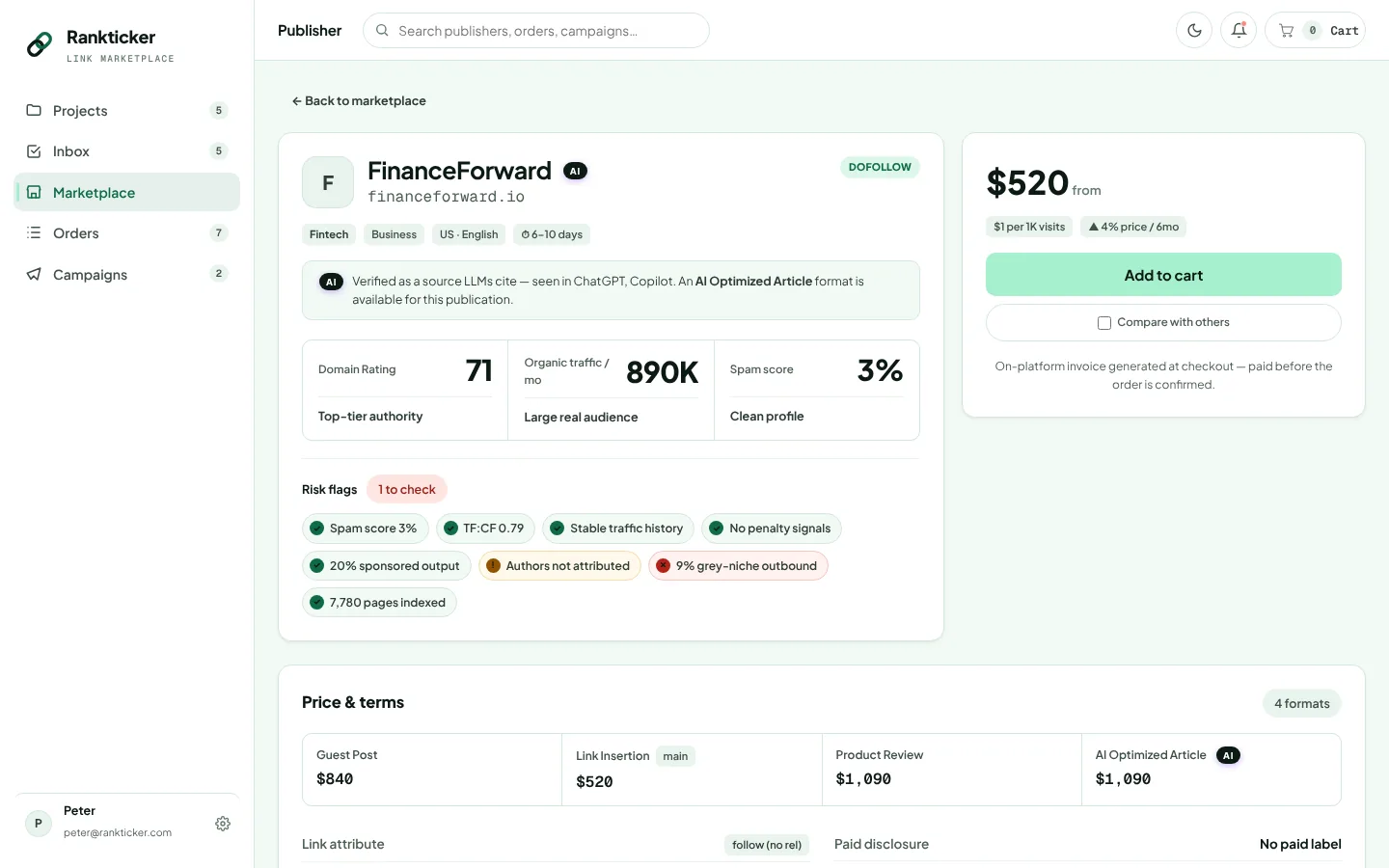
On each publisher profile, look at three things before price: author attribution, whether paid disclosure is shown, and the grey-niche outbound flag. An insurance guide sitting next to casino and payday lending links on the same site is a reputational problem as well as an SEO one. How we vet publishers covers the rest.
Example campaign (illustrative only): a specialist pet insurer. Objective "Improve AI visibility"; monthly budget £4,000; geo United Kingdom; niche finance and pets; target URLs the "pet insurance for older dogs" page and the vet claims data study; anchors brand, "cover for dogs over eight", "its vet claims data"; max cost per link £600; Semi-auto, so compliance can review each publisher before approval.
Compliance comes first
If the article invites someone to buy cover, treat it as a financial promotion. ICOBS 2.2.2R requires communications, including financial promotions, to be clear, fair and not misleading, and ICOBS 2.2.2A requires insurance marketing communications to be clearly identifiable as such. If you use creators on social media, the FCA's FG24/1 guidance applies as well. This isn't legal advice; your compliance team decides.
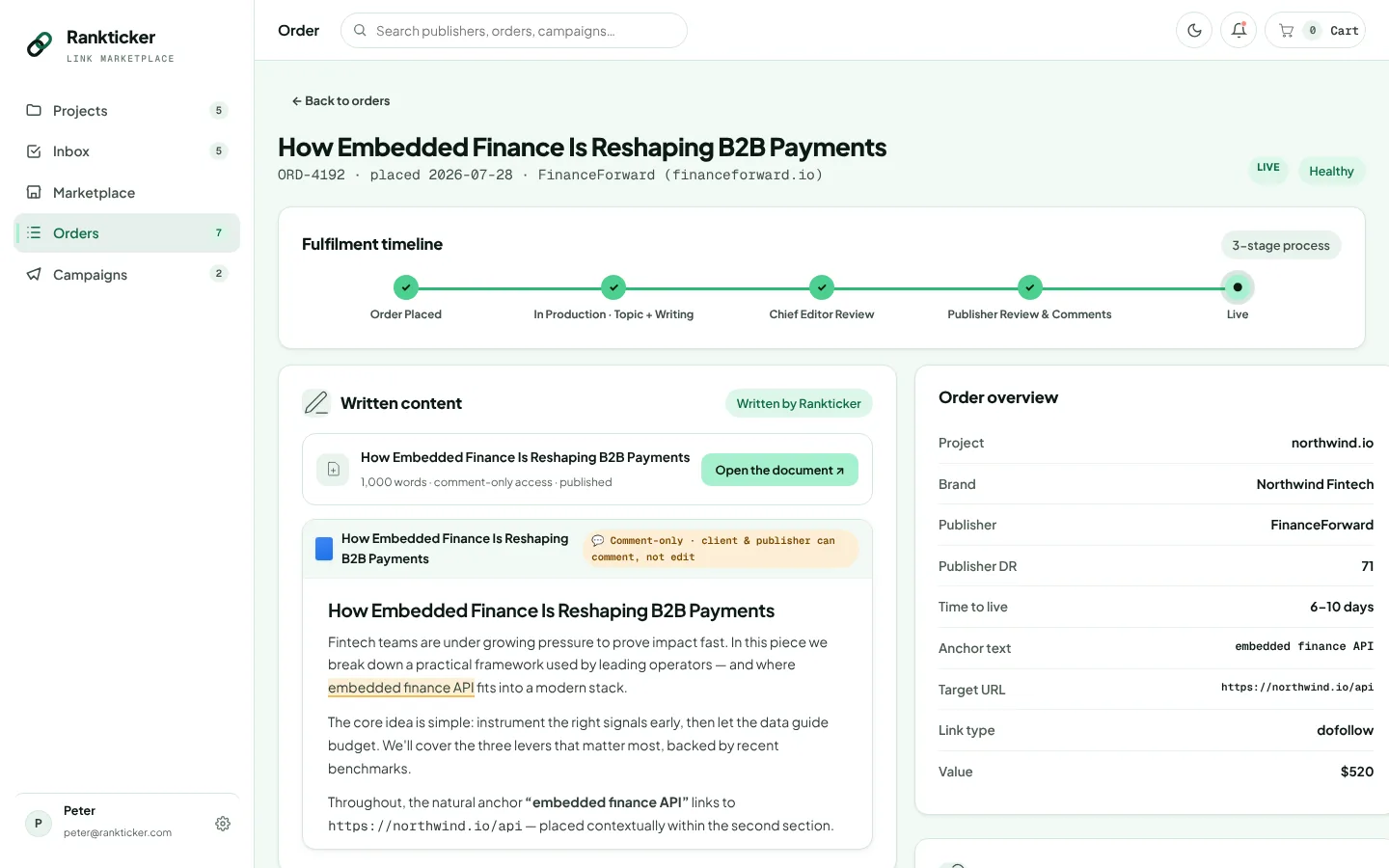
The order workflow helps. Content is written by Rankticker or supplied by you, and it passes a Chief Editor review. Review tasks land in your inbox, where compliance can comment on the draft and request revisions. After the link is live, the Live Link Tracker keeps checking the page, the anchor and the link attribute, which matters if a publisher edits the copy later.
AI visibility for insurance
People ask assistants questions they used to ask a broker: "does home insurance cover subsidence", "is lifetime pet insurance worth it", "what travel insurance covers a pre-existing heart condition". The answers lean on consumer advice organisations, regulator and government pages, personal finance press and comparison sites. Insurers get named when their guides or data are cited by those sources.
Track those prompts in the AIO Performance tab. It shows your share of voice, citation share and answer sentiment by engine, plus AIO opportunities: publications AI models cite for insurance questions. Our piece on brand mentions in AI answers goes further.
Insurance checklist
- Target specialist lines and long-tail guides rather than aggregator head terms
- Publisher profiles checked for author attribution, paid disclosure and grey-niche outbound links
- Every sponsored article reviewed by compliance before approval
- Anchors mostly branded and descriptive, no commercial exact match
- Claims data packaged for national and regional news
- Link attribute chosen per order in line with your policy
- Live links monitored for copy changes after publication
FAQ
Questions about insurance link building
Is a sponsored article about my insurance product a financial promotion?
Often, yes. If it invites or induces someone to buy cover, treat it as one: it must be clear, fair and not misleading under ICOBS 2.2.2R and clearly identifiable as marketing. Have your compliance team sign off the copy before it goes live.
Can a broker compete with comparison sites for car insurance keywords?
Rarely on the head terms. Brokers and specialist insurers win on narrower queries: classic car, modified car, landlord, pet cover for older dogs, tradesperson liability. Point links at pages built for those.
What anchor text is safe for insurance links?
Mostly branded and descriptive. Exact-match commercial anchors such as "cheap car insurance" are the pattern Google's link spam policy targets and they read badly in editorial copy, so keep them to a small minority or avoid them.
Which publishers suit insurance link building?
Personal finance and money sections, consumer advice sites, motoring, property and pet publications for the matching product lines, and insurance or small business trade press for commercial cover. Check author attribution and paid disclosure on each publisher profile.
Keep reading
Related
Fintech backlinks
Fintech backlinks from finance publications that hold up to YMYL scrutiny: formats, FCA promotion rules, anchors and AI visibility for money brands.
Link building for law firms
Link building for law firms: local and legal placements, practice and office page targets, SRA publicity rules, anchors and AI visibility for legal qu…
Paid links and Google's spam policies: what buyers need to know in 2026
Paid links and Google's spam policies in 2026: the link spam text, rel="sponsored", manual actions, SpamBrain, site reputation policy and UK ASA discl…
Brand mentions in AI answers: how to measure them and how to earn them
How brand mentions, entities and unlinked citations shape AI answers in 2026, how to measure share of voice and sentiment, and how to get into cited s…
Content creation
Rankticker product tour
See the publishers before you spend a penny
Filter real publications by niche, DR, traffic and price. Every metric and the full price are on the listing.