Use cases · Edtech
Link building for edtech
Edtech companies sell to school leaders, universities and parents, and each group reads different things. Plan your links around those buyers rather than around one keyword list.
Three buyers, three reading lists
A multi-academy trust buying a safeguarding platform and a parent choosing a times-tables app both search Google. They never read the same article.
Most edtech link plans fail on this point. The team buys a batch of placements on general "education" blogs, the links go live, and none of them sit where a school business manager or an IT lead actually reads. The DR looks fine in a report. The pipeline doesn't move.
Split the plan by buyer before you open the marketplace. School-facing products (MIS add-ons, assessment, safeguarding, timetabling) need education trade press and teacher-run resource sites. Higher education tools need sector news that learning technologists and procurement teams follow. Consumer products for parents and adult learners need family, parenting and personal finance titles, plus review and comparison pages. Some companies sell to two of these at once. They need two campaigns, and probably two sets of target pages.
The .ac.uk and .edu question
Every edtech founder asks for university links. Who wouldn't? They're right that a citation from a university department is a strong signal of relevance. They're wrong to think it can be bought.
The .ac.uk space is restricted. Jisc runs the registry and new domains go through Jisc members and approved registrars. School domains under .sch.uk are allocated by Nominet under its school domain name rules. So when a seller offers "an .ac.uk link for £90", the page behind it is usually a student society blog, an abandoned conference subdomain or something that was hacked. Google's spam policies even use this pattern as an example under site reputation: an educational site hosting sponsored reviews of payday loans. You don't want your brand next to that.
Real university and school links come from work the institution has a reason to cite: a published pilot with a named department, an impact study a lecturer can reference, a dataset on homework time or reading ages, a free resource a school lists on its parent page. Don't try to buy them. Use paid placements on education publishers to build reach and topical relevance, and treat .ac.uk citations as a by-product of research and partnerships.
Formats that work in education
Trade press and expert commentary
School leadership and education technology titles want named experts reacting to policy changes, inspection frameworks and funding announcements. A former head or a data protection lead on your team is worth more here than a generic guest post.
Data-led digital PR
Survey teachers or parents and release it when journalists are hunting for numbers: exam season, results days, the first week of September. Regional news picks up local cuts of the same data.
Teacher and subject resource sites
Small, specific sites run by teachers for a subject or key stage. Low DR is fine if the audience is exactly who buys your product.
Parenting and comparison content
For B2C apps: "best reading apps for Year 2" round-ups, product reviews, gift guides before Christmas, and AI Optimized Articles that answer the comparison questions parents ask.
Press releases still have a place for funding rounds, accreditations and partnerships with named trusts. They get picked up by trade press if there's a real story. Our view on when each format is worth the money applies here too.
Seasonality is sharp. School buyers plan around the academic year and are hard to reach in August. Parents search hardest in late summer and in January. Book placements so they're live and indexed a few weeks before each peak.
Where to point links and how to word them
Edtech sites tend to have weak pages for the queries buyers type: "phonics assessment for KS1", "MIS integration", "safeguarding software for MATs". Build those pages first. Then point most of your links at them.
Good targets: evidence and impact pages, free resources (lesson packs, templates, a reading-age calculator), subject or key-stage landing pages, and the "for schools" or "for trusts" pricing page once it ranks on page two. Anchor text should read like an education writer wrote it, which means mostly brand and descriptive phrases. Here is the mix we'd start from for a UK school-facing product. Treat it as a starting point; we'd adjust it once you see what the existing profile looks like.
| Anchor type | Example | Share of new links |
|---|---|---|
| Brand and URL | "Acme Learning", "acmelearning.co.uk" | 40–50% |
| Descriptive partial match | "a phonics tracking tool used by infant schools" | 25–30% |
| Resource or data citation | "its 2026 reading-age survey" | 15–20% |
| Exact match | "phonics assessment software" | 5% at most |
Acme Learning is a placeholder brand. More on the reasoning in our anchor text guide.
Setting it up in Rankticker
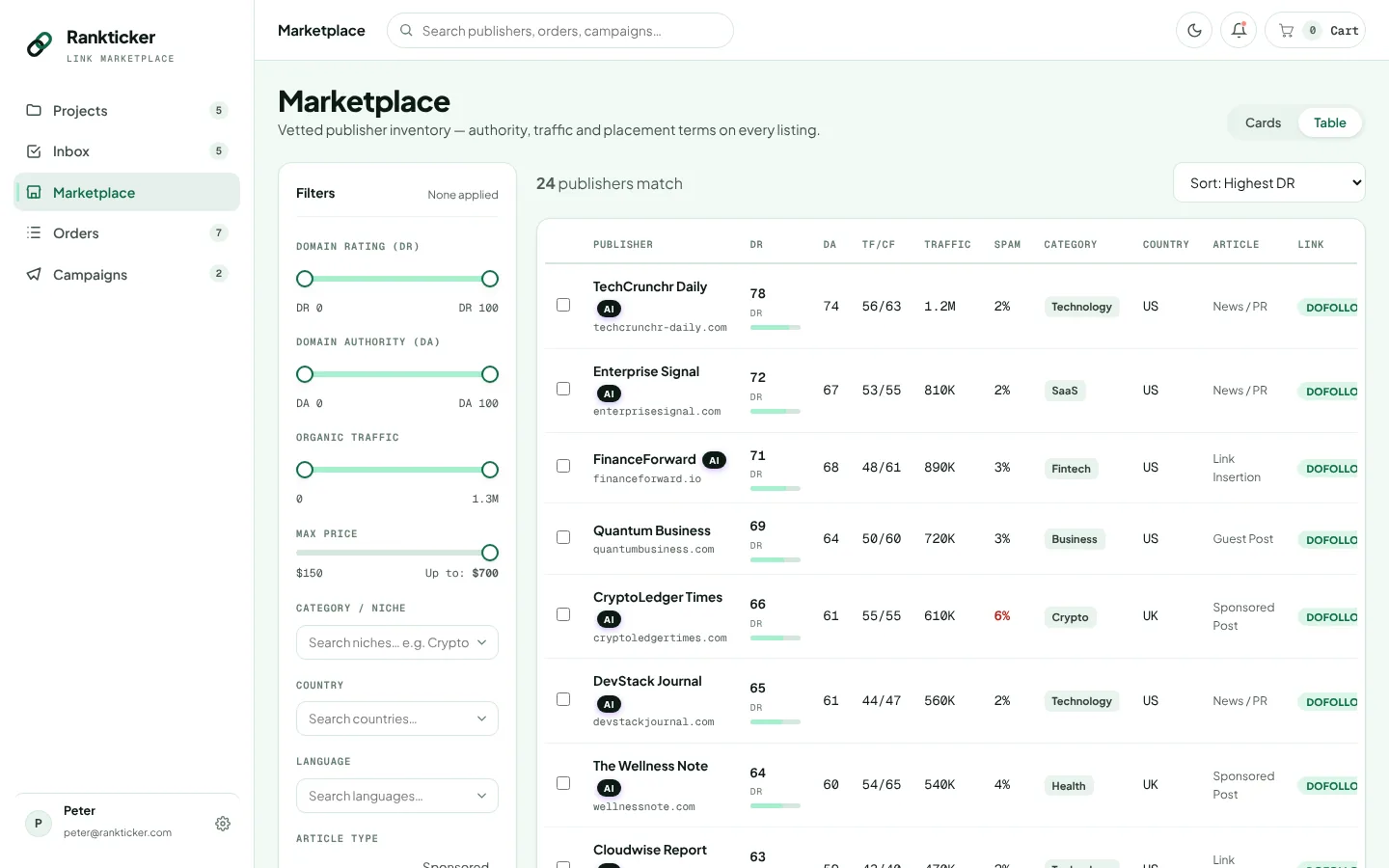
In the marketplace, filter by the Education category, country United Kingdom and language English. Set a DR floor of 30 and an organic traffic floor so you skip sites that rank for nothing. Switch to table view to compare TF:CF and spam score side by side; education is a niche where a lot of thin "study tips" sites carry high DR and very little trust flow.
Then open each publisher profile. Check the sponsored-outbound share and the grey-niche flags. An education blog that also sells casino and essay-mill links is a red flag for a product schools have to trust.
Example campaign (illustrative, not a recommendation for your site): objective "Improve backlink profile"; monthly budget £1,500; geo United Kingdom; niche Education; target URLs the KS1 phonics page and the impact study; anchors brand, "phonics tracking for infant schools", "Acme Learning's reading-age data"; max cost per link £250; mode Semi-auto, so you approve each recommendation before it's ordered.
AI visibility for edtech
Teachers and parents now ask assistants directly: "best reading app for a seven-year-old", "is this platform GDPR compliant for UK schools", "alternatives to our current MIS for a trust of twelve schools". Google says AI Overviews and AI Mode can use query fan-out, running related searches across subtopics before answering. That favours brands mentioned across several independent sources.
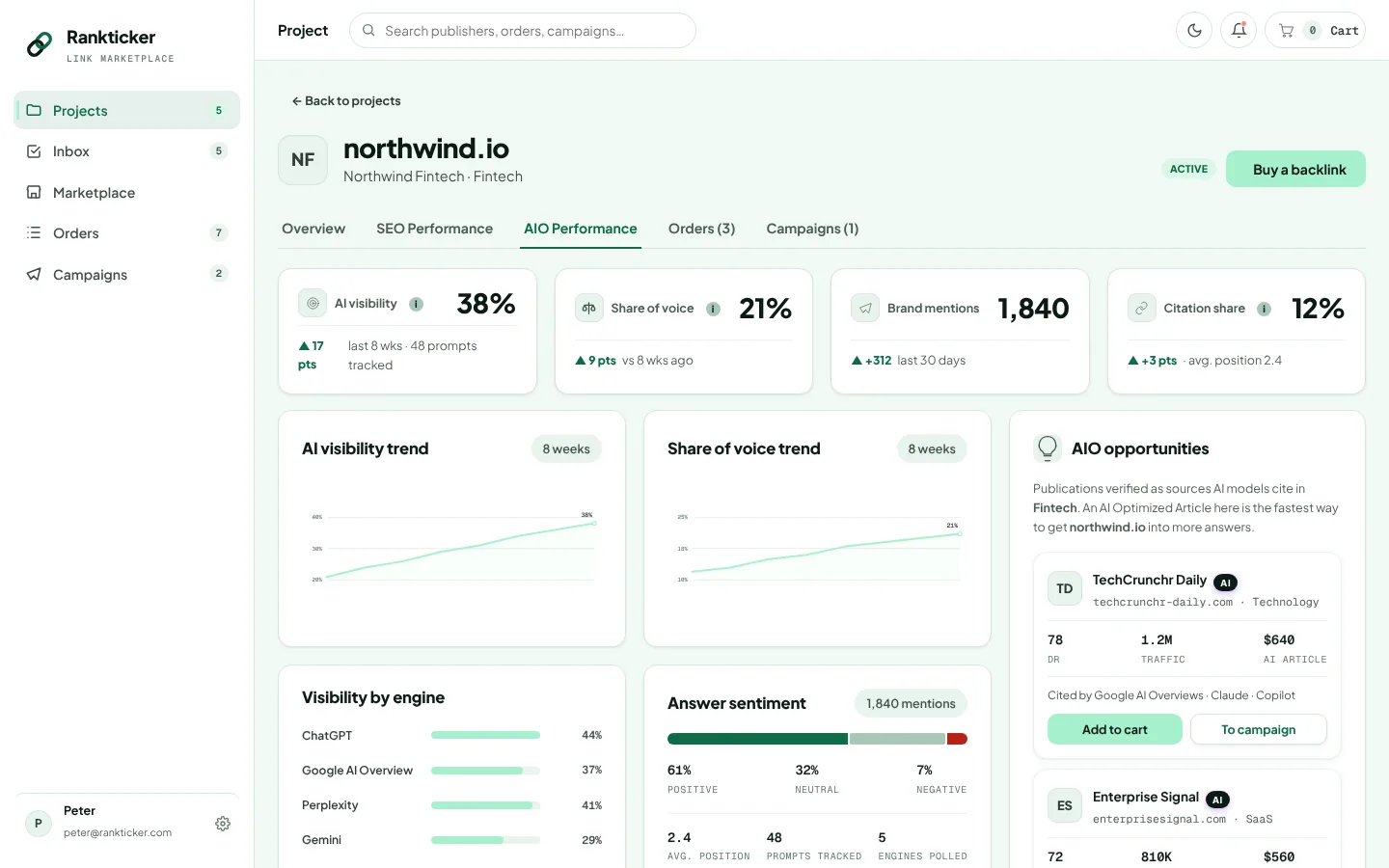
The sources that get cited for education questions tend to be comparison and review articles, trade press, government guidance and teacher forums. The AIO Performance tab tracks your share of voice for the prompts you choose and lists publications verified as sources AI models cite in education. Marketplace listings with the AI badge are those publications.
Claims and disclosure
Attainment claims are where edtech gets into trouble. "Raises reading ages by 14 months" is an objective claim, and CAP Code rule 3.7 says you need documentary evidence before it's published. That applies to copy in a sponsored article as much as to your own site. Paid placements also count as marketing, so they must be obviously identifiable as such. Google asks for paid links to carry rel="sponsored" or rel="nofollow", and you choose the attribute at checkout. Our full take is in paid links and Google's spam policies.
Edtech checklist
- Separate campaigns for school, higher education and parent buyers
- No paid .ac.uk, .sch.uk or .edu placements; earn those through pilots and research
- Subject and key-stage landing pages built before links point at them
- Data stories timed to exam season, results days and September
- Publisher profiles checked for essay-mill, casino or other grey-niche outbound links
- Every attainment claim in sponsored copy backed by evidence you hold
- Prompts tracked for the comparison questions teachers and parents ask
FAQ
Questions about link building for edtech
Can I buy .ac.uk or .edu backlinks for my edtech product?
Treat any offer of a paid .ac.uk or .edu link with suspicion. These domains are restricted to eligible institutions, so a link for sale usually sits on a student society page, a forgotten subdomain or a compromised page. Earn them through research partnerships, pilots and data that lecturers want to cite.
What is a sensible DR floor for edtech link building?
For UK school-facing campaigns we usually start at DR 30 with real organic traffic and drop to DR 20 for specialist teacher and subject sites with a small but exact audience. Relevance to the buyer matters more than a few points of DR.
Should edtech links point at the homepage?
Some should, as branded links. Most of the value comes from links to evidence pages, free teaching resources and product pages built around a subject, key stage or use case.
When should edtech companies run digital PR?
Time data stories to the school calendar. Exam season, results days and the run-up to September all bring education journalists looking for fresh numbers, while the summer holidays are quiet for school buyers.
Do I need to label paid placements on education sites?
Yes. The CAP Code requires marketing communications to be obviously identifiable, and Google asks for paid links to carry rel="sponsored" or rel="nofollow". On Rankticker you choose the link attribute and can see each publisher's disclosure policy before you buy.
Keep reading
Related
Link building for SaaS
Link building for SaaS: which publications move comparison and feature pages, how to set anchors, and how to get cited when buyers ask AI for software…
Link building for recruitment agencies and HR
Recruitment agency link building for UK agencies and HR tech: client and candidate searches, salary guides, which pages to target and a sample campaig…
Topical relevance vs Domain Rating: what to pay for in 2026
Why topical relevance beats raw Domain Rating when you buy links in 2026, how Google reads link context, and a practical checklist for judging relevan…
Link building for AI search: how publications get cited in ChatGPT, Perplexity and AI Overviews
Link building for AI search: how ChatGPT, Perplexity and Google AI Overviews find sources, what citation research shows, and how to pick publications.
AI visibility tracking
Rankticker product tour
See the publishers before you spend a penny
Filter real publications by niche, DR, traffic and price. Every metric and the full price are on the listing.