Use cases · Home improvement
Home improvement backlinks
A roofer in Leeds and a national heat pump installer both sell home improvement, but their link plans share almost nothing. Here's how we'd plan each one.
Two kinds of home improvement site
The first is the trade business: a plumber, an electrician, a roofer, a loft conversion firm. It serves a radius of maybe 20 miles, wins most work through Google Business Profile and recommendations, and competes in search with lead-gen marketplaces and trade-finder directories that hold the top organic spots for almost every "[trade] near me" query.
The second is the national brand: kitchen and bathroom retailers, window and door manufacturers, solar and heat pump installers with regional teams and DIY retailers. These compete on cost guides and comparison queries, against big publishers and consumer advice sites.
Both buy links. A trade business needs maybe ten good ones a year. A national brand might need ten a month, probably more in the run-up to winter. If you're a trade, read this page alongside our local businesses guide.
What makes links hard here
Seasonality runs everything
Boiler and heating searches climb when the weather turns. Roofing and guttering follow the first autumn storms. Garden rooms, landscaping and driveways come back in spring. A link that goes live in the peak month has missed most of the window, because it still has to be crawled and counted. We plan heating content links for July and August, exterior work for January and February.
Policy creates spikes
Grant changes move search demand overnight. The latest Boiler Upgrade Scheme notice, in effect from 21 July 2026, lists £2,500 for air-to-air heat pumps and £9,000 for some off-gas-grid replacements. An installer with a clear explainer page and a commentary angle ready on that day gets press coverage. One that writes it a month later doesn't.
Directories are a mixed bag
Some directories are worth being on because homeowners use them and leave reviews there. Accreditation registers count too: TrustMark describes itself as the only UK Government-Endorsed Quality Scheme for work in and around the home, and its member search links out to real businesses. Manufacturer "find an installer" pages are another good source if you hold the accreditation. The rest of the directory world is mostly pages nobody visits. We'd skip anything with no traffic, no reviews and a fee.
Formats and publication types that work
Home and interiors magazines and renovation blogs take expert pieces on costs, planning rules and materials. Regional news covers local firms when there's a real story: an apprentice scheme, a restoration of a listed building, a community project, storm repair work. Property and personal finance sections want numbers.
Cost guides are the strongest data-led format in this industry. "What a loft conversion cost in 2026, by region" built from your own quotes gets cited by journalists and by AI answers for months. Before-and-after project write-ups suit visual publications and product reviews suit tool and material brands. AI Optimized Articles fit the comparison questions: heat pump versus new boiler, uPVC versus aluminium windows.
Guest posts on generic "home and garden" blogs that publish ten unrelated sponsored articles a day do very little. You'll see them in the marketplace. Check the sponsored-outbound share on the publisher profile and walk away if it's high.
Where to point links
For a trade, the money pages are the service pages for the jobs you want more of, ideally with the area in the page: "Loft conversions in Harrogate". Branded links and brand-plus-town anchors carry most of the weight, plus links to a project gallery. Exact-match anchors like "best roofer Leeds" look odd in editorial copy. Would a journalist ever write that sentence? We'd keep them rare.
For a national brand, point links at cost guides, grant explainers and category pages. Anchor with the question the page answers ("how much a heat pump costs to run") and with the brand. Our anchor text guide covers ratios in more detail.
| Local trade | National brand | |
|---|---|---|
| Main targets | Service pages, project gallery, homepage | Cost guides, grant explainers, category pages |
| Anchor lead | Brand, brand + town | Brand, descriptive question phrases |
| Publication mix | Regional news, accreditation listings, a few home titles | Home and interiors magazines, property and personal finance sections, data PR |
| Links per month | One or two | Six to fifteen |
Using Rankticker for a home improvement campaign
Filter the marketplace by the home and garden category, country United Kingdom and language English. A DR floor of 25 and a traffic floor of about 1,000 organic visits a month cuts most of the dead blogs. For a regional trade, the country filter only gets you to the UK, so open each publisher profile and read the recent articles to check the audience is actually local.
With a campaign in Semi-auto mode, each recommendation shows why the publisher was picked, and you approve or decline. That's the mode we'd use for seasonal work, so you can hold back placements that would land after the peak.
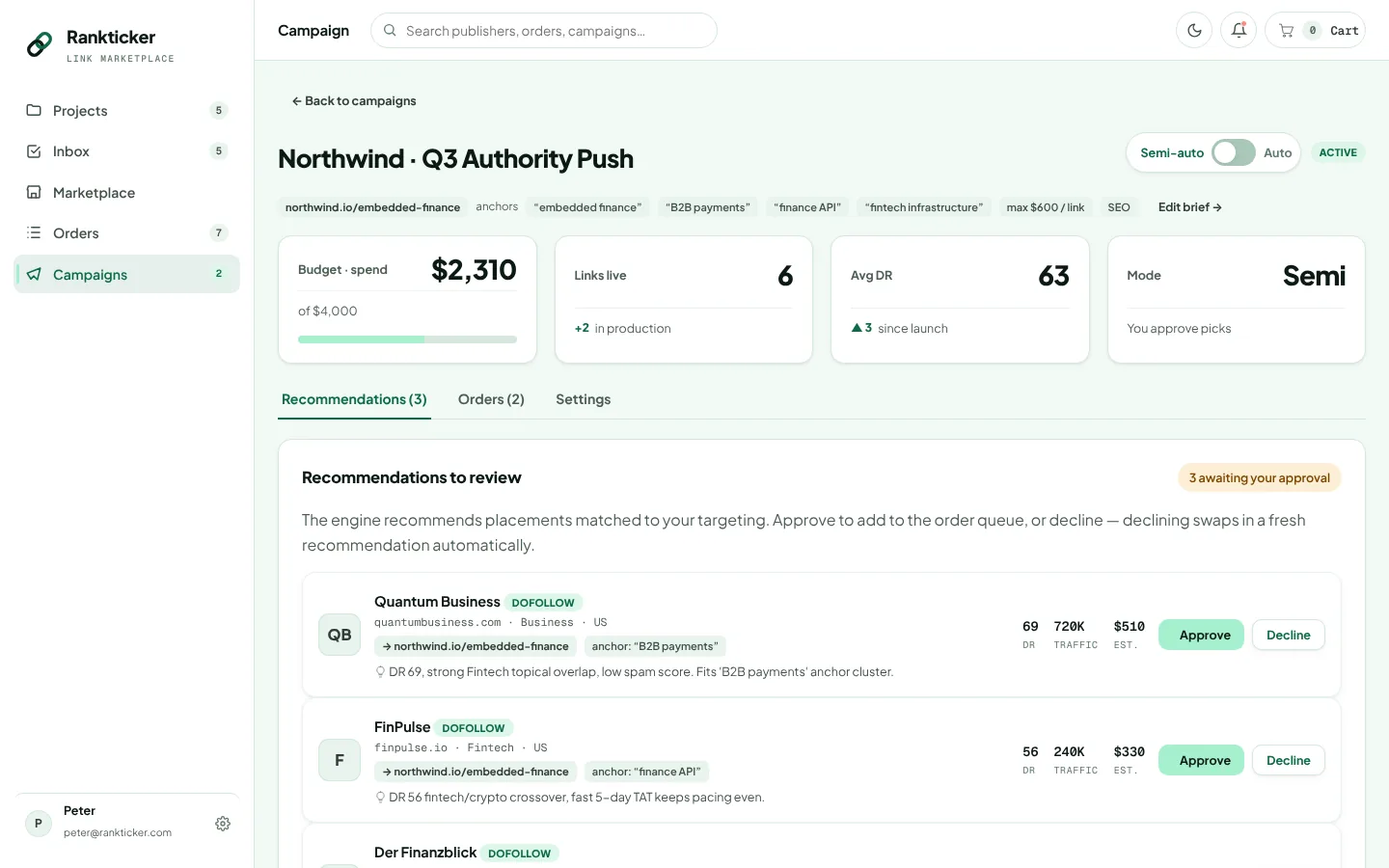
Example campaign (illustrative only): a heat pump installer covering the North of England. Objective "Improve backlink profile"; monthly budget £2,000; geo United Kingdom; niche home and garden; target URLs the running-costs guide, the grant explainer and the "air source heat pumps" service page; anchors brand, "heat pump running costs", "how the Boiler Upgrade Scheme works"; max cost per link £300; Semi-auto, with placements front-loaded into July to September.
AI visibility for home improvement
Homeowners ask assistants about cost and suitability: "how much is a loft conversion in a terraced house", "is a heat pump worth it in a 1930s semi", "do I need planning permission for a garden room". The answers cite cost guides, consumer advice sites, government guidance and the occasional forum thread. Brands that published their own cost data, and got it repeated by publishers, tend to be the ones named.
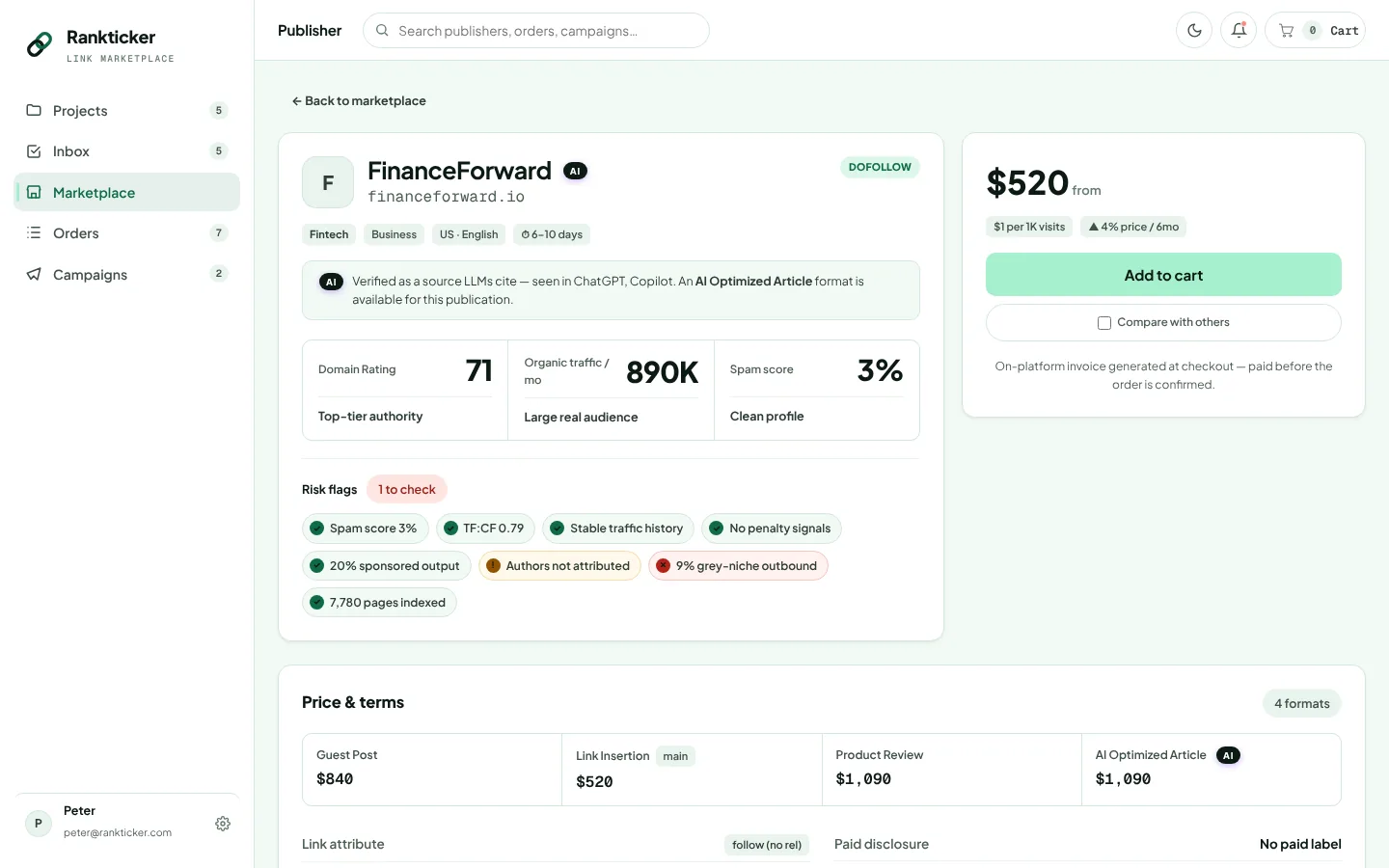
Set those prompts up in the AIO Performance tab and track whether you appear, and next to whom. Listings with the AI badge in the marketplace are publications verified as sources AI models cite. For cost-led questions, those are usually where we'd spend first.
Green claims and disclosure
Energy savings, carbon figures and "eco" language in a sponsored article are your claims. The CMA's Green Claims Code applies, and so does the CAP Code requirement that marketing is obviously identifiable. Google asks for paid links to use rel="sponsored" or rel="nofollow". You pick the attribute per order in Rankticker. Read our view on paid links and Google's policies before you decide.
Home improvement checklist
- Seasonal placements booked six to ten weeks before the demand peak
- Accreditation and manufacturer installer listings claimed and linking to the right page
- A cost guide built on your own quote data
- Service pages per job (and per area for trades) before links point at them
- Publisher profiles checked for sponsored-outbound share and local audience
- Energy and carbon claims checked against the Green Claims Code
- Explainer page and spokesperson ready for the next grant or regulation change
FAQ
Questions about home improvement backlinks
What are the best backlinks for a local tradesperson?
Accreditation and trade body listings, manufacturer installer finders, local news coverage of real jobs and community work, and a few relevant home and garden publications. A handful of these usually beats dozens of generic directory links.
Are trade directory links worth paying for?
Listings on the directories homeowners actually use are worth having for the referrals and the reviews, whatever the link attribute. Paid directories with no traffic and no reviews are not worth the fee.
Which pages should home improvement backlinks point to?
Cost guides, service pages for the jobs you want more of, project galleries with before and after photos, and grant or regulation explainers. The homepage gets branded links.
When should home improvement companies build links?
Ahead of demand. Links take weeks to be crawled and to settle, so book placements for heating and roofing content in late summer and for garden and exterior work in late winter.
Do green claims rules apply to sponsored articles?
Yes. Claims about energy savings or environmental benefit in a sponsored article are your marketing claims, and the CMA's Green Claims Code and the CAP Code apply to them.
Keep reading
Related
Local link building for small businesses
Local link building for small businesses in the UK: Google Business Profile, citations, local news, community links, anchors and a sample campaign.
Real estate link building
Real estate link building for estate agents, developers and proptech: local news, area guides, branch pages, anchors and the AI prompts home movers as…
Local link building for UK businesses
Local link building for UK businesses in 2026: local news, chambers of commerce, sponsorships, UK directories that matter and Google Business Profile.
How to budget a monthly link campaign, and what link velocity really means
How to set a monthly link building budget in 2026: sizing the gap, true cost per link, link velocity myths, pacing, max cost rules and auto vs semi-au…
Campaigns
Rankticker product tour
See the publishers before you spend a penny
Filter real publications by niche, DR, traffic and price. Every metric and the full price are on the listing.