Local SEO
Local link building for UK businesses
For a local business, the links that matter come from the places your customers already read and trust: the local paper, the chamber, the trade body, the club you sponsor. Here is how to get them and how they connect to your Google Business Profile.
TL;DR: Google uses links as part of how it judges a business's prominence. Links matter more for local organic results than for the map pack, where category, proximity and your business name dominate. The best UK local links come from regional news, chambers and business groups, trade registers, community sponsorships and a short list of directories people actually use. Point some of them at the page your Google Business Profile links to.
A heating engineer in Leeds doesn't need a link from a DR 80 American marketing blog. They need the Yorkshire Evening Post to mention the free boiler checks they ran for pensioners, the Gas Safe Register to list them, and the local rugby club's sponsor page to link to them. None of those would impress a link broker. All of them tell Google, and the people deciding who to call, that this is a real business in Leeds.
How local links feed Google Business Profile
Google says it ranks local results on relevance, distance and prominence, and that prominence is "also based on info like how many websites link to your business and how many reviews you have". That's as direct a statement about links as Google makes anywhere.
How much weight links carry depends on which results you mean. Whitespark's 2026 Local Search Ranking Factors survey, with 47 contributors, ranks factors separately for the map pack and for local organic results (Whitespark, 2026):
| Factor | List | Rank |
|---|---|---|
| Primary GBP category | Local pack | 1 |
| Proximity of address to the searcher | Local pack | 2 |
| Quality/authority of links to the GBP landing page | Local pack | 25 |
| Links to domain from locally relevant domains | Local pack | 27 |
| Quality/authority of links to domain | Local pack | 31 |
| Quality/authority of links to domain | Local organic | 3 |
| Links to domain from industry-relevant domains | Local organic | 5 |
| Links to domain from locally relevant domains | Local organic | 13 |
That is expert opinion rather than Google data, and the pattern matches what we see. In the map pack, your category, how close you are to the searcher and the name on your profile do most of the work. In the blue links below it, links are near the top. For most local businesses, both matter.
The same survey says three of the top five factors for AI search visibility are citation factors, and the report puts it plainly: "In AI SEO, mentions (citations) are the new link." That's worth taking seriously. BrightLocal's 2026 consumer survey found 45% of respondents used ChatGPT or other AI tools for local business recommendations, up from 6% the year before, though that's a sample of 1,002 US adults, not UK ones (BrightLocal, 2026). We'd expect the UK to follow.
Local news
UK regional news is concentrated in a few groups. Press Gazette's 2023 analysis found Reach owned 35 of the 50 biggest UK regional news brands online, and that four publishers (Reach, Newsquest, DC Thomson and National World) accounted for 88% of daily regional print circulation in the first half of 2022 (Press Gazette). Two things follow. Local newsrooms are small and stretched, so a story that arrives ready to run gets a better hearing. And these sites carry a lot of sponsored and partner content, so check whether a "business news" section is editorial before you pay for anything in it.
What gets local coverage:
- Local data. "Average boiler repair waits in Leeds rose to nine days this winter, from our job records" is a story. "Company launches new website" isn't.
- Community work with a human angle: free services, apprenticeships, fundraising, help after a flood or a fire.
- A response to a council decision, a planning row or a road closure that affects your customers.
- Jobs. A business hiring 15 people in a small town is news there.
- Milestones with a story behind them: 50 years trading, a second-generation owner, a move to a bigger site.
Find the reporter who covers business or your area, not the general newsdesk inbox. Email a short pitch with the facts in the first line. If you're tempted by a wire service, read our piece on press releases first; for local news, a direct email to one reporter beats national distribution.
Don't overlook hyperlocal sites, community magazines and parish newsletters with websites. Their authority metrics are modest. Their relevance to a local business is total, and their readers are your customers.
Chambers of commerce and business groups
There are 53 accredited chambers of commerce in the UK, representing more than 100,000 businesses (Somerset Chamber, on the British Chambers of Commerce network). Membership usually brings a member directory listing with a link, and the more useful links come from taking part: member news, event write-ups, speaking at a breakfast, sponsoring an awards category.
The same applies to Business Improvement Districts, local Federation of Small Businesses groups, town centre partnerships and trade associations. Their sites are local or industry-relevant by definition, they are run by real organisations, and they rarely sell links. Join the ones you'd join anyway. Then contribute something they can publish.
Community sponsorships, done honestly
Sponsoring the under-11s, a charity 10k or the village fete is good local marketing. It often comes with a link on the club or event site. Be clear about what that link is, though. Google's spam policies list exchanging money, goods or services for links as link spam unless the link is qualified with rel="sponsored" or rel="nofollow". A sponsor link is a paid link.
Most club sites won't know or care about link attributes, and you can ask them to add rel="sponsored". Either way, the value lies elsewhere: your name on a local site and a local kit, photos in the local paper, a mention in the club newsletter, people who now know who you are. Sponsor for those reasons and treat any link as a bonus. A business sponsoring 40 clubs it has no connection with, purely for footer links, is building exactly the pattern Google describes.
UK directories that still matter
Directory links are weak ranking signals, and Google lists "low-quality directory or bookmark site links" as link spam. The ones below are different: customers use them, many verify who you are, and they feed the consistent name, address and phone data that local search and AI tools rely on.
| Type | Examples | Why it's worth it |
|---|---|---|
| Map and platform profiles | Google Business Profile, Apple Business Connect, Bing Places | The base of local visibility; get these right before anything else |
| General UK directories | Yell, Thomson Local, FreeIndex | Established, used by consumers, consistent NAP data |
| Trade and review schemes | Checkatrade, TrustATrader, Which? Trusted Traders | Vetting and reviews; customers in home services check them |
| Professional registers | Gas Safe Register, NICEIC, Law Society Find a Solicitor, RICS | Official, hard to fake, strong trust signal |
| Local and membership directories | Chamber member lists, BID directories, council business directories | Locally relevant, run by real organisations |
Skip anything sold as "200 directory submissions". Those packages build the low-quality directory links Google names in its policy, and they often scatter slightly different versions of your address across the web, which is worse than not being listed.
Regional publications and county magazines
County lifestyle magazines, regional business titles and city guides sit between local news and national press. Many take paid features. That's fine, provided you know what you're buying. Under the CAP Code, marketing communications must be obviously identifiable, and the ASA expects advertorials to carry a prominent upfront label such as "Advertisement feature"; it advises against "sponsored" on its own because the word is open to interpretation (ASA guidance). The advertiser and the publisher share responsibility.
Judge a regional title the way you'd judge any publication: does it have readers in your area, does it publish real editorial alongside paid content, and does its outbound link profile look like a magazine or a link shop? Our relevance guide has the checks.
More than one location
Businesses with several branches often send every local link to the homepage. That wastes most of them. Each branch should have its own Google Business Profile linking to its own location page, and that page should say something specific about the place: the team there, the areas it covers, the jobs it has done nearby, how to find it.
Then build links to each location page from that town's sources. The Bristol branch gets the Bristol chamber and the Bristol paper; the Bath branch gets Bath's. Whitespark's experts rank links to the GBP landing page separately from links to the domain, and in the map pack the landing page links rank higher. A location page with three genuinely local links will usually do more for that branch than another national link to the homepage. It's slower work, and it doesn't scale neatly, which is partly why competitors skip it.
A local link audit you can run this week
- Your Google Business Profile category, hours and website link are correct, and the linked page is the one you want to rank.
- Your business name, address and phone number are identical across your site, GBP, Apple, Bing and the main directories.
- You're listed with your trade or professional register, and the listing links to your site.
- Every organisation you're a member of has your current details and a link.
- You have a list of five local reporters and three local or regional titles, with names.
- You have one local story ready to pitch, with a number in it.
- Sponsorships you already pay for are listed on the club or event site, with a link where they offer one.
- Some of your inbound links point at your GBP landing page as well as your homepage.
Doing this in Rankticker
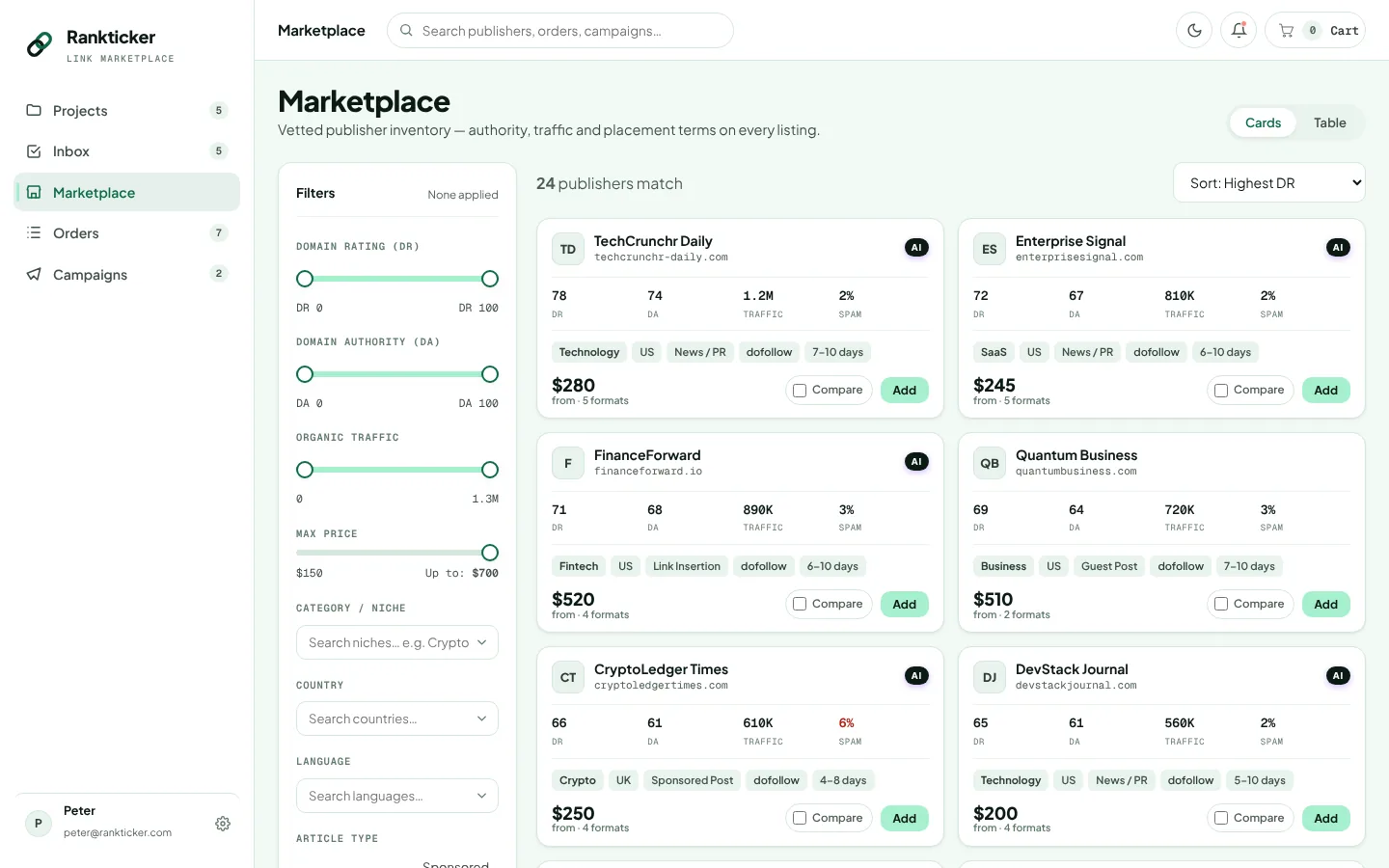
Most of the work above is relationship work you'll do yourself. Where Rankticker helps is the regional and niche publications that do accept contributed or sponsored content. In the marketplace, filter by country (United Kingdom), language and category, and use the News/PR article type for news-style placements. Each publisher profile shows organic traffic, risk flags and whether paid disclosure is shown, so you can check a regional title before you buy.
Set the geo and niche on a campaign to keep recommendations local, and use SEO tracking to follow referring domains and local keyword positions for the project. If AI recommendations matter in your sector, the AIO Performance tab tracks whether assistants mention you for the prompts your customers use; see brand mentions in AI answers. The local businesses page covers the set-up in more detail, with sector notes for trades on the home improvement page.
FAQ
Questions about local link building UK
Do backlinks help Google Business Profile rankings?
Yes, indirectly. Google says prominence is partly based on how many websites link to your business and how many reviews you have. Expert surveys rank links higher for local organic results than for the map pack.
Which UK directories are worth listing in?
The ones customers use and that check who you are: Yell, Thomson Local, FreeIndex, trade schemes like Checkatrade, TrustATrader and Which? Trusted Traders, and your professional body's register. Skip bulk directory packages.
Is a sponsorship link a paid link?
By Google's definition, yes. It is fine to sponsor a club or event, but the link should ideally carry rel="sponsored", and the real value is local exposure and coverage.
How do I get coverage in my local paper?
Give a reporter a local story: local data, a community project, a response to a council decision, new jobs, or a business milestone with a human angle. Contact the named business or local reporter directly.
Do paid local advertorials need labelling in the UK?
Yes. The CAP Code requires marketing communications to be obviously identifiable, and the ASA expects a prominent upfront label such as "Advertisement feature".
Keep reading
Related
Local link building for small businesses
Local link building for small businesses in the UK: Google Business Profile, citations, local news, community links, anchors and a sample campaign.
Home improvement backlinks
Home improvement backlinks for UK trades, installers and brands: cost guides, seasonal timing, accreditation links, anchor mix and a sample campaign s…
Link building for law firms
Link building for law firms: local and legal placements, practice and office page targets, SRA publicity rules, anchors and AI visibility for legal qu…
Press releases, SEO and AI visibility in 2026
Do press releases still help SEO and AI visibility in 2026? What Google says about syndication links, how often AI cites releases, and when editorial …
Brand mentions in AI answers: how to measure them and how to earn them
How brand mentions, entities and unlinked citations shape AI answers in 2026, how to measure share of voice and sentiment, and how to get into cited s…
Paid links and Google's spam policies: what buyers need to know in 2026
Paid links and Google's spam policies in 2026: the link spam text, rel="sponsored", manual actions, SpamBrain, site reputation policy and UK ASA discl…
See the publishers before you spend a penny
Filter real publications by niche, DR, traffic and price. Every metric and the full price are on the listing.