Use cases
Travel link building
Travel demand comes in waves, and links take weeks to write, publish and get crawled. The work is choosing destination-relevant publications and getting placements live well before people book.
Find publishers in this nicheSee how it works
The problem
Travel links run on a calendar
UK holiday booking has a well-known spike. ABTA calls the first Saturday after the Christmas and New Year break "Sunshine Saturday" and says it is usually the busiest day of the year for booking foreign holidays. A link to your Greek islands page ordered in January will be live for the summer, but it missed the window where a lot of people chose where to go.
Every travel business has its own version. Ski operators book through autumn. City break sellers spike around events and school holidays. Hotels in Edinburgh live and die by August. Plan the campaign backwards from those dates and allow for writing, review, publication and crawling.
The second issue is supply quality. Travel blogging has a long tail of sites that once had real readers and now mostly sell links, with traffic that halved after a core update and a sidebar of casino banners. DR alone won't show you that.
Then relevance. A walking holiday operator gets more from a hiking blog that covers the Picos de Europa than from a general travel site that covers everything badly, and much more than from a lifestyle site with a "travel" tag.
Placements
Publications and formats that fit travel
Destination and activity blogs
Specialists in a region or an activity: hiking, diving, ski, family travel. Their readers are already planning the trip you sell.
Travel and lifestyle press
Guest features, itineraries and "where to go in May" roundups on publications with real readers and named writers.
Data-led pieces
Price indexes, "cheapest ski resorts for families" tables, weather or crowd data by month. Editors use them, and AI answers lift the numbers.
Reviews and AI Optimized Articles
Reviews of a tour or a hotel, written by someone who did it, plus structured explainers like "when to go to Madeira for walking".
For inbound tourism, think in source markets. A Cornish holiday park with Dutch and German guests needs publications in Dutch and German, which is what the language filter is for.
Targets and anchors
Build to pages that come back every season
Destination pages, tour or itinerary pages, and seasonal hubs with stable URLs ("/ski-holidays/" rather than "/ski-deals-2027/"). The offers on them change, the URL doesn't, and each year's links add up. Hotels should point links at the property page and location guides more than individual room pages.
Anchors that read naturally in travel copy are usually descriptive: "guided walking holidays in northern Spain", "family ski chalets in Morzine". Mix those with your brand and plain URLs, and avoid repeating short head terms like "cheap holidays", which look bought and probably won't rank for you anyway against the big online travel agents. More on mixing anchors in our anchor text guide.
One travel-specific risk: bloggers refresh their best posts every year. "Best Greek islands for families" gets rewritten each January, and sometimes the rewrite quietly drops your link or swaps it for whoever paid most recently. Who checks that in March? The Live Link Tracker does, re-checking each live link for the anchor, the target redirect and the link attribute, and flagging changes in your Inbox.
In Rankticker
Setting up a seasonal campaign
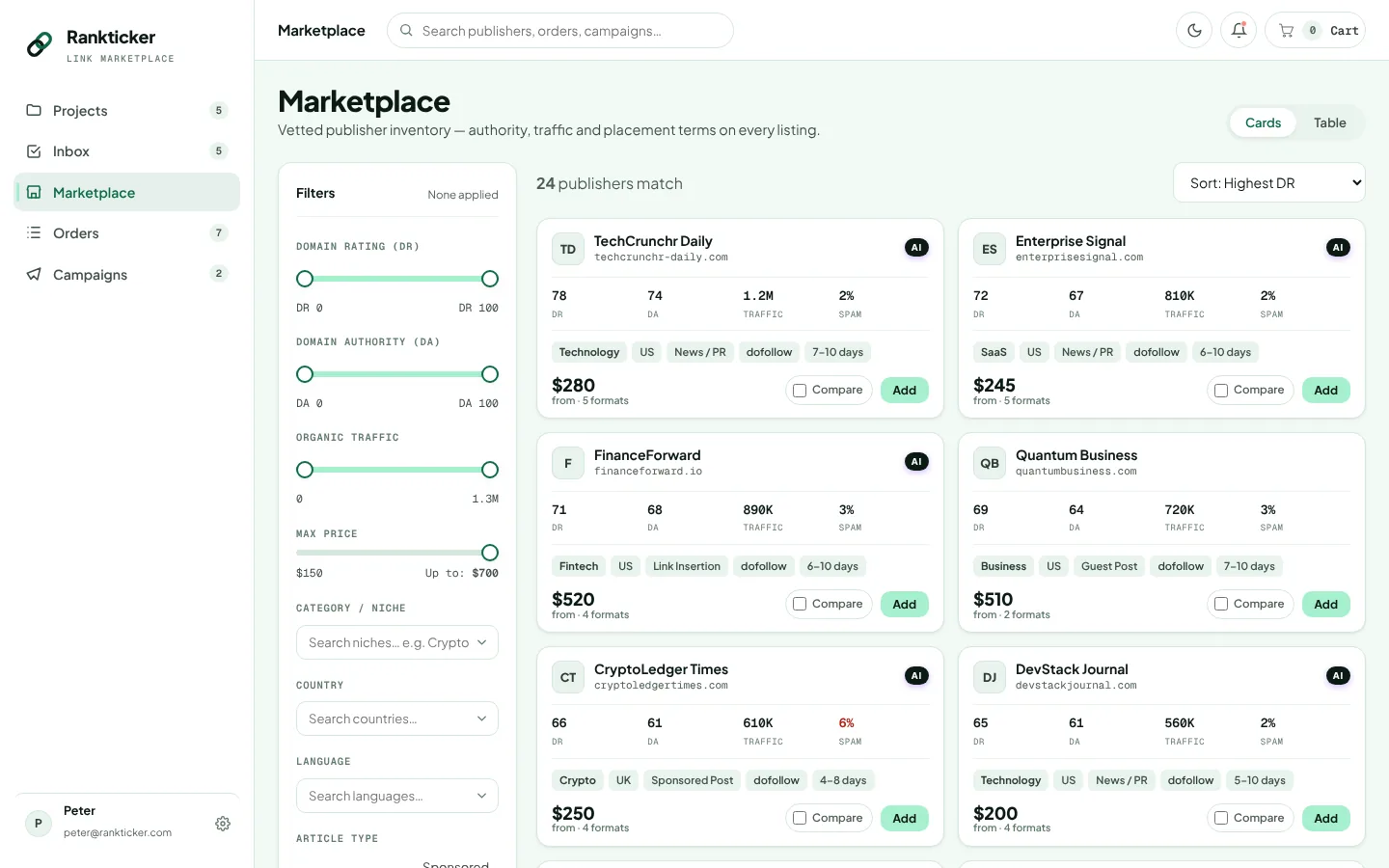
Filter the marketplace to travel plus your activity niche, then set country and language to your source markets. On each publisher profile, check the traffic trend and the sponsored-outbound share before anything else. Turnaround times on each listing tell you how far ahead you need to order.
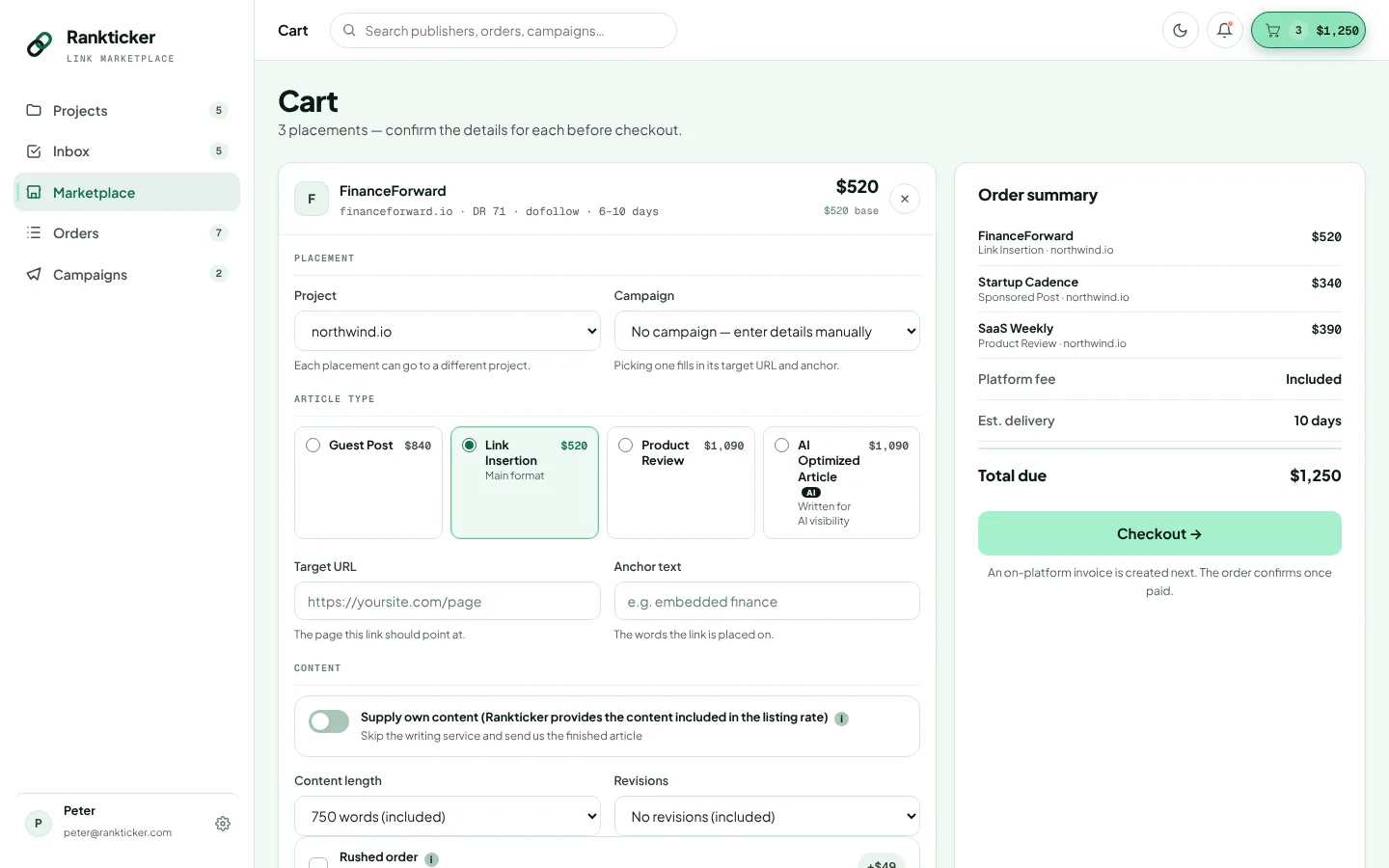
Campaigns run on a monthly budget, so raise it in the months before your booking peak and drop it afterwards. In the cart, each placement gets its target URL, anchor and article type, and you can mark an order as rushed when a date is close.
Example only: a UK tour operator selling guided walking holidays in Spain and Portugal. Objective: improve backlink profile. Monthly budget £2,000 for most of the year, raised to £4,500 from September to December. Geo: United Kingdom and Ireland. Targets: eight destination pages, the "walking holidays" hub. Anchors: about half branded or URL, the rest descriptive destination phrases. Max cost per link £350. Filters: travel and outdoors niches, English, DR 25+, organic traffic 2,000+, AI badge for a third of placements. Illustrative figures, not a quote.
AI visibility
Trip planning has moved into AI chats
Travellers ask long, specific prompts: "best time to visit Madeira for hiking", "family-friendly all-inclusive in Crete under £3,000 for August", "is [operator] ATOL protected", "quiet alternative to Santorini". The answers name destinations and operators, then cite guides, forums and video.
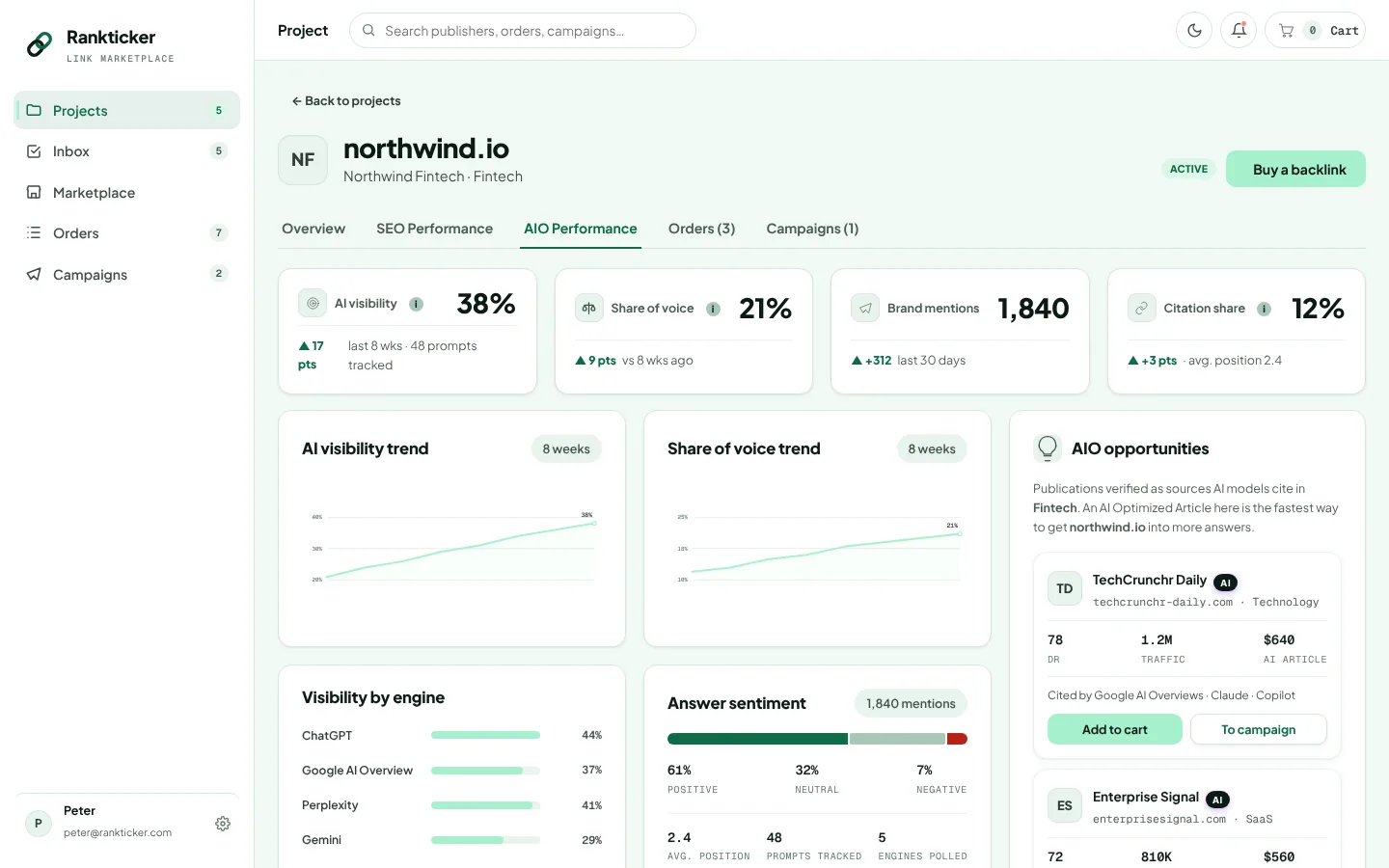
Profound's citation analysis found Reddit and YouTube among the most cited domains in Google AI Overviews. Editorial travel guides are the part of that mix you can reach. The AIO Performance tab lists the publications AI engines cite for your niche and tracks your share of voice by engine.
Travel link building checklist
- Work backwards from your booking peaks and order early
- Build to evergreen destination and hub URLs, not dated deals
- Check traffic trend and sponsored-outbound share on every travel blog
- Use language filters for overseas source markets
- Quote prices that include compulsory charges, per the ASA's travel pricing advice
- ATOL holders: show name, ATOL number and logo on publicity, as ATOL Standard Term 1 requires
- Disclose press trips and paid reviews, and mark paid links rel="sponsored" as Google recommends
FAQ
Questions about travel link building
When should a travel brand build links for summer?
Months ahead. ABTA describes the first Saturday after the Christmas break as usually the busiest day of the year for booking foreign holidays, so links for summer pages should be live and crawled before January.
Are travel blogs worth buying links on?
Some are excellent. Many have inflated or collapsing traffic and sell links to anyone. Check the traffic trend, the sponsored-outbound share and whether the site covers your destinations before ordering.
Should links point at deals pages?
Rarely. Dated deals pages expire. Build to evergreen destination, tour and seasonal hub pages, and update the offers on them.
What rules apply to prices in sponsored travel content?
The ASA expects quoted prices to include non-optional taxes and charges, and 'from' prices to be genuinely available. ATOL holders must show their name, ATOL number and logo on publicity materials.
How do I reach overseas source markets?
Use the language and country filters to find publications read in the markets your guests come from, and brief content in that language.
Keep reading
Related
Ecommerce link building
Ecommerce link building that reaches category pages: product reviews, gift guides, seasonal timing, anchors and AI shopping prompts, plus an example c…
Food and drink link building
Food and drink link building for UK brands: recipe and gift-guide placements, product reviews, HFSS and alcohol ad rules, anchors and a sample campaig…
How to budget a monthly link campaign, and what link velocity really means
How to set a monthly link building budget in 2026: sizing the gap, true cost per link, link velocity myths, pacing, max cost rules and auto vs semi-au…
Press releases, SEO and AI visibility in 2026
Do press releases still help SEO and AI visibility in 2026? What Google says about syndication links, how often AI cites releases, and when editorial …
Campaigns
Rankticker product tour
See the publishers before you spend a penny
Filter real publications by niche, DR, traffic and price. Every metric and the full price are on the listing.